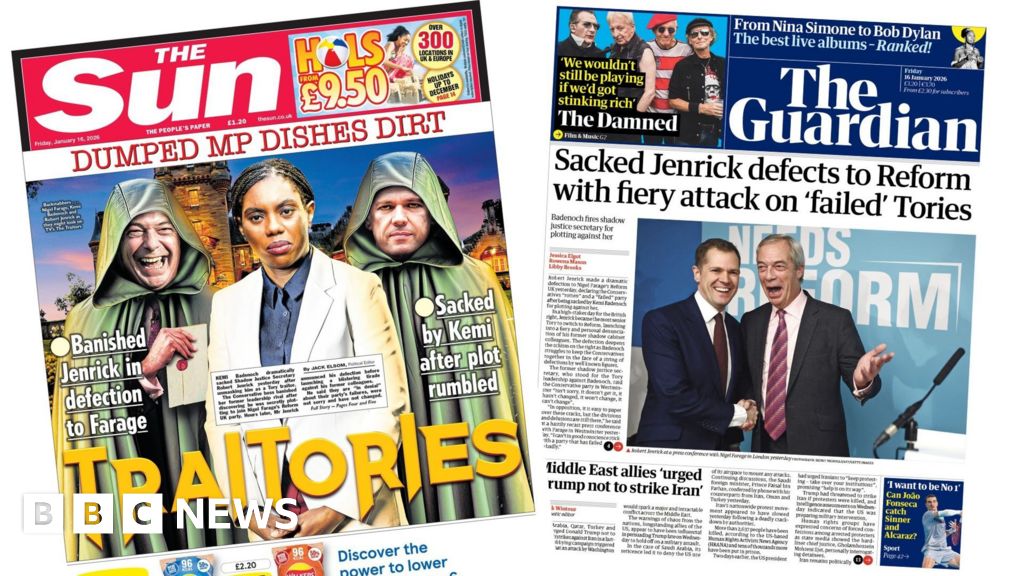
Former Conservative shadow minister Robert Jenrick has defected to Reform UK after being sacked by Tory leader Kemi Badenoch amid allegations he was plotting to join Nigel Farage’s party; reports say he negotiated with Reform for months and has publicly blasted the Conservatives as "rotten". The move dominated UK front pages, with Farage welcoming Jenrick and papers framing the episode as internal Tory betrayal; while politically significant for party dynamics and potential election positioning, it is unlikely to have a material immediate impact on financial markets.
Market structure: The Jenrick–Farage story increases political fragmentation risk in the UK, which favors large, internationally diversified FTSE-100 exporters (commodity majors, banks with global footprints) and hurts domestically focused SMEs and consumer-facing midcaps that depend on UK consumer confidence. Expect short-term GBP pressure (1–3% moves) and a modest rise in gilt risk premia (10–40 bps) if polling shifts materially; UK media & broadcasters see transient traffic/ad-revenue spikes but negligible long-term cashflow change absent regulatory shifts.
Risk assessment: Tail risks include a snap election or coalition instability producing >100–150 bps gilt selloff and >5% GBP devaluation within 30–90 days; conversely rapid consolidation of the right could produce policy clarity and rally risk assets. Immediate horizon (0–7 days) is headline-driven volatility; short-term (1–3 months) is polling-led re-rating of UK domestics; long-term (6–24 months) depends on legislative outcomes (tax/regulation) that change corporate margins.
Trade implications: Implement FX and equity delta-hedged strategies: use short-duration GBP volatility trades and rotate from midcaps into exporters/miners (BHP, RIO) for 3–6 month holds; prefer gilts underweight or shorter-duration gilt exposure until political risk falls below a 20% probability (implied by <15 bps weekly move). Media names and MRU.TO see headline-driven spikes—trade as event-driven microcaps with strict stop-losses.
Contrarian angles: Consensus underestimates midcap vulnerability; markets may underprice a sustained 2–4% GBP slide that boosts exporters by 3–8% relative to domestics over 3 months. Historical parallel: 2019–20 UK political shocks moved gilts 50–100 bps and re-rated exporters vs domestics—use that as a scenario stress and size positions accordingly.
AI-powered research, real-time alerts, and portfolio analytics for institutional investors.
Request DemoOverall Sentiment
neutral
Sentiment Score
0.00
Ticker Sentiment
