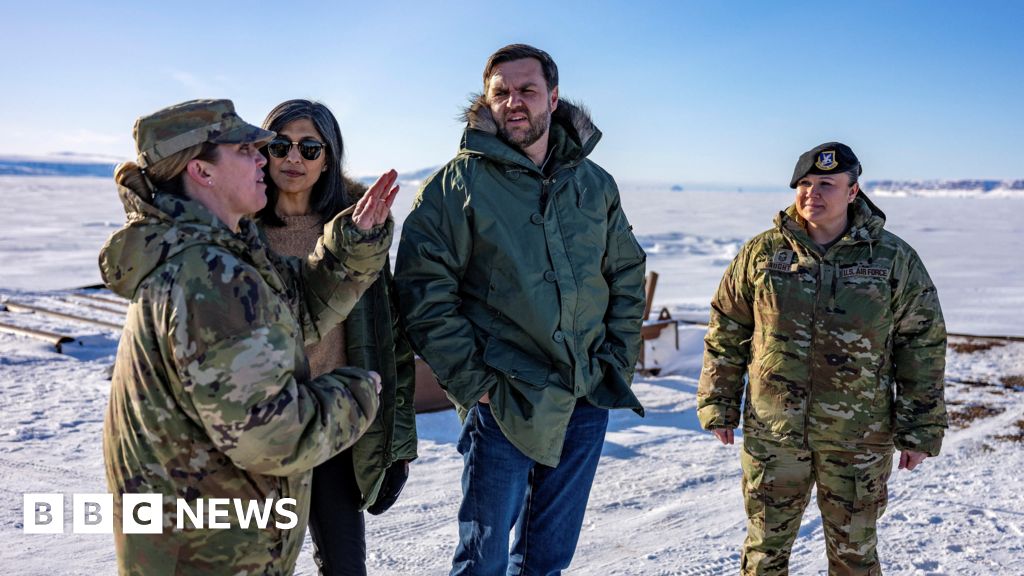
US vice‑presidential-led talks in Washington over Greenland — driven by President Trump's stated desire to 'acquire' the island — have raised acute geopolitical risk between the US, Denmark and Greenland and prompted NATO allies (notably the UK and Germany) to propose expanded Arctic military deployments. Greenland's strategic value spans missile‑defense positioning (Pituffik base), control of the GIUK maritime choke‑point, undersea infrastructure vulnerabilities and access to rare earths and minerals, meaning outcomes could affect defense spending, Arctic security postures and critical‑minerals supply considerations. Investors should monitor the meeting's outcome for potential shifts in NATO cooperation, regional military deployments and policy that could influence commodity supply chains, insurance and defense contractors.
Market structure: A credible near-term win for defence contractors and Arctic infrastructure suppliers (radar/ISR, submarine detection, seabed security) is likely: expect re-rating pressure on prime US names (LMT, NOC, RTX) and European peers (RHM.DE, BAES.L) within weeks as NATO/UK/DE advocate stepped-up presence. Commodities: signaling increases strategic demand for rare earths/critical minerals over 1-5 years supports miners with scalable processing (MP, LYC) but physical supply response will be multi-year and capital-intensive. FX and rates: short-lived diplomatic flare-ups would bid USD and safe-haven bonds; persistent transatlantic rupture would widen EUR-USD spreads and risk premia on Danish/EU assets.
Risk assessment: Tail risk includes an extreme diplomatic break (low-probability) that could trigger sanctions, trade fragmentation and >10% drawdowns in EU equities; operational tail includes accidents during Arctic militarisation raising insurance/claims in regional shipping. Time horizons: immediate (days) — headline volatility around the White House meeting; short-term (weeks–3 months) — defence contractor order visibility and ETF flows; long-term (1–5 years) — mining capex cycles and Arctic shipping route economics. Hidden dependencies: Greenland projects hinge on Danish political support, Indigenous consent and multi-year permitting; a quick headlines-driven deal is unlikely.
Trade implications: Direct plays — establish a 2–3% long position in a basket: LMT, NOC, RHM.DE (equal-weight) over 3–12 months to capture defence reallocation; add 1–2% long in MP (MP) for strategic rare-earth exposure with 18–36 month horizon. Options — buy 3-month call spreads on RHM.DE and LMT (buy ATM, sell +10% strike) sized to 0.5–1% notional to express conviction while capping premium. Pair trade — long LMT (2%) / short IAG.L (1%) to capture defence vs travel sensitivity if Arctic tensions harden. Reduce cyclical EU tourism/airline exposure by 20% within 2 weeks if diplomatic statements escalate.
Contrarian angles: Consensus assumes US territorial gambit; probabilistically NATO/EU will instead increase cooperative presence — invest in diversified defence suppliers and niche Arctic service providers (satcom, subsea security) rather than single-name US acquisition plays. The panic premium in small-cap miners may be overdone: prefer larger liquid names (MP, LYC) with processing optionality; avoid development-stage Greenland juniors (binary, >50% downside risk on permitting delays). Historical parallel: 1940s US presence led to long-term allied cooperation, not annexation — position size accordingly and scale into confirmed NATO commitments (>=$2bn or formal Arctic Sentry announcement).
AI-powered research, real-time alerts, and portfolio analytics for institutional investors.
Request DemoOverall Sentiment
moderately negative
Sentiment Score
-0.35
