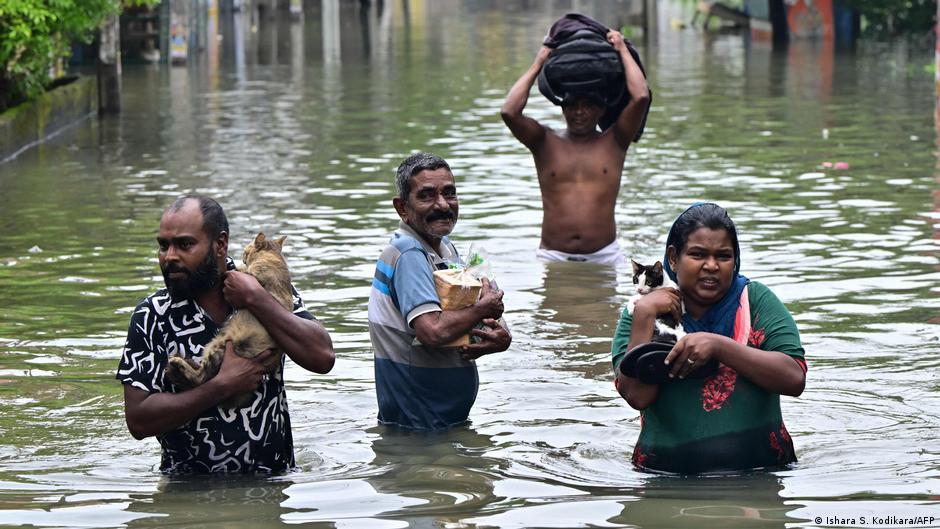
Sri Lanka declared a state of emergency after Cyclone Ditwah-triggered floods and landslides left 153 confirmed dead, about 200 missing, destroyed more than 20,000 homes and displaced over 78,000 people into nearly 800 relief centers. The president invoked emergency powers to accelerate relief as roads and rail lines are blocked, power outages persist around Colombo, and schools and offices were closed; India has sent two search-and-rescue teams and aid. Immediate implications include major local infrastructure and logistics disruption, elevated humanitarian and reconstruction costs, and heightened near-term sovereign and operational risk for investors with exposure to Sri Lanka or regional supply chains.
Market structure: Flooding and landslides in Sri Lanka are an idiosyncratic shock with outsized sovereign-credit and FX implications rather than a global commodity shock; expect local demand for construction materials and logistics to surge while tourism, retail banks and domestic corporates suffer revenue losses for 1–6 months. Reconstruction spending will shift pricing power to regional heavy-equipment and cement suppliers (India listed names) and to freight operators if Colombo port capacity is disrupted for more than 2–4 weeks.
Risk assessment: Tail risks include rapid Sri Lanka sovereign-default dynamics (CDS widening +300–500bps) and LKR depreciation of 10–30% within 3 months if capital flight accelerates; insurers/reinsurers face near-term claims but potential higher pricing over 12–24 months. Hidden dependencies include disrupted regional supply chains (spare parts, container stacking) and stimulus/aid conditionality from India/IFIs that could reallocate budgets away from other sectors.
Trade implications: Near-term trades favor FX/credit protection on Sri Lanka and selective long exposure to Indian construction/cement and heavy-equipment exporters for a 6–12 month reconstruction cycle; consider tactical reinsurance longs on multi-quarter expiries to capture higher rates. Use options to size convexity: buy protection (CDS or FX calls) and finance with call spreads on insurers/reinsurers rather than outright equity exposure.
Contrarian angle: The market may overprice long-term loss to reinsurers and underprice revenue upside for regional construction exporters; if Colombo port downtime exceeds 3 weeks, container rates and freight equities could re-rate positively for 1–3 quarters. Historical parallels: short-lived spikes in local sovereign stress after natural disasters (e.g., 2004 tsunami) often reverse when concessional aid and reconstruction contracts flow — position sizing must assume asymmetric outcomes.
AI-powered research, real-time alerts, and portfolio analytics for institutional investors.
Request DemoOverall Sentiment
strongly negative
Sentiment Score
-0.60
