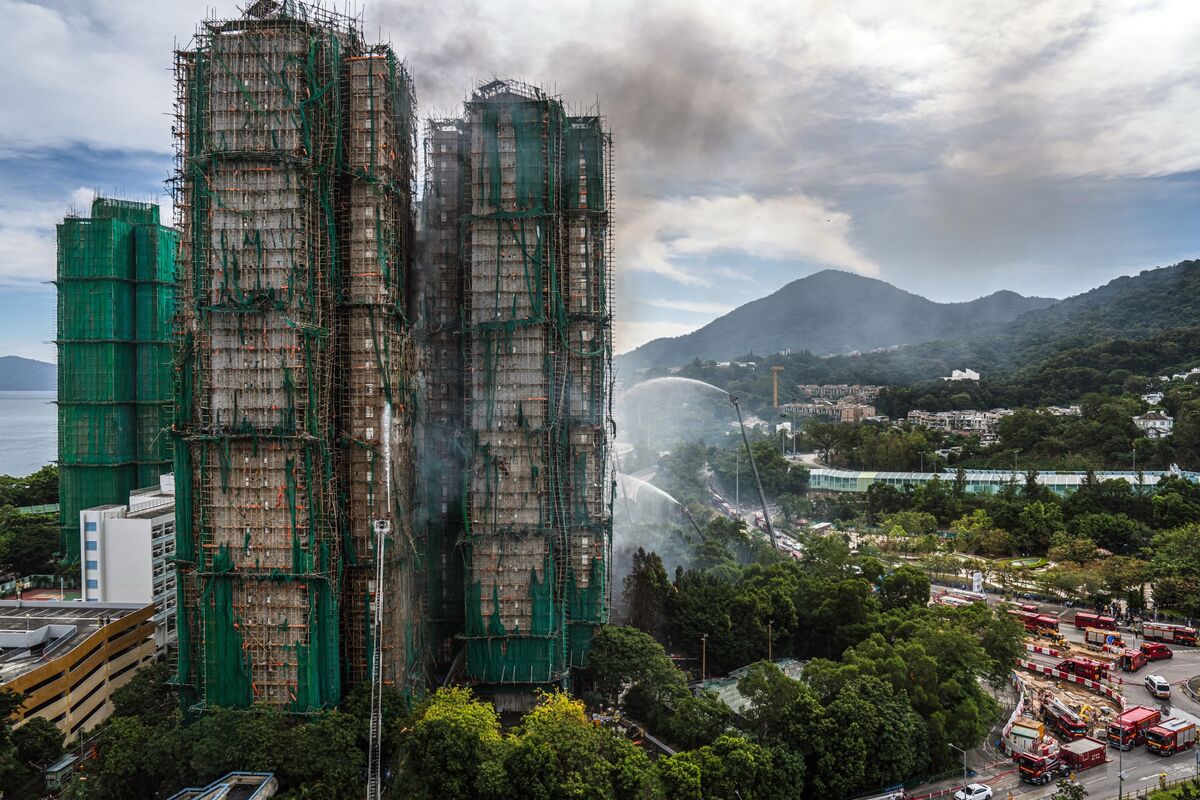
A deadly residential blaze in Hong Kong’s 1980s-era housing block killed at least 44 people and has heightened concerns about safety and maintenance of China’s high-rise residential stock. With China home to more than 3,500 skyscrapers over 150 meters — many residential — the incident raises the prospect of tighter regulation, higher upkeep and remediation costs, and increased investor scrutiny of property valuations and developers exposed to aging tower blocks.
Market structure: The Hong Kong tower fire spotlights an asset-class shock for China’s ~3,500 skyscrapers >150m and older high-rise stock, creating clear winners (retrofit contractors, large state builders, materials suppliers) and losers (levered private developers, owners of aging REIT portfolios, insurers). Ballpark retrofit demand could be CNY175–700bn if average remediation costs run CNY50–200m per tower, shifting near-term capex into construction/materials and away from new sales and dividends over 12–36 months. Competitive dynamics favor large, state-backed contractors (scale, bonding capacity) and vertically integrated materials players who can price and schedule work; smaller builders will face margin compression and possible insolvency.
Risk assessment: Immediate market reaction (days–weeks) is sentiment-driven: elevated CDS/spread widening for non-investment-grade China property bonds and HSI/REIT underperformance. Short-term (weeks–months) regulatory risk is highest—mandatory retrofits, liability caps, and retro funding schemes could force balance-sheet hits; long-term (1–3 years) operational risk is capacity bottlenecks, steel/cement price volatility, and higher insurance loss reserves. Tail risks include nationwide mandatory retrofits financed poorly, triggering municipal bond issuance and developer defaults; catalysts to watch are HK/PRC building-safety investigations and insurer reserve filings in the next 30–90 days.
Trade implications: Implement a tactical overweight to large state contractors and materials: consider 2–4% long in China State Construction (3311.HK) and CNBM (3323.HK) for 6–18 months; pair with 1–2% short exposure to high-leverage private developers Country Garden (2007.HK) and Evergrande (3333.HK) to capture divergence. Buy a 3‑month ATM put hedge on Hong Kong tracker 2800.HK equivalent to 1% portfolio to protect against sentiment-led drawdowns; scale into longs if 2800.HK falls >8% or spreads on China property IG widen >200bp.
Contrarian angles: Consensus focuses on negative hits to property; the market may underprice a large, targeted retro-fit stimulus that becomes a construction-cycle tailwind for materials/contractors over 12–24 months (historical parallel: UK post-Grenfell remediation). Avoid blanket shorts on REITs—selective buys on well-capitalized REITs after >10% price dislocations could be mean-reverting. Key unintended consequences: aggressive liability rulings could bankrupt small insurers or force systemic reinsurance demand, creating arbitrage in reinsurer equity and bond instruments.
AI-powered research, real-time alerts, and portfolio analytics for institutional investors.
Request DemoOverall Sentiment
moderately negative
Sentiment Score
-0.45
