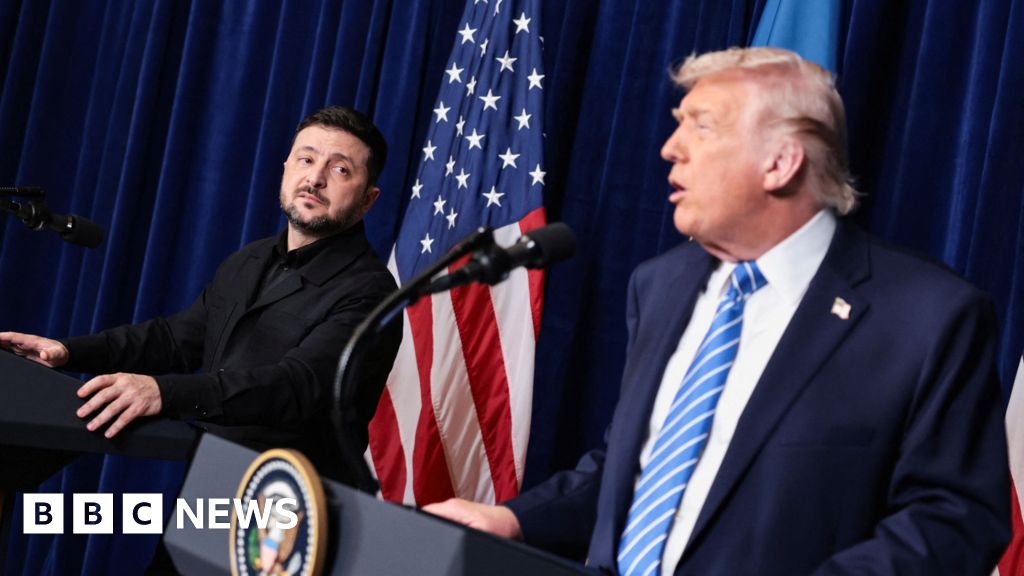
At Mar-a-Lago, Presidents Trump and Zelensky said they achieved agreement on roughly 90% of a 20-point peace plan and that security guarantees for Ukraine are about "95% done," but key territorial issues — notably a proposal to demilitarise parts of the Donbas — remain unresolved; Russia currently controls about 20% of Ukraine overall (≈75% of Donetsk, ≈99% of Luhansk). US and Ukrainian teams are scheduled to meet next week and Zelensky floated a potential January White House meeting with European leaders, while Trump also spoke by phone with Putin and suggested possible trilateral talks. The developments modestly lower tail risk by indicating progress toward a settlement, but the unresolved land question preserves significant geopolitical uncertainty for energy and defence-sensitive markets.
Market structure: A credible move toward a negotiated pause/reconciliation (e.g., formal trilateral talks or a written 'security guarantee' within 60–90 days) would likely compress the defence risk premium: expect 5–15% downside pressure on large-cap US/European defense names (LMT, RTX, GD, ITA) and a 3–7% rotation into cyclicals (CAT, construction/materials) as risk premia reprice. Energy and grains are second-order — a durable easing that allows Ukrainian exports to scale could depress wheat/corn prices 8–20% over 3–6 months; conversely a breakdown would spike them similarly.
Risk assessment: Tail risks include a talks collapse triggering rapid escalation (supply-chain shocks, renewed sanctions, oil spikes >15%) or snap policy shifts by the US if territory concessions are agreed (domestic political backlash leading to aid withdrawal). Near-term (days–weeks) headline sensitivity is high; medium-term (3–6 months) outcomes hinge on formal agreements and tangible troop/security deployments; long-term (1–3 years) centers on reconstruction-driven demand for heavy equipment, materials and banking/credit exposure to Europe/Ukraine.
Trade implications: Establish small, event-driven positions: short ITA or pair short LMT vs long CAT if a written agreement appears within 90 days; alternatively buy wheat put spreads (WEAT or March futures) ahead of supply normalization. Use 6–12 week option structures around scheduled follow-ups (next-week delegation talks; potential Jan White House meeting) and scale trades: 2–4% notional per theme, stops at 10% adverse move.
Contrarian angles: Consensus focuses on defence losers; underappreciated is reconstruction upside — if a ceasefire and framework are formalized within 6–12 months, expect 12–30% upside in construction/earthmoving (CAT) and select European banks financing reconstruction (BNPQY, BNP.PA) as EU guarantees mobilize. The market may underprice the magnitude and duration of reconstruction flows while overreacting to headline wobble.
AI-powered research, real-time alerts, and portfolio analytics for institutional investors.
Request DemoOverall Sentiment
mixed
Sentiment Score
0.05
