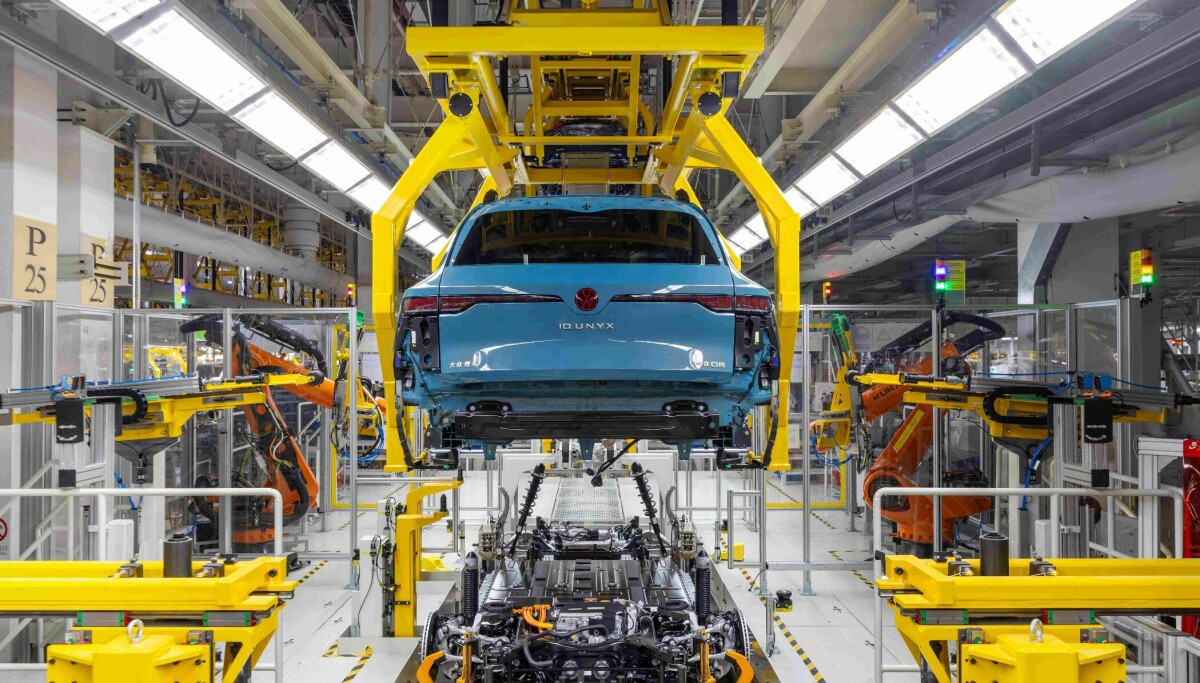
Advance sales of the ID.Unyx 08 began end-March at about €30,000; the five-metre SUV is built in VW’s Hefei complex, which comprises 510,000 sqm of hall space with current annual vehicle capacity of 360,000 and a components/battery plant sized for 150,000–180,000 batteries. VW invested ~€1bn in a 100,000 sqm China R&D centre (opened 2024) that produced the China Electrical Architecture (CEA) and local CMP/CSP platforms; the ID.Unyx 08 uses Xpeng’s Sepa 2.0 platform and carries advanced AD hardware (11 cameras, 15 radars). High localisation (~90% domestic machinery), sustainability measures (green power, phosphate‑free paint wastewater, EV logistics saving ~100 tonnes CO2/year) and shorter development cycles (from >3 years toward ~2 years) underpin VW’s accelerating China comeback.
The Hefei program materially changes the economics of western OEM participation in China by shifting value capture from platform exports to local systems and software — that re-centers margin creation on in-market architecture, ADAS stack and aftersales services rather than purely hardware. Expect the profit pool to tilt toward firms that own E/E stacks and calibration/test capabilities; this favors Chinese automation, sensor and semiconductor suppliers whose revenue per vehicle can be 3–5x higher once software/configuration and calibration services are bundled.
Execution risk is concentrated in three narrow tranches: ADAS calibration/software integration, battery supply cadence, and warranty/recall exposure from mixed-platform assembly. Failures in any tranche produce sharp P&L hits (mid-single-digit margin compression that can persist 2–4 quarters) because fixing E/E/systemic issues requires software rework and hardware recalibration at scale, not just part swaps.
A faster China-specific development cycle also creates an export arbitrage pathway: low-cost, highly equipped China builds can be exported to higher-margin markets, pressuring incumbents and compressing global EV ASPs in the 12–36 month window. That pathway will be the decisive catalyst for rerating EV pure-plays if they can monetize software/over-the-air updates and spare-parts/servicing in export markets, but it also invites regulatory and certification friction that can flip the tailwind into a multi-quarter headwind.
AI-powered research, real-time alerts, and portfolio analytics for institutional investors.
Request DemoOverall Sentiment
moderately positive
Sentiment Score
0.40
Ticker Sentiment
