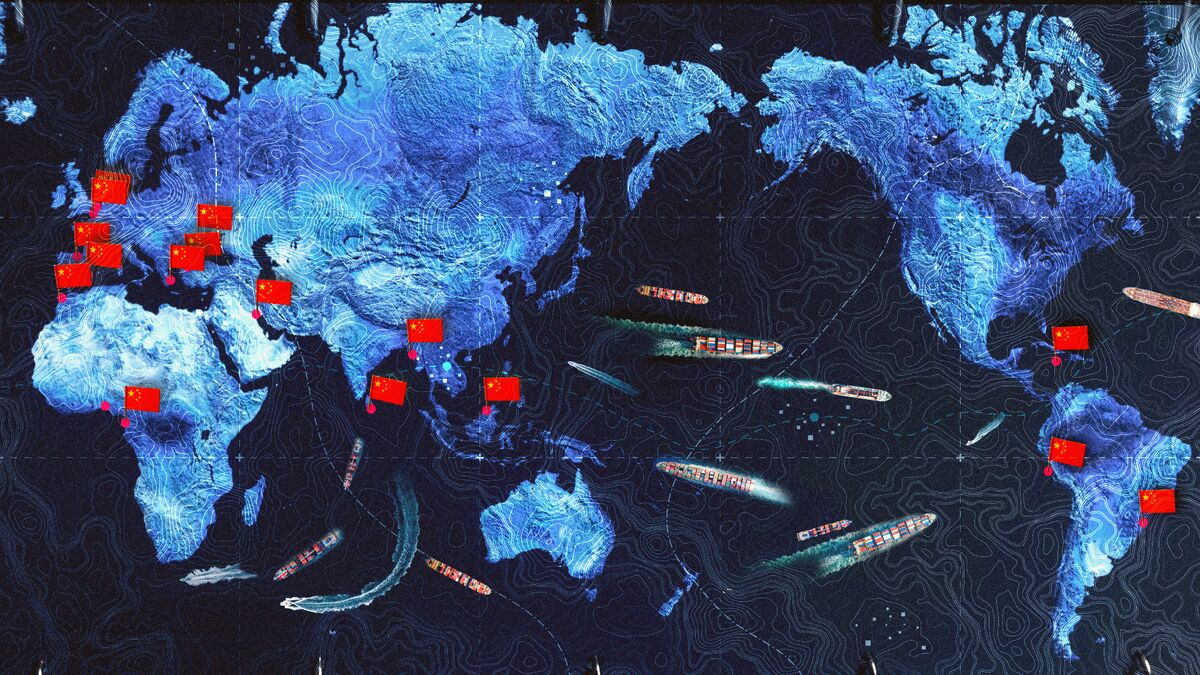
Over the past two decades China has deployed tens of billions of dollars to build or invest in a global network of commercial ports—on six continents (all except Antarctica)—with state-owned or affiliated entities investing more than $60 billion across 129 overseas port projects as part of the Belt and Road Initiative. The expansion entrenches Beijing's trade and logistics influence amid US–China trade tensions and raises strategic concerns that many of these facilities could have military uses, potentially prompting regulatory responses, reallocations of supply‑chain exposure, and shifts in demand for defense and strategic infrastructure assets.
Market structure: China’s $60bn+ port push (129 projects) shifts terminal bargaining power toward state-affiliated operators and coastal logistics chains, pressuring independent port operators and third‑party logistics margins by an estimated 5–15% over 3–5 years in routes where Chinese partners secure slot guarantees. Shipping lines and commodity traders gain optionality to re-route cargoes to lower-cost, captive terminals; this creates asymmetric pricing power for Chinese SOEs in transshipment hubs and raises long‑run barrier-to-entry for Western port PPPs. Fixed‑income markets should price higher termpremia for EM sovereigns heavily leveraged to Chinese infra (widening 5y CDS +150–400bp possible in stressed cases), while defense equities and insurance/reinsurance stand to re-rate upward on security risks.
Risk assessment: Tail risks include militarization of dual‑use ports triggering sanctions or blockades (low probability, high impact) that could collapse specific supply corridors within weeks and spike container rates +200–400% transiently. Immediate (days) risks are headline-driven FX volatility in EM currencies (±3–8% moves), short‑term (months) are sanctions/regulatory responses by US/EU limiting Chinese ownership of strategic ports, long‑term (years) is structural decoupling of trade networks and supply‑chain fragmentation. Hidden dependencies: local political stability, debt-servicing terms of BRI loans, and insurance coverage (war risk) create nonlinear exposures not evident in balance sheets.
Trade implications: Favor 12‑24 month longs in defence primes (LMT, NOC, RTX; 1–2% each) and selective Chinese port/shipper exposure (China COSCO Shipping 1919.HK / CICOY OTC, 2–3%) to capture captive volume upside; trim cyclic container names (ZIM, MATX) by 25–40% over 30–60 days. Implement options: buy 9–12 month call spreads on LMT/RTX (funded by short near‑term calls) to capture rerating; buy 6–12 month put spreads on EMB (iShares J.P. Morgan USD EM Bond ETF) sized to cover 1–2% portfolio risk to hedge EM sovereign spillovers.
Contrarian angles: Consensus treats Chinese ports as purely geopolitical threats; missed is commercial arbitrage — many host countries lack alternatives and will accept lower tariff floors, benefiting Chinese logistics ecosystems while depressing incumbents. The market may be underpricing transient profit pools (5–10% incremental EBITDA) for select Chinese SOEs over 12 months while overpricing permanent contagion for broad EM sovereigns; historical parallel: Japanese shipping/port expansion in the 1980s produced both commercial integration and eventual political pushback, implying a 2–5 year window to harvest commercial gains before material policy reversals. Unintended consequence: accelerated Western subsidies to rival ports could create short‑term capex spikes—look for announced funds within 90 days as a reversal catalyst.
AI-powered research, real-time alerts, and portfolio analytics for institutional investors.
Request DemoOverall Sentiment
moderately negative
Sentiment Score
-0.45
