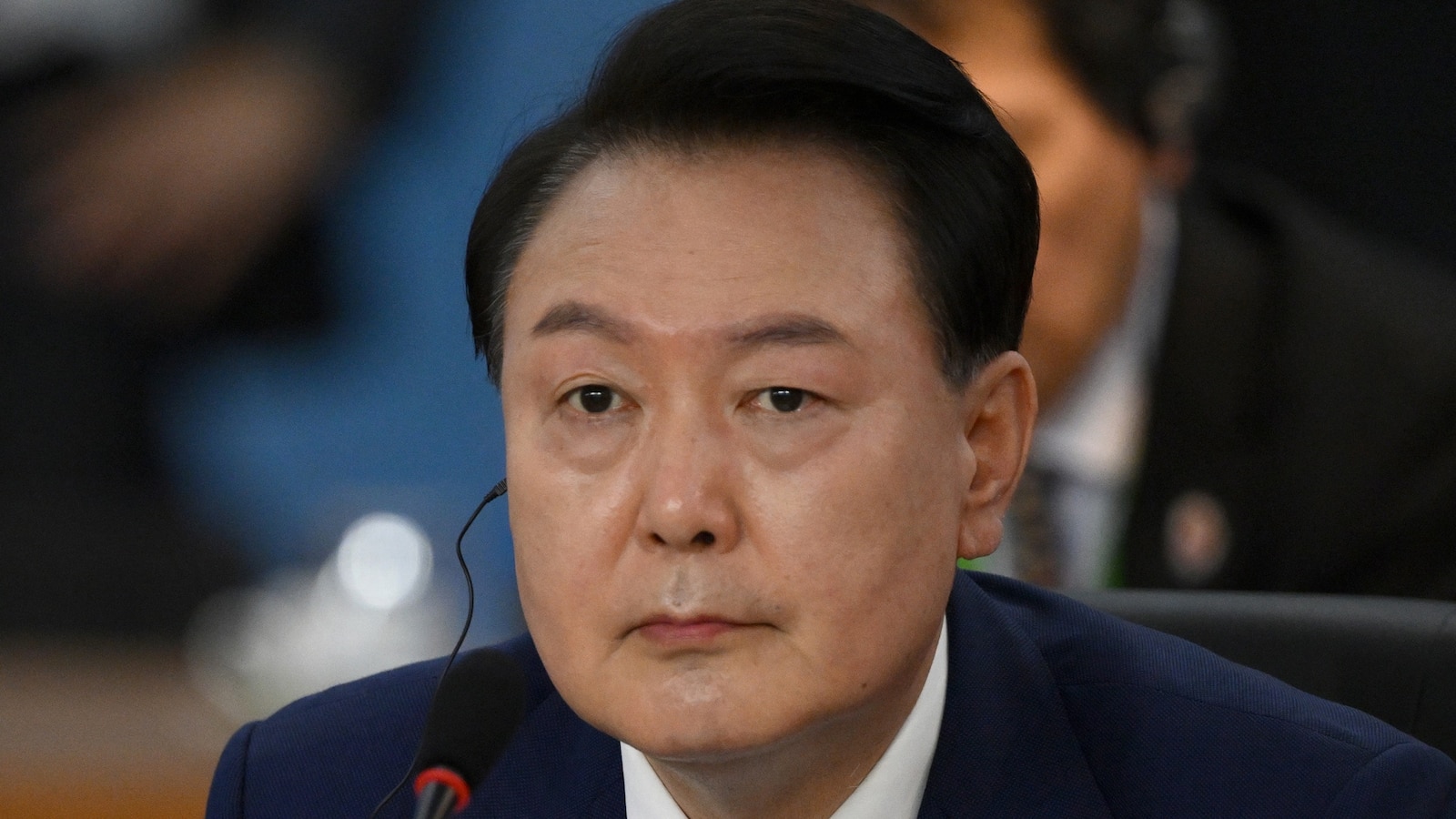
A Seoul court sentenced former South Korean President Yoon Suk Yeol to five years in prison for obstructing his arrest and unlawfully implementing martial law during the December 2024 crisis, ruling the declaration and execution of martial law illegal and finding he had convened a limited set of handpicked ministers. The ruling — the first criminal verdict tied to the martial law episode — and prosecutors' separate recent pursuit of the death penalty on insurrection charges elevate political and legal risk for South Korea, likely weighing on investor sentiment and introducing additional uncertainty for Korean assets and governance stability.
Market structure: The conviction increases near-term political risk premia for Korean assets—expect a 3–7% knee-jerk drawdown in KOSPI/KOSPI-200 and 2–4% KRW weakness within 2–8 weeks as foreigners reduce cyclically sensitive positions. Domestic-focused sectors (retail, banks, real estate developers) lose pricing power from capital outflows; exporters (semiconductors, shipbuilders) are relatively insulated by USD revenue and could outperform on a relative basis. Financial plumbing (local bond ETFs, small-cap funds) will see wider bid-ask spreads and lower liquidity for 1–4 weeks.
Risk assessment: Tail risks include large-scale protests or emergency measures that freeze markets, or a ratings agency downgrade that lifts 10y KTB yields +50–100bps; probability 5–15% over 3–6 months. Immediate window (days) is volatility spikes; short-term (weeks/months) is sustained FX/Bond pressure; long-term (quarters) depends on legal appeals and election calendar—confidence recovery likely only after 6–12 months if political stability returns. Hidden dependency: foreign custody outflows could trigger forced liquidation in illiquid small caps, amplifying losses.
Trade implications: Tactical plays: short broad Korea exposure (EWY or KOSPI-200 futures) and buy USDKRW call spreads to hedge FX—target a 2–4% KRW move in 1 month with stop at 1.5%. Credit/bond: go long 5–10y KTB yields via short KTB futures anticipating +20–40bps within 3 months, stop at +10bps. Use put spreads on EWY (1-month 3–5% OTM) to limit premium outlay; add 1–2% GLD as tail hedge.
Contrarian angles: Consensus may oversell large-cap export champions; semiconductor exposure (Samsung 005930.KS / ADR SSNLF, SK Hynix 000660.KS) could be a 3–12 month recovery trade given secular memory/logic demand—construct pair: short EWY and long Samsung (size 1:0.4) to capture domestic-political drag while keeping export upside. Reaction may be overdone if legal appeals extend but markets stabilize within 3 months.
AI-powered research, real-time alerts, and portfolio analytics for institutional investors.
Request DemoOverall Sentiment
moderately negative
Sentiment Score
-0.35
