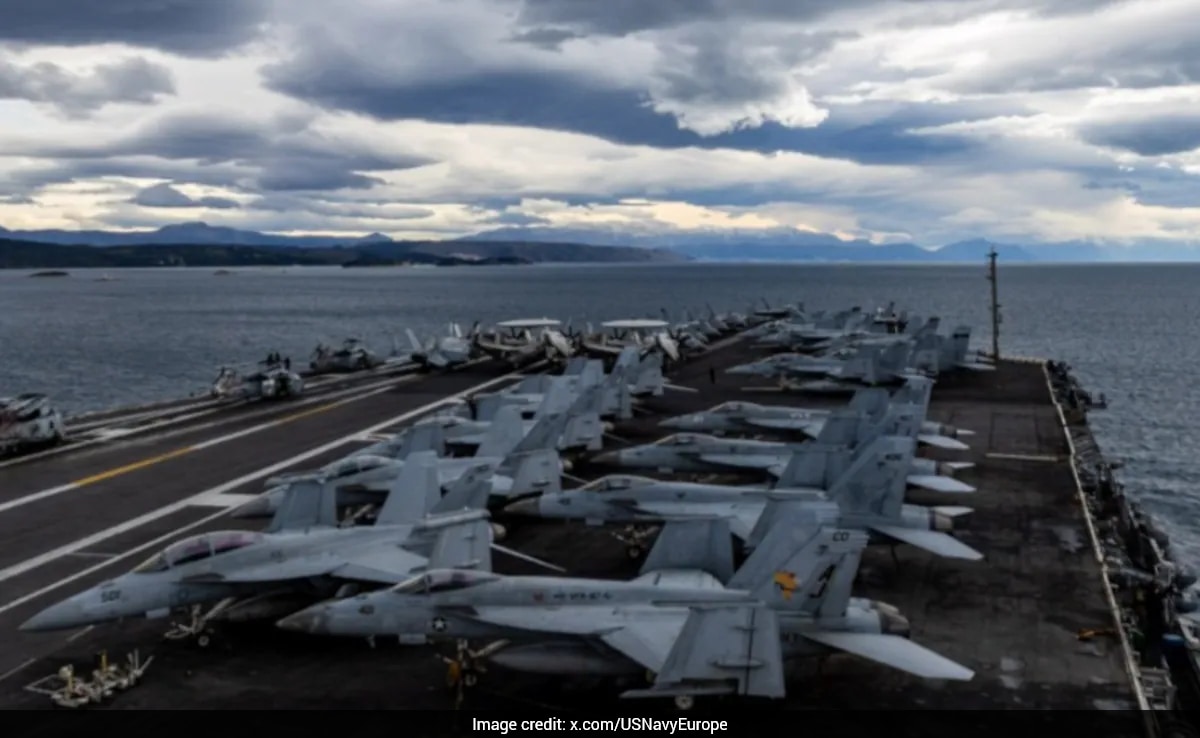
The U.S. has deployed two guided-missile destroyers, USS Frank E Peterson and USS Michael Murphy, to support mine-clearing operations in the Strait of Hormuz after heightened threats linked to Iran. Nearly 800 ships have been stranded for weeks, and the blockage has pushed global oil prices above $100 per barrel amid disruption to a route handling roughly 20% of global oil and gas flows. The situation raises near-term risks for energy markets and global shipping while the Navy establishes a safer passage.
The immediate market response should be a wider geopolitical risk premium rather than a clean directional bet on crude. The larger second-order issue is not just spot barrels, but shipping insurance, convoy economics, and the probability of episodic disruptions forcing refiners and traders to reprice prompt-delivery cargoes higher than forward curves. That tends to steepen the front end of the oil curve, lift implied volatility across energy, and punish freight-sensitive industries even if the physical blockage is temporary.
The winners are more nuanced than “energy up, everything else down.” US defense and maritime security contractors benefit from a fresh budget narrative if this evolves from one-off deterrence into a sustained mine-countermeasure posture; the real commercial opportunity is in UUVs, sensors, and electronic warfare rather than platforms. Outside of defense, tanker owners and LNG/shipping names can actually outperform if ton-mile demand rises from rerouting and longer voyage times, but only if vessels can be insured and cleared to sail. That creates a bifurcation: asset-light commodity producers gain from higher prices, while logistics-heavy users absorb input-cost shock and inventory risk.
The contrarian view is that the market may be overestimating permanence. Mine-clearing operations are designed to restore passage quickly, and unless there is evidence of repeated seeding or direct kinetic escalation, the premium can compress within days rather than months. The better trading setup is to own volatility and relative winners, not outright chase the first spike in crude; the highest convexity is in names exposed to oil-price upside with limited demand destruction, while airlines, chemical producers, and discretionary transport should mean-revert only after a credible corridor is reopened.
AI-powered research, real-time alerts, and portfolio analytics for institutional investors.
Request DemoOverall Sentiment
mildly negative
Sentiment Score
-0.35
