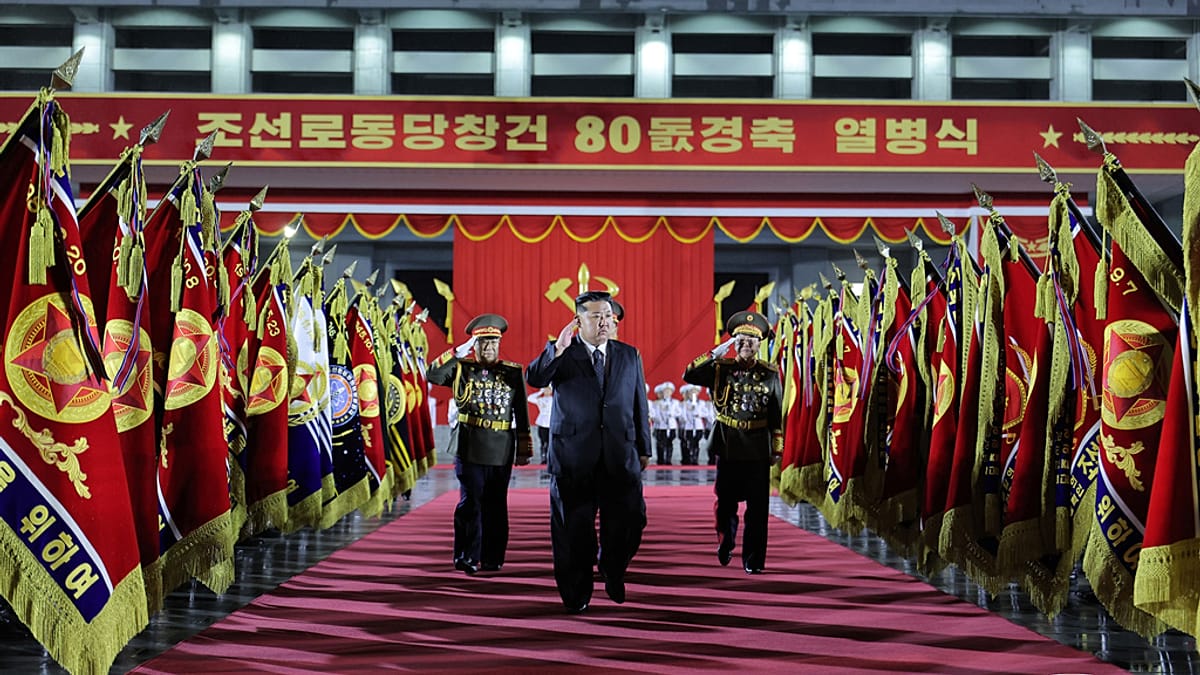
North Korean leader Kim Jong-un replaced three senior personal-security chiefs, a reshuffle spotted at an October military parade that Seoul links to heightened assassination fears after Pyongyang deployed troops to aid Russia in Ukraine and following the U.S. operation against Venezuela's Nicolás Maduro. Seoul’s agencies say Kim has upgraded countermeasures—seeking jamming equipment and drone-detection gear—and analysts note increased focus on succession with daughter Ju-ae appearing alongside him; the developments raise regional geopolitical and security risk, with potential implications for defense and surveillance procurement but limited direct market impact.
Market structure: Immediate winners are defense primes (Lockheed LMT, Northrop NOC, Raytheon RTX), C‑UAS and EW specialists, and cybersecurity vendors as governments pay up for counter‑decapitation tools; losers are Korea‑exposed consumer cyclicals, regional travel/airlines and smaller EM banks that face capital flight. Pricing power should shift to prime contractors and specialists where backlog-to-revenue ratios can expand by +10–25% over 12–24 months if governments convert heightened risk into procurement. Cross‑asset: expect a classic risk‑off move — USD and JPY bid, KRW weakening >1–3% in spikes, Treasuries and gold rally, oil up on shipping/insurance risk.
Risk assessment: Tail risks include direct US/North Korea kinetic exchange or a regional proxy escalation with <5% probability next 12 months but >$100bn economic shock if realized; market moves could exceed 10–20% regionally. Near term (days–weeks) expect volatility (VIX +10–30%) around any missile/force deployments; medium (3–12 months) see repricing of defense/cyber capex; long term (1–3 years) structural supplier reshoring and semiconductor chokepoints may constrain production and margin capture. Hidden deps: EW/C‑UAS rollout depends on RF semiconductor supply and export controls; catalyst set includes satellite imagery leaks, troop movement announcements, or US special operations.
Trade implications: Tactical: overweight defense and cyber for 3–12 months while hedging EM/Korea exposure — defense upside targeted +15–25% if procurement follows. Use options to express asymmetric risk: buy 6–12 month calls on LMT/NOC or buy protective put spreads on EWY (MSCI Korea) sized 0.5–1% portfolio for tail risk. Rotate 3–5% from cyclicals/EM into GLD and long‑duration Treasuries (TLT) as immediate hedges; take profits or unwind once geopolitical headlines cool for 4–6 weeks.
Contrarian angles: Consensus overweights headline risk but may underprice long‑cycle gains for niche suppliers (C‑UAS integrators, RF semiconductor vendors) where small firms can rerate 30–60% on program wins — look for sub‑$5bn revenue names with visible DoD/Allied contracts. Historical parallel: post‑2014 Crimea saw defense primes rerate over 12–24 months; downside is faster diplomatic de‑escalation which would snap back defense equities — set stop losses at −12% on new positions or trim at +20% gains.
AI-powered research, real-time alerts, and portfolio analytics for institutional investors.
Request DemoOverall Sentiment
mildly negative
Sentiment Score
-0.25
