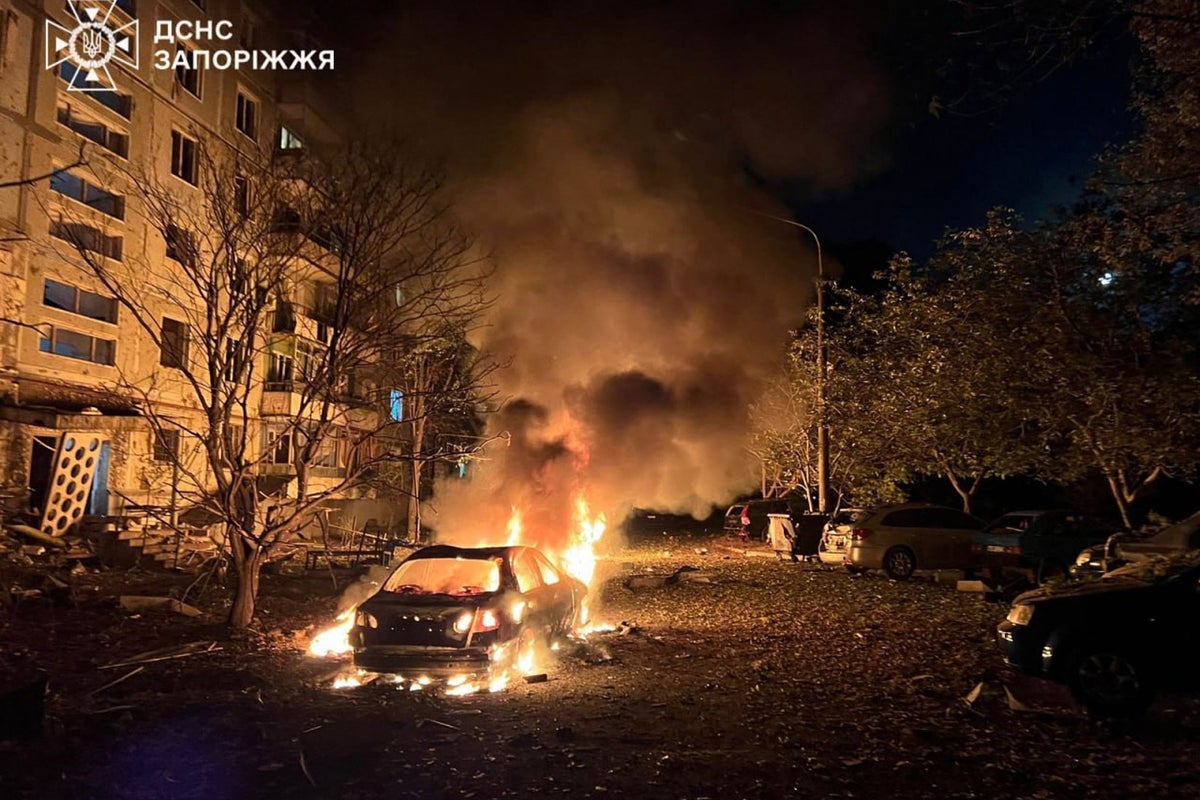
Russia launched a major missile and drone assault on Ukraine, killing at least five civilians and targeting critical infrastructure, prompting Poland to scramble jets and raising concerns about NATO air safety. Concurrently, Ukraine retaliated with strikes causing power outages in Russia's Belgorod, while European nations expressed alarm over increasing Russian drone incursions into their airspace, interpreting them as tests of defensive capabilities. This escalation underscores heightened geopolitical tensions and risks to regional stability, with Ukrainian President Zelensky accusing Moscow of deliberately targeting civilian infrastructure ahead of winter.
Ukraine-Russia war latest: Five dead in mass missile and drone attack by Putin’s forces after Poland scrambles jets Comes amid mounting concern Russia could be behind growing number of recent drone incursions in airspace of Ukraine's European allies At least five civilians have died after Russia launched drones, missiles and guided aerial bombs at Ukraine overnight in a major attack that officials there said targeted civilian infrastructure. Moscow sent more than 50 ballistic missiles and around 500 drones into nine regions across Ukraine, Ukrainian president Volodymyr Zelenskyy said on Sunday morning. NATO member Poland said it scrambled aircraft early on Sunday to ensure its air safety after Russia launched the airstrikes on Ukraine, with Ukrainian officials reporting missiles and drones raining down on the Lviv region near the Polish border. On Saturday, a Russian drone strike against a railway station hit a passenger train, killing one and wounding 30, as Moscow stepped up strikes on Ukraine's rail and power networks. Meanwhile, German media reported that drones had been spotted at airports and military installations across Germany over the past two days, suggesting sightings this week at Munich Airport, which forced the closure of both runways, were the tip of the iceberg. There is mounting concern that Russia could be behind a growing number of recent drone incursions in the airspace of Ukraine's European allies. All we know about large-scale Russian attack on Ukraine that killed five Russia launched drones, missiles and guided aerial bombs across Ukraine in the early hours yesterday, killing five people in a major nighttime attack that Ukrainian officials said targeted civilian infrastructure. Moscow fired 53 ballistic and cruise missiles and 496 drones, Ukraine's air force said. Volodymyr Zelensky reported that nine regions were targeted. Four people, including a 15-year-old, died in a combined drone and missile strike on Lviv, according to regional officials and Ukraine's emergency service. It was the largest aerial assault on the historic western city and surrounding region since Russia's full-scale invasion on February 2022, according to Maksym Kozytskyi, head of the local military administration. Earlier in the war, Lviv was seen as a haven from the fighting and destruction farther east. In a Telegram post, Kozytskyi said Russia launched about 140 Shahed drones and 23 ballistic missiles across the region. At least six more people were injured, according to a statement by Ukraine's police force. Thousands without power in Russia's Belgorod after Ukraine attack Ukraine's overnight shelling of the Russian region of Belgorod damaged power infrastructure, snapping electricity links to thousands of customers, the governor of the region bordering Ukraine said this morning. Although engineers and emergency services restored power to nearly 34,000 consumers by Monday morning, about 5,400 in 24 municipal areas were still without electricity, governor Vyacheslav Gladkov said. Belgorod and other regions adjacent to Ukraine have faced persistent cross-border shelling and drone attacks, as the war Moscow unleashed against Kyiv in 2022 has spilled on to Russian soil, disrupting civilian life and damaging critical infrastructure. Ukraine offered no immediate comment on the attack. Both sides say their strikes with each other's territory aim to destroy infrastructure key to the overall war effort. Patrolling Nato’s skies with the RAF: A bird’s-eye look at Europe’s creeping frontline As the seemingly unremarkable ZZ-343 aircraft taxies along the apron at RAF Brize Norton, it passes the vibrant union flag livery of its distinctly more glamorous twin the Vespina, emblazoned with the words “United Kingdom”. The planes are fine examples of these islands’ genius for compromise. They’re passenger carriers that are also airborne fuel tankers, known as Voyager. Vespina is fitted out to carry royalty and other British VIPs – but put to better use by the military most of the time. On this autumnal evening, ZZ-343 left her sibling on a once almost unimaginable mission. Part of Operation Eastern Sentry, she is carrying fuel to Typhoon fighter jets patrolling the skies over Poland to see off Russian invaders. Inconceivable at the end of the 20th century, Eastern Sentry is now what passes for a “norm”. The hybrid Voyager aircraft is now engaged in hybrid warfare with Russia that’s heating up and defining the early decades of this century. Patrolling Nato’s skies with the RAF: A birds-eye look at Europe’s creeping frontline Watch: Zelensky criticises partners over 'zero real reaction' to Russian strikes Russia openly trying to hit Ukraine's civilian infrastructure, says Zelensky Volodymyr Zelensky has accused Moscow of deliberately and openly trying to attack Ukraine’s civilian infrastructure in the recent military onslaught. “Russia is openly trying to destroy our civilian infrastructure right now, ahead of winter – our gas infrastructure, our power generation and transmission,” he said in his nightly address. “Zero real reaction from the world. We will fight so that the world does not remain silent and so that Russia feels the response,” Zelensky said. Mystery drones are causing havoc across Europe. Here’s what we know Mystery drone incursions into European Union airspace have sparked considerable alarm among both the public and political figures in recent weeks. These incidents, which extended to Nato airspace, reached an unprecedented scale last month, with some officials attributing them to Russia. Such actions have been interpreted by some European officials as Moscow testing the alliance's defensive capabilities, prompting concerns over Nato's readiness against potential Russian aggression. Countries are scrambling to figure out how to respond in the moment, including weighing whether to allow authorities to shoot the drones down. Mystery drones are causing havoc across Europe. Here’s what we know Avoid Putin's 'escalation traps', says German defence minister Germany must improve its anti-drone defences, its defence minister said, but warned against a hasty response to airspace incursions by Russia which would risk falling into "Putin's escalation trap". Boris Pistorius' remarks in an interview with Handelsblatt newspaper followed drone sightings at Munich Airport that cancelled dozens of flights and stranded over 10,000 passengers this weekend. Authorities have yet to attribute blame, but officials have said Russia was responsible for dozens of recent aircraft incursions and sightings in the airspace of Ukraine's European allies. "Putin knows Germany very, very well," Pistorius said of the Russian President, who was a KGB agent in East Germany in the 1980s. "We mustn't fall into Putin's escalation trap," he added. "If we shot an aeroplane down, he would claim the airspace violation was just pilot error and we had shot down an innocent young man," he told Handelsblatt. Russian air defence unit destroys drone heading for Moscow, mayor says Russia's air defence unit destroyed a drone heading for Moscow, the mayor of the capital said this morning. Emergency services were despatched to the site where the debris fell, mayor Sergei Sobyanin said on Telegram. Watch: Zelensky shares video of Russian drone strike on Ukrainian passenger train Trump says Putin's offer on nuclear arms control 'sounds like a good idea' US president Donald Trump said Russian president Vladimir Putin's offer to voluntarily maintain limits on deployed strategic nuclear weapons "sounds like a good idea." Putin last month offered to voluntarily maintain limits capping the size of the world's two biggest nuclear arsenals set out in the 2010 New START accord, which expires in February, if the US does the same. “Sounds like a good idea to me," Trump told reporters as he departed the White House, when asked about Putin's offer. Russia's UN ambassador Vassily Nebenzia last week had said Moscow was still waiting for Trump to respond to Putin's offer to voluntarily maintain the limits on deployed strategic nuclear weapons once a key arms control treaty expires. Any agreement on continuing to limit nuclear arms would stand in contrast to rising tensions between the United States and Russia since Trump and Putin met in Alaska in mid-August given reported incursions of Russian drones into Nato airspace. Join our commenting forum Join thought-provoking conversations, follow other Independent readers and see their replies Comments A significant escalation in the Russia-Ukraine conflict is underway, characterized by a large-scale Russian missile and drone assault targeting civilian and critical energy infrastructure across nine Ukrainian regions. The attack, involving over 50 missiles and nearly 500 drones, resulted in civilian casualties and prompted NATO member Poland to scramble fighter jets due to strikes near its border, highlighting the tangible risk of spillover into NATO territory. Concurrently, European security concerns are intensifying due to a series of mystery drone incursions over allied airspace, including at Germany's Munich Airport, which officials suggest may be Russian tests of NATO's defensive posture. This 'hybrid warfare' tactic directly impacts European commerce and transportation. While Ukraine has conducted retaliatory strikes on Russian infrastructure in Belgorod, Ukrainian President Zelensky has accused Moscow of a deliberate campaign to destroy its energy grid ahead of winter, criticizing a lack of international response. The situation underscores a broadening of the conflict's scope, with direct implications for European energy security, defense readiness, and regional stability.
AI-powered research, real-time alerts, and portfolio analytics for institutional investors.
Request DemoOverall Sentiment
strongly negative
Sentiment Score
-0.80
