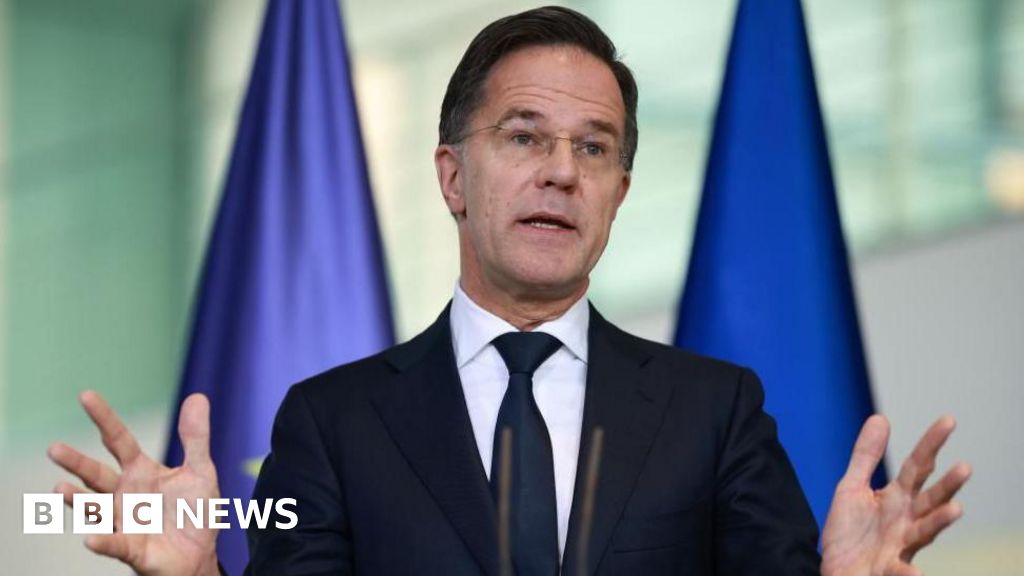
NATO secretary‑general Mark Rutte hailed former President Trump for forcing allies to pledge higher defence spending—committing NATO members to aim for 5% of GDP on defence by 2035—and said Trump has strengthened collective defence and support for Ukraine; Rutte warned Russia could attack NATO allies within five years, a threat Moscow dismissed. The article highlights intensified US‑led negotiations over a Trump peace plan and possible security guarantees for Kyiv, EU talks on using frozen Russian assets to fund Ukraine, and alarming Russian war‑economy output (Kiel Institute estimates roughly 150 tanks, 550 infantry fighting vehicles, 120 Lancet drones and 50+ artillery pieces produced monthly), while Western Europe remains years from matching that pace. For investors, the piece underscores an elevated geopolitical risk premium and a likely sustained lift in European defence spending, industrial mobilisation and related procurement opportunities, alongside policy uncertainty about peace terms and the use of frozen Russian assets.
NATO secretary-general Mark Rutte credited former US President Donald Trump with securing a NATO commitment for members to target defence spending of 5% of GDP by 2035, calling it Trump’s "biggest foreign policy success" and asserting the alliance is now "stronger than it ever was." Rutte warned Russia could attack NATO allies within five years; President Putin publicly dismissed that threat as "nonsense," underscoring persistent high-level geopolitical tensions.
The article highlights a pronounced military-production asymmetry: a Kiel Institute report estimates Russia is producing roughly 150 tanks, 550 infantry fighting vehicles, 120 Lancet drones and more than 50 artillery pieces per month, while Western Europe remains years from matching that output. France and Germany are reviving voluntary military service and Rutte stressed the risk Europe would be "weaker than the Russians" if Hague spending commitments are not implemented.
Policy uncertainty is elevated as US envoys negotiate a Trump-proposed peace plan reportedly conceding eastern Ukrainian territory in exchange for security guarantees modeled on Article 5, while EU leaders debate using frozen Russian assets to fund Ukraine. These developments point to a sustained geopolitical risk premium, a supportive environment for defence procurement and industrial mobilisation, and asymmetric sanction-related market effects consistent with the mixed, hawkish signals and modest market-impact score.
AI-powered research, real-time alerts, and portfolio analytics for institutional investors.
Request DemoOverall Sentiment
mixed
Sentiment Score
0.00
Ticker Sentiment
