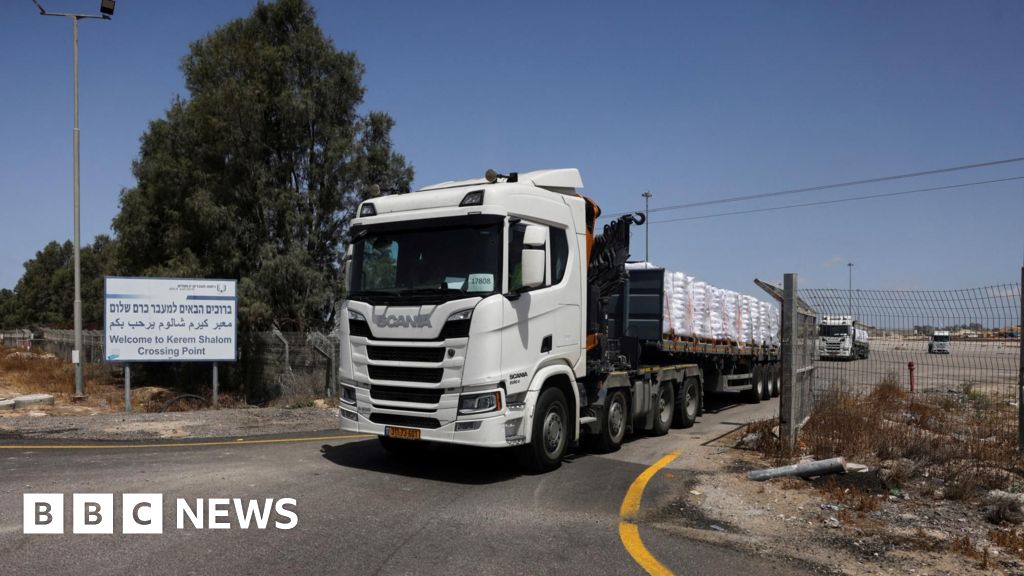
Israel has allowed a limited amount of UN aid into Gaza after an 11-week blockade following pressure from US senators, a move described by the UN as insufficient to address the looming famine affecting over two million Palestinians. Prime Minister Netanyahu stated the aid is temporary until Israel establishes its own distribution hubs under a US-backed plan, while also declaring intensified military operations throughout Gaza. International leaders have criticized Israel's actions as inadequate and threatened further measures if restrictions on humanitarian aid are not lifted, raising concerns about the region's stability.
Israel has permitted a nominal resumption of UN humanitarian aid into Gaza—five UN lorries initially, with nine cleared by the UN entering—following an 11-week blockade, a decision Prime Minister Netanyahu attributed to pressure from US Senators and the strategic imperative to prevent famine to maintain international support for ongoing military operations aiming to defeat Hamas and free hostages. This aid, including baby food, is critically insufficient according to the UN's humanitarian chief who termed it "a drop in the ocean" for the 2.1 million Palestinians, where experts warn of a looming famine and the Hamas-run health ministry reported 57 child malnutrition deaths during the blockade. Netanyahu indicated this allowance is temporary, pending the establishment of a US-backed non-governmental aid distribution system, which the UN rejects on humanitarian principle grounds and whose operational timeline is disputed by aid experts. Concurrently, Israel has intensified its military offensive throughout Gaza, ordering new evacuations in southern Khan Younis for an "unprecedented attack" and stating intentions to "take control of all areas," an escalation that has reportedly killed over 3,000 people and displaced 400,000 since the prior ceasefire ended. The limited aid has been condemned as "wholly inadequate" by leaders from the UK, France, and Canada, who have threatened "further concrete actions," highlighting increasing diplomatic pressure and regional instability, a sentiment reflected by the article's negative (-0.5) overall sentiment score and pessimistic tone. Internally, Netanyahu's decision faces criticism from far-right coalition partners fearing it bolsters Hamas.
AI-powered research, real-time alerts, and portfolio analytics for institutional investors.
Request DemoOverall Sentiment
Negative
Sentiment Score
-0.50
