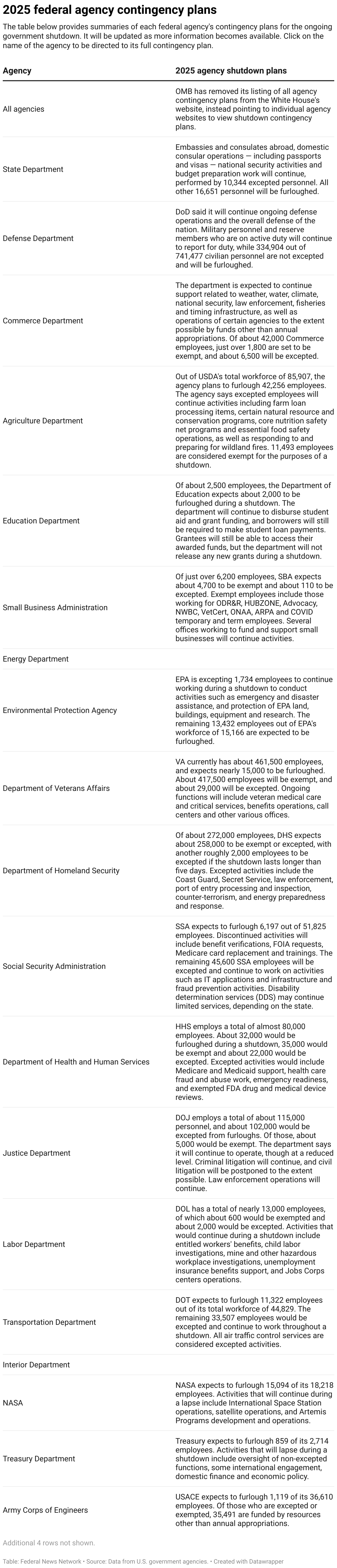
With a government shutdown imminent, federal agencies have prepared individual contingency plans, though the Office of Management and Budget is notably not centralizing this information as in previous years. The Congressional Budget Office estimates that a lapse in discretionary funding for fiscal year 2026 could result in approximately 750,000 daily furloughs, incurring an estimated $400 million in daily compensation costs, signaling potential significant short-term economic impact.
An imminent U.S. government shutdown introduces significant short-term economic uncertainty, reflected by a strongly negative sentiment score (-0.7) and a moderate market impact rating (0.6). A key operational detail is the Office of Management and Budget's departure from past practice by not compiling agency contingency plans, which complicates assessments of specific service disruptions. The Congressional Budget Office quantifies the potential scale of the disruption, estimating that a future shutdown in fiscal year 2026 could furlough approximately 750,000 federal employees daily, representing a direct compensation cost of roughly $400 million per day. While these figures are a forward projection, they serve as a potent proxy for the immediate economic drag from lost wages and deferred consumer spending. The core risk is rooted in political and fiscal policy, with the unknown duration of the shutdown standing as the primary variable that will dictate the severity of the economic consequences and market reaction.
AI-powered research, real-time alerts, and portfolio analytics for institutional investors.
Request DemoOverall Sentiment
strongly negative
Sentiment Score
-0.70
