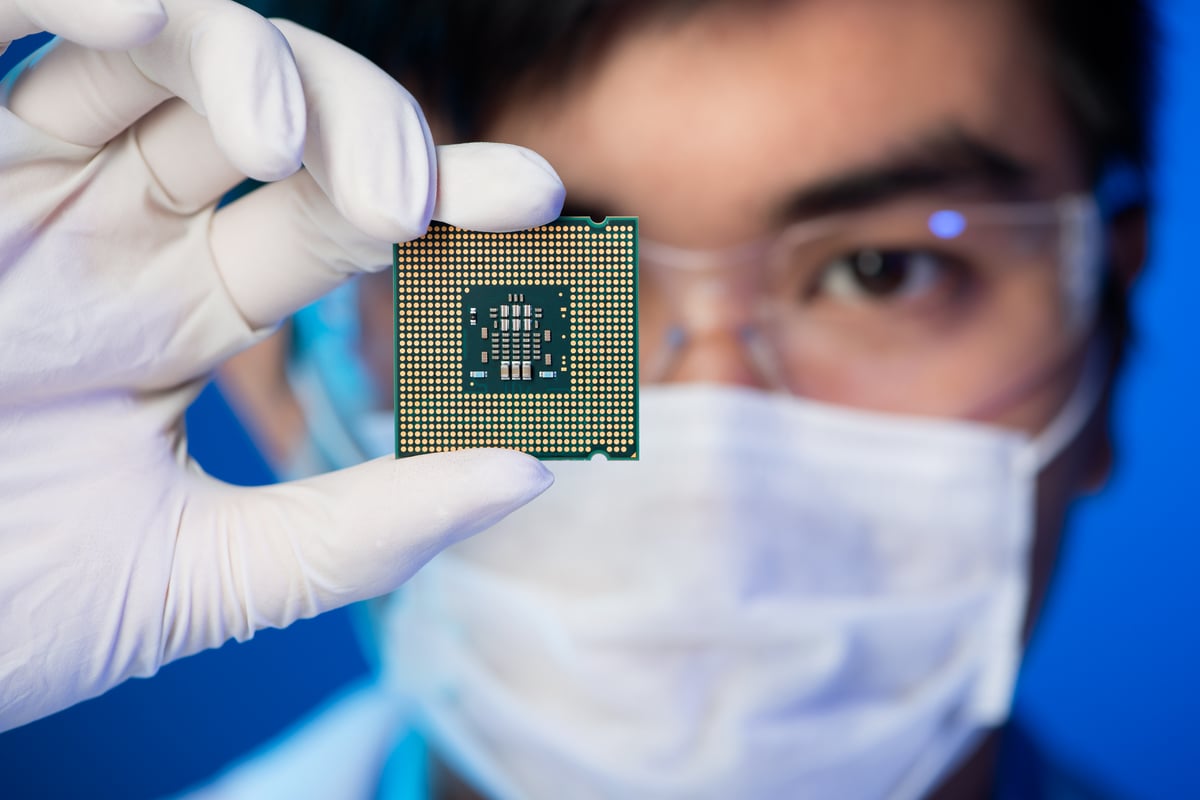
Taiwan Semiconductor (TSMC) is presented as a compelling AI-era investment with Wall Street one-year average price target of $342 (~20% upside). The company reported Q3 revenue growth of 41% in U.S. dollars, is ramping a 2-nanometer node that cuts power consumption 25–30% versus 3nm, and trades at ~28x forward earnings versus peers AMD (55x) and Nvidia (38x). With hyperscaler capex expected to surge into 2026 and multi-year data-center growth projections, the article argues TSMC's combination of technological leadership and attractive relative valuation supports further upside.
Market structure: Winners are TSM (foundry), semicap equipment names (ASML, LRCX, KLA) and hyperscaler customers (NVDA, AMZN, GOOG) that can scale AI with better cost/perf; losers include legacy-node fabs (SMIC, UMC) and commodity memory if capital shifts concentrate on AI logic chips. Advanced-node scarcity supports pricing power in 2025–26 (implied ~20–30% ASP premium for 2nm vs 3nm); by 2028 incremental supply from new fabs could compress those spreads. Cross-asset: sustained capex increases lift semicap equities and specialty commodity prices (helium/neon, high-purity copper) and raise USD demand vs TWD; heavy capex may modestly increase IG issuance and short-term tech credit spreads.
Risk assessment: Tail risks include a China/Taiwan geopolitical shock, ASML/EUV export curbs, or a TSM yield/2nm operational failure — each could cause >30–50% drawdowns. Near-term (days–weeks) volatility centers on earnings/guidance; short-term (3–12 months) on 2026 capex confirmations; long-term (3–5 years) depends on AI compute CAGR assumptions (consensus implies multi-year 30–60% DC spend growth). Hidden dependencies: extreme customer concentration (NVIDIA/AMD) and single-source tools (ASML) create single points of failure. Key catalysts: TSMC 2026 capex guide, NVDA data-center guidance, ASML shipment cadence, and Taiwan geopolitical headlines.
Trade implications: Establish a core 2–3% long position in TSM (TSM) over 4–6 weeks targeting $342 (analyst 12-month) with a tactical stop-loss at -15% or if TSM revenue guide misses consensus by >3%. Pair trade: long TSM 2% / short AMD 1% to capture valuation arbitrage (TSM ~28x fwd vs AMD ~55x) and hedge AI demand beta. Option tactics: buy 12–18 month LEAP calls ~10–15% OTM to lever upside and/or sell cash-secured puts ~15% below current to collect premium; size options so max portfolio vega is <2% equity exposure. Rotate +1% into ASML/LRCX and trim non-AI cyclicals by 1–2%.
Contrarian angles: The consensus underestimates Taiwan geopolitical and operational concentration risk — valuation gap may compress downward if a tail event occurs, so downside is underpriced. Conversely, the market may be underpricing the speed at which 2nm lowers TCO for hyperscalers, which could extend useful life of nodes and paradoxically slow replacement cycles (dampening near-term capex beyond 2027). Historical parallel: memory-cycle overinvestment led to rapid price collapse; similar overbuild in foundry capacity by late-decade is plausible if 2026 spending chases market share. Hedge with short-dated puts or reduce position if TSM underperforms NVDA/AMD by >15% in 30 days.
AI-powered research, real-time alerts, and portfolio analytics for institutional investors.
Request DemoOverall Sentiment
strongly positive
Sentiment Score
0.75
Ticker Sentiment
