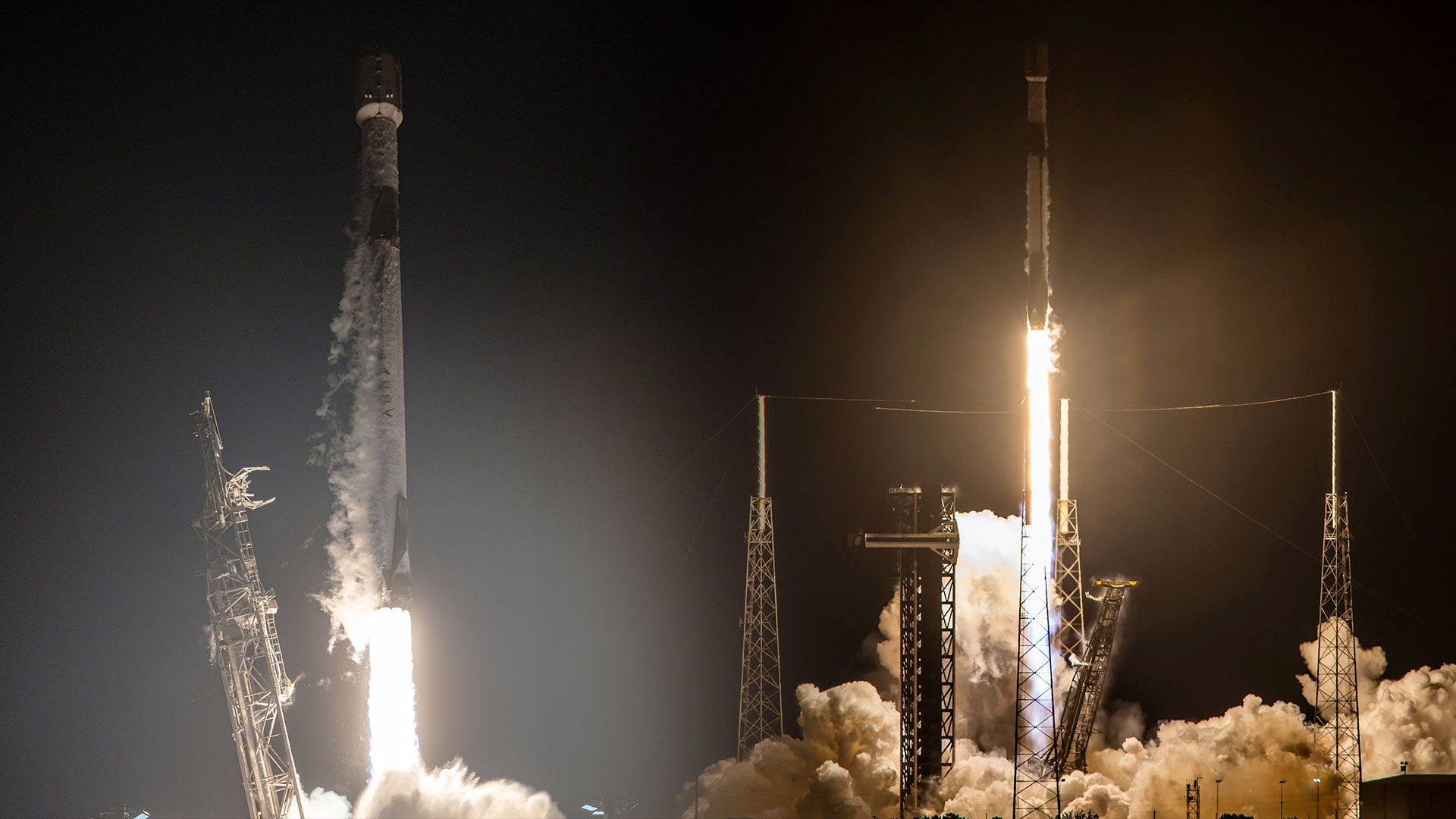
SpaceX conducted two Falcon 9 launches in two days, deploying a combined 53 Starlink satellites (24 from Vandenberg SLC-4E on Feb. 14 and 29 from Cape Canaveral SLC-40 on Feb. 16), with successful deployments confirmed about an hour after each liftoff. Both first stages landed on drone ships — Booster 1081 on its 22nd flight and Booster 1090 on its 10th reuse — bringing the Starlink network to over 9,600 active units; Monday’s mission was SpaceX’s 19th Falcon 9 flight of the year and the 602nd in company history. The flights underscore SpaceX’s high launch cadence and reusability progress and incrementally expand its broadband, cell-to-satellite and in-flight connectivity footprint.
Market structure: SpaceX’s two-launch, 53‑satellite cadence (now >9,600 active units) reinforces Starlink’s capacity lead and creates incremental downward pressure on LEO broadband pricing and ARPU. Direct beneficiaries are vertically integrated suppliers and prime contractors that win government/ground‑segment work (L3Harris, Maxar) and airlines/telcos adopting turnkey Starlink IFEC and cell‑to‑sat solutions; legacy GEO/MEO incumbents (Viasat/SES/Iridium) face 10–30% margin compression risk in contested segments over 12–24 months.
Risk assessment: Tail risks include regulatory intervention on spectrum/ops or US export controls (5–15% chance in 12–24 months), major on‑orbit collision or insurance shock (3–8% per year) and launch failure/asset loss (1–3% per flight). Immediate effects (days) are execution confirmations; short term (weeks–months) see pricing/partnership announcements re‑rate incumbents; long term (2–5 years) expect structural ARPU deflation for mass‑market broadband and consolidation among smaller operators.
Trade implications: Favor suppliers of hardware/ground systems and diversified launch plays while hedging legacy satcom operators and IFEC intermediaries. Practical tactics: long selective suppliers and small‑launch competitors (Rocket Lab RKLB) with 6–12 month horizons; trim or short Viasat (VSAT) and Gogo (GOGO) via puts sized to portfolio risk; reduce exposure to small‑cap satellite credit where covenant risk will spike if insurance/policy costs rise.
Contrarian angles: Consensus underestimates consolidation/M&A among incumbents — severe margin pressure will force strategic sales, creating acquisition upside for deep‑pocket primes (BA, LHX). Conversely, the market may be over‑discounting incumbents’ enterprise and government contracts: if a competitor seals major public‑sector deals in next 6–12 months, short positions on VSAT/GOGO could be wrong‑footed. Watch orbital debris/insurance trends as a non‑linear cost that can rapidly reprice smaller players.
AI-powered research, real-time alerts, and portfolio analytics for institutional investors.
Request DemoOverall Sentiment
mildly positive
Sentiment Score
0.35
