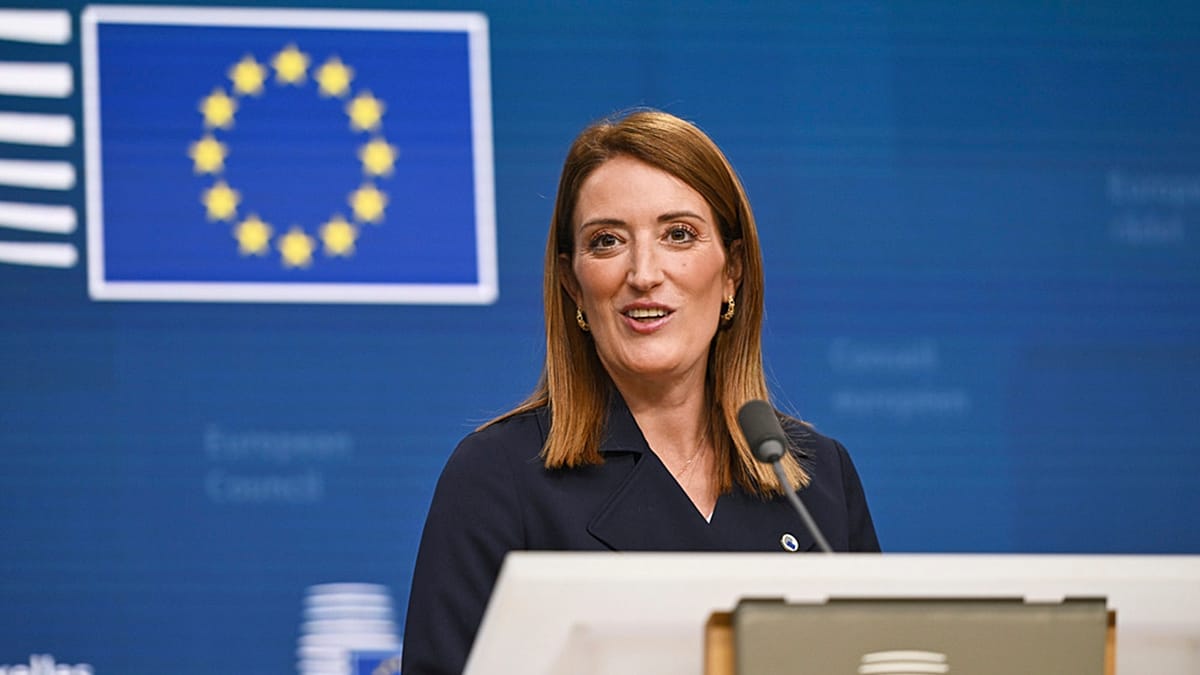
European Parliament President Roberta Metsola endorsed allowing subsets of EU member states to pursue deeper integration via enhanced cooperation and warned leaders there is a narrow window before the March European Council to deliver concrete timelines. EU leaders, including Ursula von der Leyen and Emmanuel Macron, floated a two-speed union and pushed for accelerated completion of the Capital Markets Union, Banking Union, Savings & Investments Union and Energy Union—with Macron urging joint financing by June if unanimity at 27 is not possible—measures that signal potential structural shifts in fiscal and financial integration but remain political intentions rather than immediate market-moving policy.
Market structure: Enhanced cooperation and a push for Capital Markets Union/Banking Union explicitly favor pan‑European champions in finance, autos and energy infrastructure. Expect relative winners: large cross‑border banks (BNP.PA, SAN.MC, UCG.MI), global automakers (STLA.PA, BMW.DE, VOW3.DE) and industrials/renewables suppliers (SIE.DE) that can scale capital across borders; losers are small domestic banks and niche suppliers dependent on fragmented national rules. Mechanically, a successful CMU could lower EU SME cost of equity by ~50–150bp over 12–36 months, compressing funding spreads and boosting P/E multiples in growth and midcap names.
Risk assessment: Tail risks include political backlash or constitutional/legal challenges that halt integration, causing peripheral spreads to spike >100–200bp and EUR to drop 2–4% within weeks. Immediate phase (days–weeks) will be headline‑sensitive; short term (to March) is a binary catalyst window for market repricing; long term (12–36 months) is implementation risk with ECB/fiscal policy interactions. Hidden dependencies: national elections (IT, PL, FR), ECB balance sheet stance, and trade negotiations; these can amplify or negate policy gains.
Trade implications: Tactical positions: overweight EU banks and autos into the March run‑up (size 2–4% each), hedge sovereign and idiosyncratic execution risk via IG credit protection or short CDS on weaker domestic banks (e.g., BPE.MI). Use 3–9 month call spreads on UCG.MI or BNP.PA to capture upside while capping premium; pair trade idea: long STLA.PA vs short smaller domestic supplier exposure to benefit from cross‑border scale.
Contrarian angles: Markets may price swift implementation; history (Schengen/euro) shows multi‑year rollouts — upside is likely underdone if legislation passes, downside is larger if politics stall. Unintended consequence: two‑speed integration could fragment supply chains, hurting Tier‑1 auto suppliers and increasing capex uncertainty. Favor flexible, hedged exposure and size positions to conviction (2–4%), not full thematic bets.
AI-powered research, real-time alerts, and portfolio analytics for institutional investors.
Request DemoOverall Sentiment
neutral
Sentiment Score
0.12
