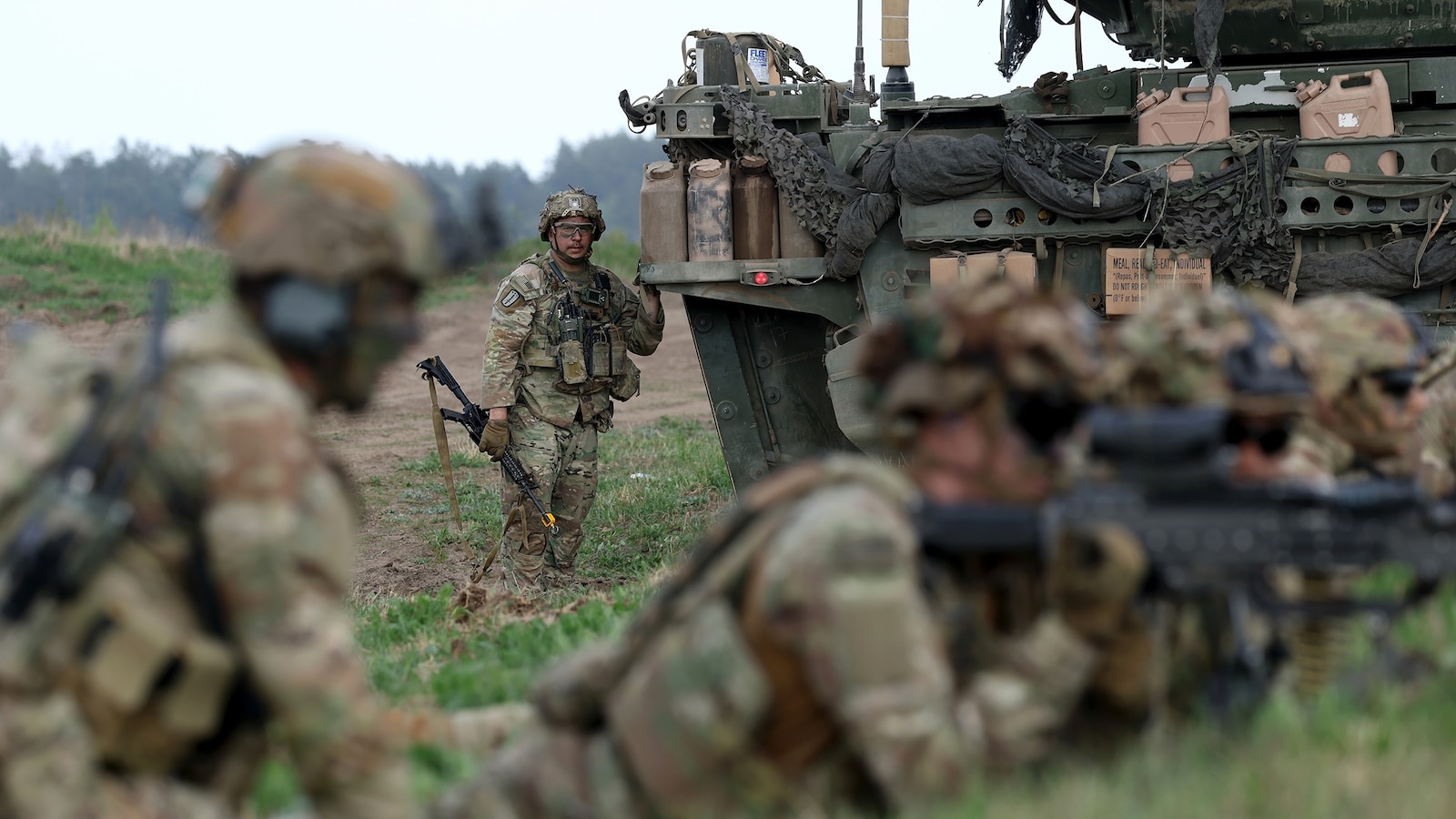
The Pentagon abruptly canceled deployment of a 4,200-troop armored brigade to Poland, cutting U.S. combat power there by nearly half. The decision comes alongside a separate planned withdrawal of roughly 5,000 troops from Germany and amid a $4-$6 billion Army shortfall, raising questions about the scale of the U.S. military drawdown in Europe. Poland currently hosts about 10,000 U.S. troops, and officials say the move surprised both Congress and defense personnel.
This is less about one brigade and more about the marginal credibility of the U.S. forward-defense guarantee in Europe. The second-order issue is that rotational armor is the cheapest visible signal of deterrence; cutting it saves cash but disproportionately weakens the political theater that reassures allies and complicates Russian planning. If this becomes a pattern, the market should expect a slow premium widening in European security-linked assets, not from immediate war risk, but from a higher probability of sustained European rearmament and procurement acceleration. The budget angle matters because the Army’s fiscal stress creates a forced-prioritization regime: training, readiness, and overseas posture are competing with modernization. That tends to advantage suppliers exposed to allied rearmament and munitions replenishment over platforms tied to U.S. rotational presence. In other words, any reduction in U.S. troop footprint can be partially offset by higher European capex on air defense, armor, artillery, ISR, and logistics, which is a multi-quarter to multi-year demand tail. The contrarian view is that the headline may be more symbolic than operational. NATO already has the marginal combat mass in theater, and the U.S. can preserve deterrence with airpower, prepositioned stocks, and rapid reinforcement at lower cost. If policymakers are trading away expensive rotations for more durable enablers, the market reaction should fade; the bigger bullish signal would be a sustained reallocation into munitions and base infrastructure rather than a one-off troop cut. Tail risk is political, not tactical: if allies interpret this as the first step in a broader retrenchment, Europe could fast-track procurement and raise defense spending targets within 1-2 budget cycles. Conversely, any escalation in the Ukraine theater or a NATO credibility scare could reverse the drawdown narrative quickly, forcing a re-risk of U.S. posture and a temporary boost in defense primes tied to Europe deployment. The most actionable window is the next 3-6 months, when budget revisions and allied procurement plans will reveal whether this is an isolated cost-cut or the start of a structurally lower U.S. footprint.
AI-powered research, real-time alerts, and portfolio analytics for institutional investors.
Request DemoOverall Sentiment
mildly negative
Sentiment Score
-0.25
