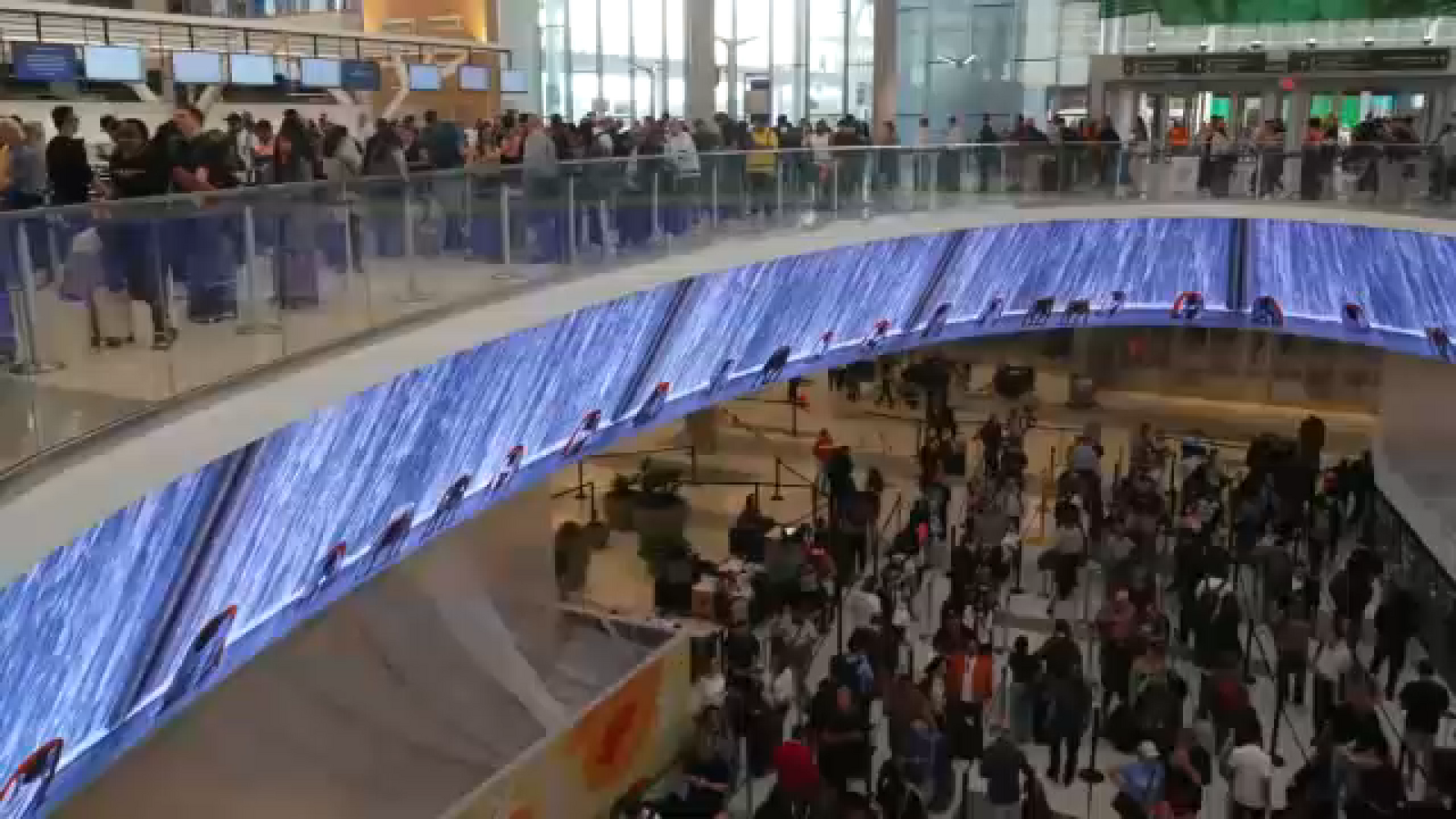
Nearly 40% of TSA officers were absent at Houston's George Bush Intercontinental Airport (vs. 11% national rate) with Hobby at 43%, producing reports of up to four-hour security waits and only ~33–50% of the usual 37 checkpoint lanes operating. Bush served 48.4 million passengers in 2024 (34.8M on United), amplifying disruption for a major United hub; reported wait times later improved to under two hours. The operational strain is directly tied to the ongoing partial federal shutdown and elevated local event/travel demand, creating short-term downside risk to airline/airport operations despite Houston reporting record hotel bookings in March.
Operational fragility at a single dominant hub creates outsized P&L sensitivity for the incumbent carrier: delays and elevated callouts translate into concentrated IRROPS costs (crew deadhead, re-accommodation, customer recovery) that can push unit costs in those origin markets up by low-single-digit percentages over a quarter, while leaving network peers relatively unscathed. Because hubs are liquidity concentrators for both passengers and crews, localized staffing shocks force cascade effects — higher cancel/rebook rates and uneven aircraft utilization — that depress on-time performance metrics for multiple reporting periods and increase near-term cash outflows for passenger recovery.
Second-order winners include competitors with diffuse networks or alternate gateway exposure who can cherry-pick premium business/leisure flows out of the stressed hub and command pricing power on diverted itineraries; outsized losers are high-fixed-cost operators with heavy hub concentration and weak balance-sheet liquidity. Crucially, demand elasticity is heterogeneous: leisure bookings show stickiness (lower short-term sensitivity) while high-frequency corporate travel is the marginal, economically sensitive segment that will re-route or defer in the first 2–8 weeks of persistent disruption.
Binary catalysts dominate timescales. A quick legislative funding fix or retroactive hazard pay would normalize callouts within days and create a sharp mean-reversion trade window; conversely, a protracted hiring freeze plus attrition embeds a multi-quarter capacity constraint that could permanently lower load factors on premium routes and force yield dilution. Monitor TSA/hiring announcements, same-day cancellation rates, and United’s unit revenue guidance for 1–12 week inflection signals that will flip the trade from tactical to structural.
AI-powered research, real-time alerts, and portfolio analytics for institutional investors.
Request DemoOverall Sentiment
mildly negative
Sentiment Score
-0.25
Ticker Sentiment
