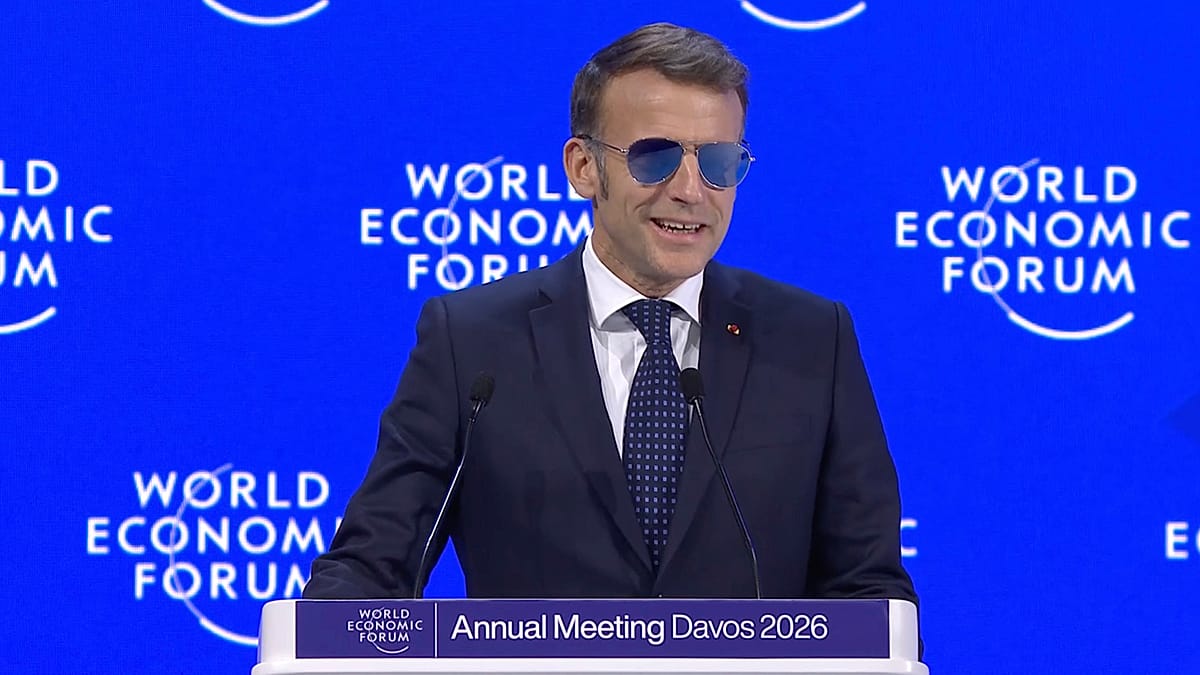
At Davos President Emmanuel Macron used his address to warn Europe to deploy tools to protect its interests amid a public diplomatic spat with U.S. President Donald Trump, who posted private messages and threatened 200% tariffs on French wine and champagne. Macron pushed European strategic autonomy, urged activation of the EU anti-coercion instrument and announced plans for €36 billion in additional military spending over 2026-2030, highlighting potential downside for French exporters and transatlantic commercial ties while creating upside for defense-related sectors.
Market structure: Immediate winners are European and US defence primes (Safran SAF.PA, Thales HO.PA, Lockheed LMT, Northrop NOC) from announced French €36bn+ defence spending and rising NATO rhetoric; losers are French luxury/wine exporters (LVMH MC.PA / LVMUY, Pernod Ricard RI.PA) facing tariff tail risk. Activation of the EU anti‑coercion instrument would reduce US tech incumbents' access to EU procurement, shifting pricing power toward EU suppliers in select enterprise/cloud niches. Cross‑asset: expect near‑term safe‑haven USD and Treasuries inflows, widening French OAT/Bund spreads, modest upside for gold and oil on geopolitical risk rerating.
Risk assessment: Tail risks include unilateral 200% tariffs on French wine or reciprocal EU sanctions, and formal activation of anti‑coercion rules that disrupt US–EU supply chains; probability medium (10–25%) over 30–90 days but high impact on specific names. Time horizons: market moves in days around Davos/Trump speech; policy moves over 1–8 weeks (EU summit/anti‑coercion), structural capex/defence wins over 2026–2030. Hidden dependencies: corporate revenue exposure >15% to US market or EU defence procurement windows; watch 10y OAT/Bund spread and export volume prints as state variables. Catalysts: EU instrument vote (7–30 days), any Trump tariff proclamation (0–7 days), NATO/Davos bilateral outcomes.
Trade implications: Constructive: establish modest long exposure to SAF.PA and HO.PA (1–2% each) and selective US defence (LMT/NOC 0.5–1% each) via equity or 6–12 month call spreads; hedge political/FX risk by buying EURUSD puts or UUP (0.5–1%). Defensive/short: small, hedgeable short or put positions on MC.PA/LVMUY and RI.PA (0.5–1% notional) sized to potential 10–25% tariff shock; buy 3‑6 month puts 10% OTM. Fixed income: go long French 10y yields (short OAT futures) if OAT/Bund > +15–20bp wider.
Contrarian angles: Consensus assumes prolonged decoupling and big luxury damage — that may be overstated: luxury revenues are resilient and tariffs could be rolled back quickly if political costs mount; therefore shorts should be small and options‑hedged. Historical parallel: 2018 US tariff skirmishes produced initial dislocations then mean reversion within 3–6 months for global luxury stocks. Unintended consequence: EU anti‑coercion activation could accelerate domestic EU tech champions and defense consolidation — overweight selective European industrials for 12–36 month thematic exposure.
AI-powered research, real-time alerts, and portfolio analytics for institutional investors.
Request DemoOverall Sentiment
moderately negative
Sentiment Score
-0.35
