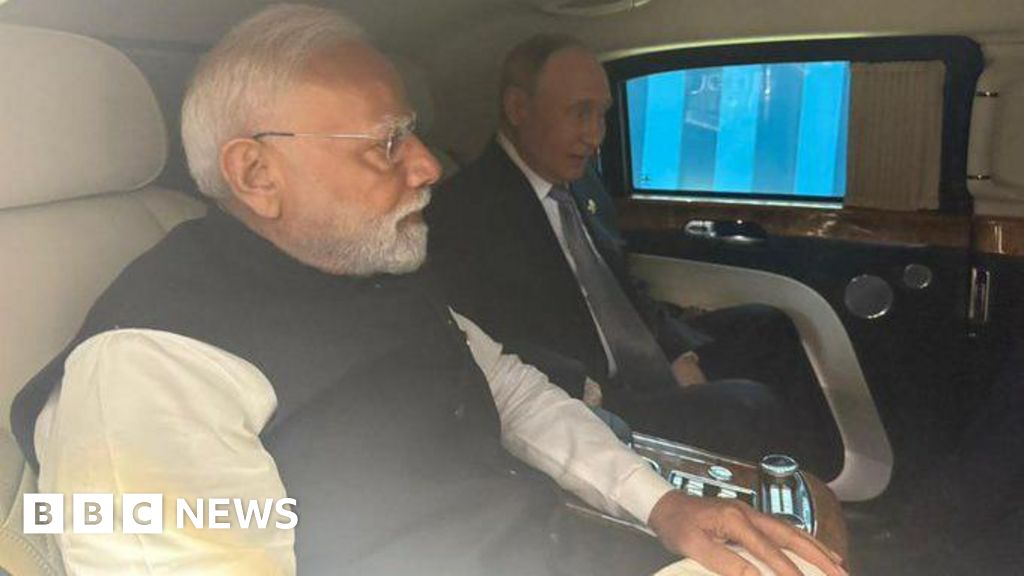
Indian Prime Minister Modi and Russian President Putin held significant talks at the SCO summit, reinforcing their close ties despite US President Trump's imposition of a 50% tariff on Indian goods, specifically targeting India's continued purchases of Russian oil and weapons. India's defiance, despite being a strategic US partner, highlights evolving geopolitical alignments that challenge US global dominance and could lead to further fragmentation in global trade and alliance structures, impacting supply chain stability and investment considerations.
A high-profile meeting between Indian Prime Minister Modi and Russian President Putin at the Shanghai Co-operation Organisation (SCO) summit signals a deliberate strengthening of ties, directly defying US geopolitical and economic pressure. The United States has imposed a punitive 50% tariff on Indian goods, including a 25% penalty for transactions with Russia, to discourage India's purchases of Russian oil and weapons, which are a key funding source for Russia's war in Ukraine. Despite this, India, a nation described as a vital US strategic partner, shows no sign of altering its procurement policy, suggesting a significant realignment of its foreign and trade policy. This development, set against the backdrop of a summit with China's Xi Jinping, is framed as a challenge to US global dominance and is actively disrupting established trade flows, as evidenced by the US losing its position as India's largest trading partner. The situation creates considerable uncertainty, reflecting a fragmentation of global alliances and a bifurcation of supply chains, with the SCO bloc consolidating as an alternative to the US-led economic order.
AI-powered research, real-time alerts, and portfolio analytics for institutional investors.
Overall Sentiment
moderately negative
Sentiment Score
-0.50
