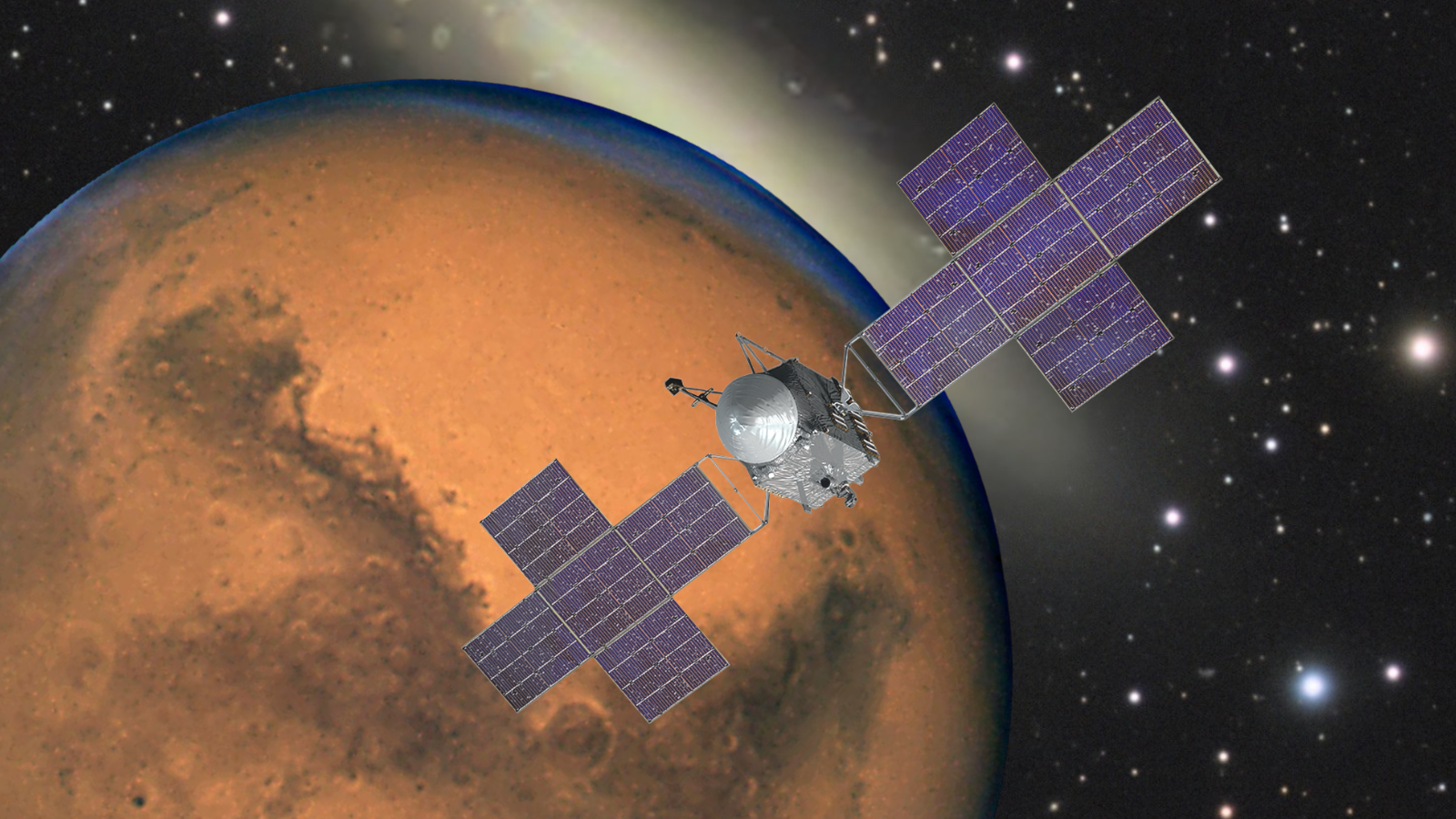
NASA’s Psyche spacecraft will pass within about 2,800 miles of Mars on May 15 to use the planet’s gravity for a trajectory boost toward the 16 Psyche asteroid. The flyby will also support instrument calibration and testing, including thousands of Mars observations with the multispectral imager. The mission remains on track to reach Psyche in 2029.
This is a low-direct-economic-impact event, but it is a useful read-through on NASA program execution risk and the broader cadence of deep-space hardware validation. The important second-order signal is that the mission is still cleanly on trajectory two years after launch, which modestly reduces near-term headline risk around deep-space science budgets and contractor execution, even though the market impact is mostly reputational rather than financial. The real commercial angle is not the flyby itself but the calibration step: if the imaging and science payloads perform well under an in-flight stress test, it de-risks later mission milestones and strengthens the case for continued funding of planetary science and autonomous navigation systems. That tends to support the premium multiple assigned to prime contractors with exposure to high-reliability deep-space avionics, guidance/navigation/control, radiation-hardened compute, and optical sensing — areas where a successful validation can translate into follow-on awards across civil space and defense. A second-order theme is competitive positioning among space primes and specialized subs. NASA’s willingness to use flybys as instrument checkouts favors firms that can demonstrate software-defined payload flexibility, not just launch capability. Over a multi-quarter horizon, that can incrementally shift procurement preference toward vendors with reusable flight heritage and lower anomaly rates, while penalizing laggards whose systems require more ground intervention. The contrarian view is that this is too early to monetize as a catalyst: investors often extrapolate one clean mission milestone into broader space spending upside, but actual budget allocation is constrained by appropriations and launch cadence. The better trade is to treat this as a sentiment-supportive datapoint, not a standalone thesis driver, and only lean in if it coincides with another procurement or launch-order inflection.
AI-powered research, real-time alerts, and portfolio analytics for institutional investors.
Request DemoOverall Sentiment
neutral
Sentiment Score
0.05
