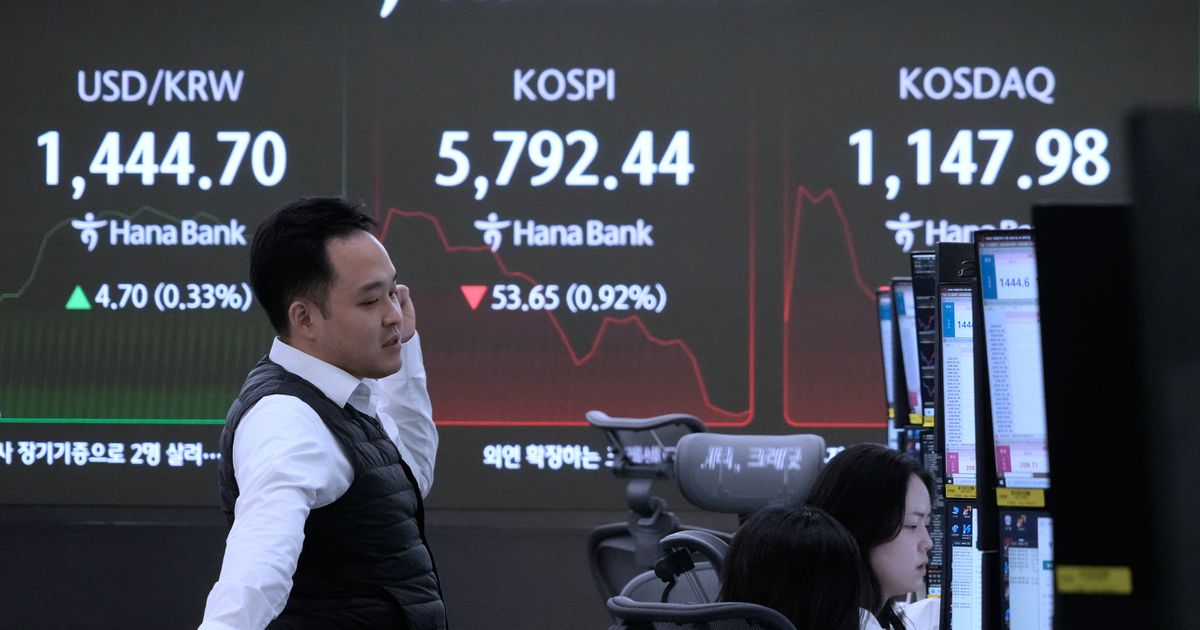
Global equity markets were mixed as AI-driven sector rotation and renewed tariff risk pressured U.S. stocks: the S&P 500 fell 1% to 6,837.75, the Dow dropped 1.7% to 48,804.06 and the Nasdaq sank 1.1% to 22,627.27 after President Trump announced temporary 15% tariffs and a Citrini Research report flagged AI-driven disruption to the consumer economy. Big declines hit software and cybersecurity names—CrowdStrike down 9.8% (YTD -25.3%), AppLovin down 9.1% (YTD -43.5%)—while chip and AI-adjacent names rallied ahead of Nvidia’s profit report; regional moves included Nikkei +0.9% to 57,321.09 and Hong Kong’s Hang Seng -1.8% to 26,590.32. Commodity and FX moves were modestly market-relevant: WTI $66.62/bbl, Brent $71.41/bbl, USD/JPY ~155.86 and bitcoin fell 4.3% to $63,180, all underscoring a risk-off repositioning among investors.
Market structure is bifurcating: AI infrastructure (NVDA, Samsung, ASML, Advantest, Disco) gains pricing power from concentrated GPU/wafer-equipment supply and outsized capex by hyperscalers, while incumbents whose value is “human-centric” or labor-intensive (CRWD, APP, select consumer services) face demand compression. Expect margin expansion for chipmakers (mid-single to high-single percentage points over 12–18 months) and revenue risk for vulnerable software vendors whose TAM can be structurally redefined by automation.
Tail risks center on policy and sequencing: an aggressive tariff regime (temporary 15% tariffs) or regulatory clampdown on AI could halve expected incremental profits for winners within 12–24 months; operational risk from rapid AI adoption could cause 20–40% revenue disruption for exposed SaaS firms in 6–18 months. Near-term catalysts (NVDA earnings Wednesday, Anthropic product rollouts, State of the Union) will drive volatility; monitor court/tariff timelines over the next 30–90 days.
Trades: bias long concentrated semiconductor exposure and short selected cybersecurity/app names. Tactical: establish a 2–3% long NVDA ahead of earnings with a protective 1–2% hedged put or a call-spread to cap cost; initiate 1–2% short positions in CRWD and APP as 4–8 week momentum trades targeting 15–30% mean reversion if negative headlines persist. Use options (NVDA 1–2 week straddle if IV<+40% vs historical; otherwise buy 3–6 month call spreads) and rotate 3–5% from software into SMH/ASML over next 30 days.
Contrarian view: the market may over-penalize cybersecurity vendors — many can embed AI and reprice as managed services, capping downside beyond a 30–40% drawdown. Conversely, semis concentration is a fragility: if tariffs raise hardware costs >5% or NVDA supply normalizes and IV collapses >30% post-earnings, downside for NVDA could be swift. Watch NVDA guidance vs capex cadence from GOOGL/AMZN over next 2 quarters as the real arbiter of durable market share shifts.
AI-powered research, real-time alerts, and portfolio analytics for institutional investors.
Request DemoOverall Sentiment
moderately negative
Sentiment Score
-0.45
Ticker Sentiment
