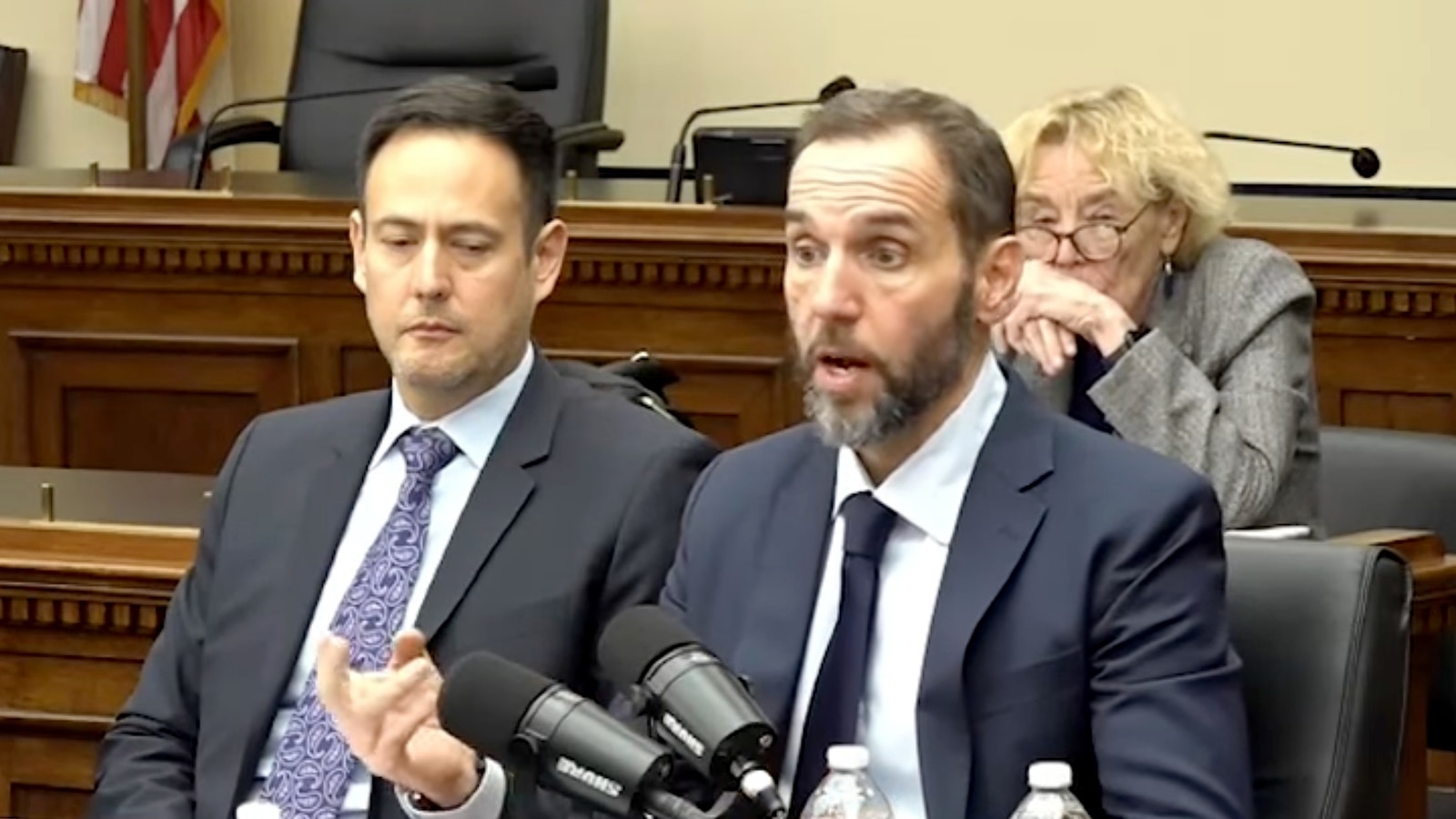
Former special counsel Jack Smith told the House Judiciary Committee he had proof beyond a reasonable doubt to charge Donald Trump in both the 2020 election-interference and classified-documents matters and repeatedly denied any political influence in those charging decisions. DOJ restrictions limited his testimony on the classified-documents case, he said prosecutions were dropped after Trump’s reelection due to constitutional limits on charging a sitting president, and he warned he expects potential political retribution, reinforcing ongoing legal and political risk but with limited immediate market implications.
Market structure: The deposition increases political/legal risk priced into US assets but is not a catalyst for sector-specific structural change. Short-term winners: defense contractors (LMT, NOC, RTX) and cash/Treasuries as investors seek safety; losers: small-cap and domestic-consumer cyclicals sensitive to policy uncertainty. Cross-asset: expect spiky equity implied volatility (+5–15 vol points intra-week), modest downward pressure on 2–5y yields (flight-to-safety) and a bid for USD in acute risk-off episodes.
Risk assessment: Tail risks include a sustained erosion of rule-of-law that reduces US risk premium (large negative shock), or retaliatory political actions that trigger regulatory/clampdown risk on specific sectors; probability low but impact high. Immediate (days): headline-driven vol; short-term (weeks–months): polling/legal developments repricing election odds; long-term (quarters+): policy/regulatory regime change if election outcome shifts, affecting taxes, trade and defense budgets. Hidden dependency: markets care more about perceived predictability of governance than any single deposition.
Trade implications: Favor tactical long-vol protection and quality/defense longs while trimming small-cap cyclicals. Use options to cost-effectively hedge tail risk (3-month 20-delta SPX puts or VIX call spreads) and overweight large-cap defensives. Pair trades: short IWM vs long SPY to capture small-cap underperformance in risk-off windows; rotate into XLF if evidence of deregulatory policy emerges post-election.
Contrarian angles: Consensus underestimates persistence of elevated political premium; current market complacency (low Market Impact Score) suggests hedges are cheap relative to realized-event risk. Reaction may be underdone—buying 3–6 month protection is cheap insurance. Historical parallels (Watergate-era policy uncertainty) show multi-quarter volatility persistence, not one-week blips, so size hedges accordingly.
AI-powered research, real-time alerts, and portfolio analytics for institutional investors.
Request DemoOverall Sentiment
neutral
Sentiment Score
-0.10
