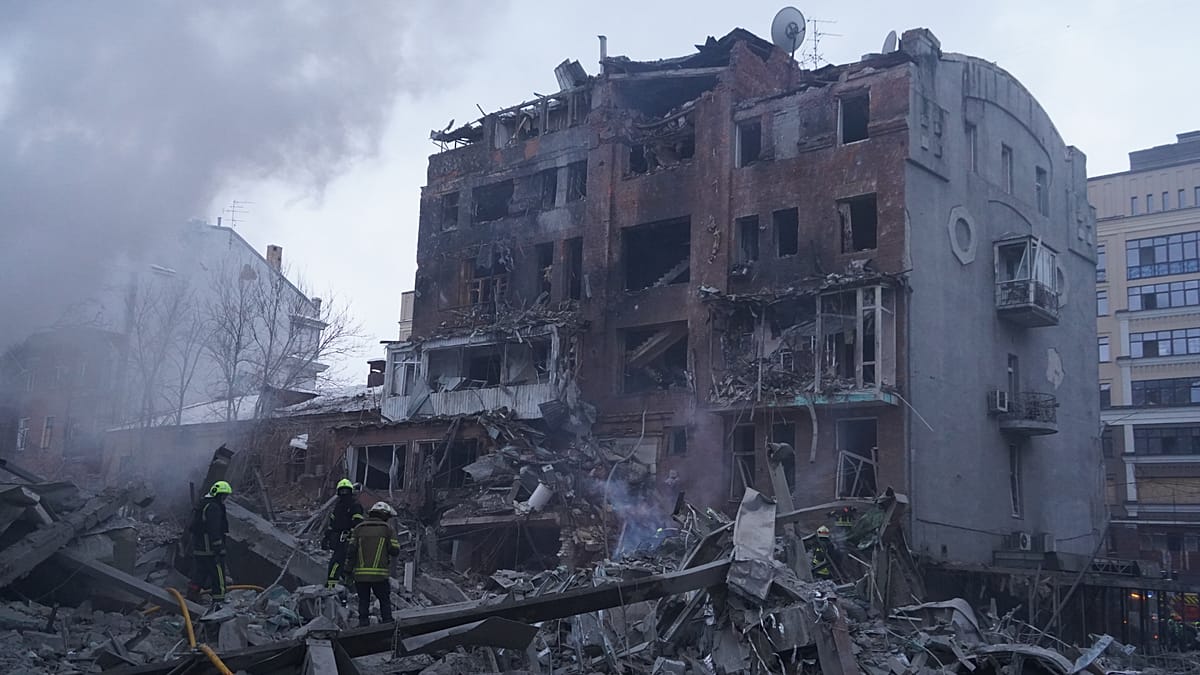
A Russian strike destroyed a five-story apartment building in Kharkiv, killing at least two people (including a recovered three-year-old) and injuring 19 others — 16 of whom were hospitalized — while also damaging a shopping centre and cars; authorities warned more victims may remain under rubble. Kharkiv governor Oleh Syniehubov and President Zelenskyy condemned the attack, while Russia’s Defence Ministry denied responsibility and blamed a local ammunition explosion; separately, local officials reported a large drone attack on Zaporizhzhia that damaged residential buildings with no casualties. The incidents reinforce ongoing geopolitical risk in Ukraine, supporting a cautious, risk-off stance for investors due to potential escalation and further economic and infrastructure disruption in the region.
Market structure: Escalation in Kharkiv increases near-term demand for defense equipment, energy security and agricultural risk premia. Winners: US/EU defense primes and defense ETFs (pricing power for FY+1 budgets), oil/gas and grain exporters; losers: Ukrainian real estate, regional insurers/banks, European leisure & travel. Cross-asset flows: expect immediate bid for USD, JPY and gold, with downward pressure on European equities and sovereign spreads for vulnerable EM/CEE issuers.
Risk assessment: Tail risks include a broader supply-chain shock (grain blockade, gas transit cuts) or NATO entanglement — low probability but high impact (oil +15-30%, TTF spikes +50% possible winter scenario). Immediate (days): volatility spike in commodities and FX; short-term (weeks–months): defense order revisions and sanctions; long-term (quarters–years): sustained higher European defense budgets and reconstruction capex. Hidden dependencies: winter gas storage levels, Black Sea shipping corridors, and Chinese diplomatic positioning can flip outcomes quickly.
Trade implications: Tactical trades should capture commodity and defense repricing while hedging geopolitical gamma. Use size-limited, time-boxed positions (options for convexity) and tilt away from European cyclicals. Catalysts to watch: US/NATO aid votes (next 30–90 days), EU sanctions packages, and monthly NATO/energy storage data.
Contrarian angles: Consensus bids defense and oil immediately; risk is front-loaded pricing where multiples already reflect near-term aid — look for overstretch in large-cap defense after >15% run-up. Reconstruction winners (European infrastructure/materials) are underowned and may compound over 12–36 months; buying into drawdowns post-major sanctions announcements can capture multi-year alpha.
AI-powered research, real-time alerts, and portfolio analytics for institutional investors.
Request DemoOverall Sentiment
strongly negative
Sentiment Score
-0.70
