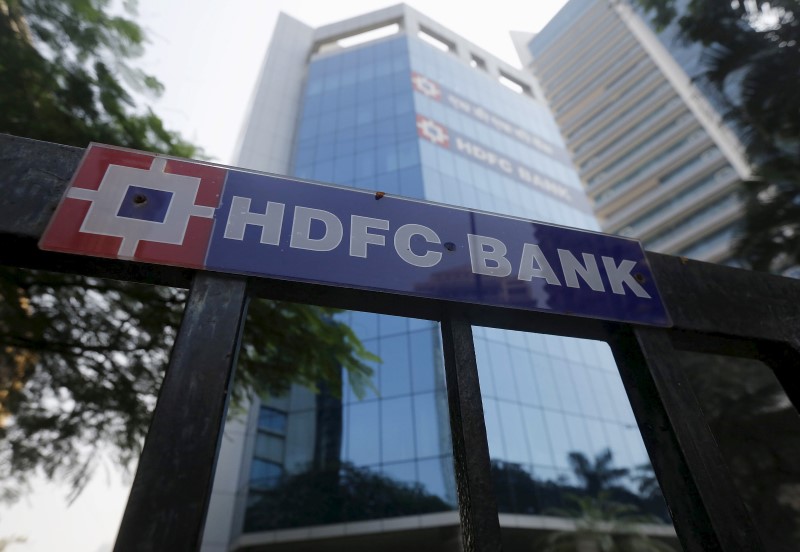
JPMorgan upgraded HDFC Bank to Overweight and lowered its price target to INR1,010 from INR1,090, citing expected credit recovery and ROA inflection despite NIM pressure and a lower subsidiary valuation (Rs94 vs Rs129). The stock trades at $24.35, down 33% YTD and near a 52-week low of $24.30, with a 12-month forward P/B of 1.5x (a 16-year low) and a 17% discount to ICICI on forward P/B. JPM cut FY26 and FY28 EPS estimates by -0.2% and -1.7% (remaining ~2-3% below Bloomberg consensus); Q3 2025 EPS of $0.4004 met expectations while revenue missed $5.05B vs $5.10B consensus. Investors should weigh the upgrade and apparent valuation upside against ongoing NIM competition and recent share-price weakness.
The current price action in the India private-bank complex looks driven more by sentiment and technical derating than by a fundamental, irreversible deterioration in deposit franchises. Idiosyncratic valuation gaps across large private banks create a plausible path to mean reversion over 6–12 months driven by normalization in credit growth and a re-pricing of subsidiary stakes, but the path will be bumpy and conditioned on systemic funding dynamics.
A key second-order channel is deposit competition: if liability acquisition stays elevated, margin recovery will be delayed and compress ROA across smaller lenders and NBFC counterparties that rely on bank bid for cheap funding. Conversely, banks with scalable low-cost deposit engines or superior digital acquisition should gain market share and see a multi-quarter NIM inflection earlier — this dynamic will amplify relative performance dispersion within the sector.
Tail risks are concentrated and time-sensitive. In the short run (days–weeks) technical oversold conditions can trigger violent squeezes; in the medium term (3–9 months) a weaker-than-expected credit impulse or renewed asset-quality shock could re-rate the whole cohort lower; structurally (2+ years) the upside depends on sustained improvements in deposit mix and a recovery in corporate and retail credit growth rather than one-off accounting/valuation adjustments.
AI-powered research, real-time alerts, and portfolio analytics for institutional investors.
Overall Sentiment
mildly positive
Sentiment Score
0.12
Ticker Sentiment
