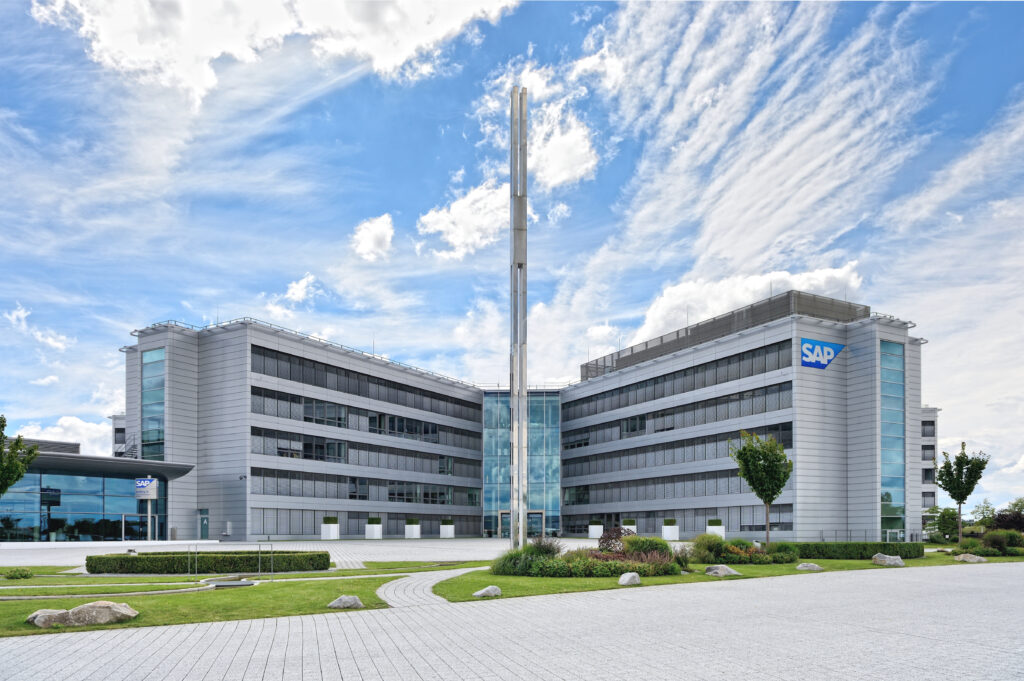
SAP reported a strong Q1 2026 update, with current cloud backlog of €21.9 billion up 20% and cloud revenue rising 19% reported, or 27% at constant currencies. Cloud ERP Suite revenue increased 23% and total revenue grew 6%, while IFRS and non-IFRS operating profit both rose 17%. Management highlighted momentum in Business AI and disciplined cost control, supporting a positive but not transformative earnings readout.
The key signal is not the headline growth rate, but the quality of the backlog conversion: SAP is showing that enterprise buyers are still willing to commit to multi-year platform migrations even in a cautious macro. That usually favors the software vendor with the deepest installed base, because once finance/procurement/HR stacks are embedded, switching costs rise and renewal risk falls—so this is more durable than a cyclical software rebound.
Second-order winner is the broader enterprise AI ecosystem, but only selectively. SAP’s AI messaging matters because it can turn a platform sale into a higher-ARPU expansion cycle, pressuring adjacent suite vendors and point-solution software firms whose value proposition is now being bundled into the core ERP workflow. The risk is that this is still largely an execution story: if AI monetization stays more narrative than dollarized over the next 2-3 quarters, investors may eventually re-rate the stock back to “high-quality cloud compounder” rather than “AI winner.”
The most important near-term catalyst is not the quarter itself but the upcoming investor event cycle, where management will need to prove that current demand is broadening beyond migration work into net-new workload expansion. If the market sees backlog growth decelerating before year-end, the stock can de-rate quickly because the multiple already assumes sustained premium growth and margin resilience. Conversely, any sign of accelerating cloud ERP attach or AI-driven upsell could keep sentiment supported for months.
Consensus may be underestimating how much of SAP’s strength is defensive share gain rather than purely market expansion. In a slower IT spend environment, large incumbents with migration complexity often take share from smaller vendors first, then from hyperscaler-adjacent application layers; that makes SAP a relative winner even if enterprise budgets stay tight. The trade is therefore less about absolute growth and more about relative resilience versus weaker application software names with thinner moats and lower switching costs.
AI-powered research, real-time alerts, and portfolio analytics for institutional investors.
Request TrialOverall Sentiment
moderately positive
Sentiment Score
0.62
Ticker Sentiment
