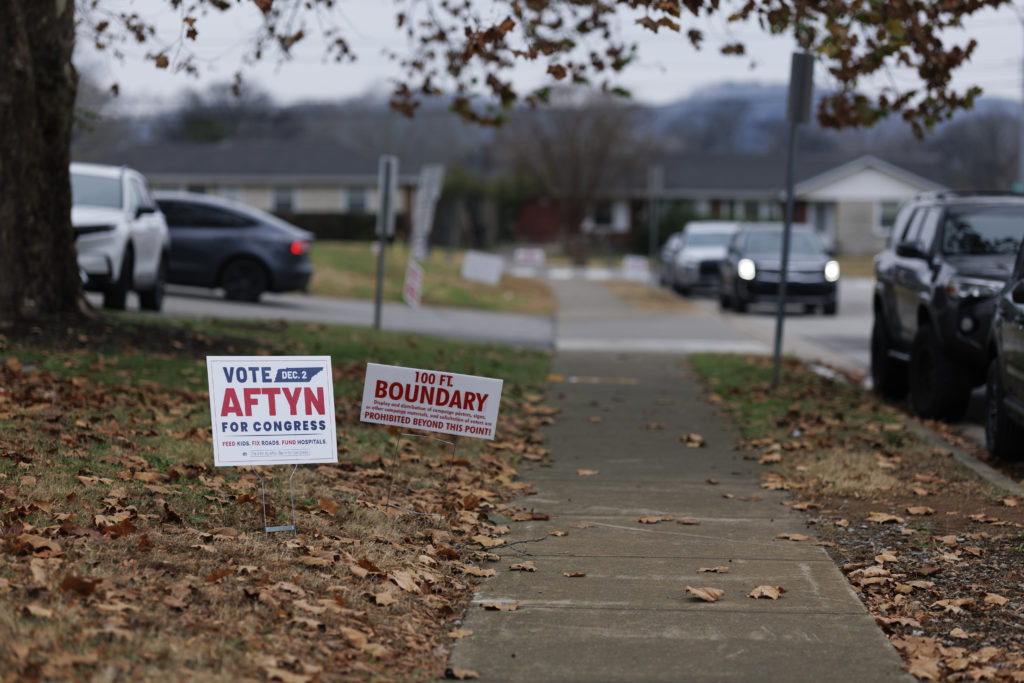
The Tennessee 7th District special election, prompted by Rep. Mark Green’s resignation, has drawn heavy national attention and spending as a test of former President Trump’s influence: MAGA Inc. has spent more than $1 million for Republican Matt Van Epps while House Majority PAC has committed $1 million to Democrat Aftyn Behn, and Democratic-linked Your Community PAC has run national mail efforts after spending over $16 million supporting Democrats elsewhere. The district is solidly conservative—Green and Trump previously won it by roughly 20-point margins—so turnout (complicated by early voting during Thanksgiving) and campaign messaging on issues such as tariffs, tax cuts and DOJ document disclosures are the principal variables to monitor for signals about broader partisan momentum ahead of next year’s midterms.
Market structure: This Tennessee special election is primarily a political-signal event with localized fiscal/regulatory implications rather than a direct macro shock; a decisive Republican win (>8-point margin) would modestly increase odds of pro-growth policy narratives and favor cyclical, small-cap and regional-bank exposure (XLF, KRE, IWM, XLE) over 1–3 trading days with typical moves ~1–3%. A narrow Democratic strong showing (<5-point margin) or surprise flip would increase perceived probability of broader Democratic momentum into mid‑2026, pressuring rate‑sensitive and pro‑growth cyclicals while boosting defensives and long-duration tech sector hedges for several weeks.
Risk assessment: Tail risk: a surprise Democrat victory or razor-margin result triggering contested narratives could spark a risk‑off knee‑jerk (S&P down 1.5–3%, VIX +15–35%) within 24–72 hours; medium‑term (3–6 months) larger policy shifts remain low probability from a single seat. Hidden dependency: headline-driven flows (PAC spending, ad buys) can transiently distort regional media and local ad markets; catalysts include midterm polling shifts, fundraising flows from MAGA Inc or House Majority PAC, and early‑vote turnout data within 48 hours.
Trade implications: Implement conditional, short-horizon trades: (1) if Van Epps wins by >8 pts, establish a 1.5–2% long in XLF and 1% long in KRE within 48 hours, target +6–12% upside over 1–3 months, stop loss -6%; (2) if margin <5 pts or Democrats overperform, buy a 30‑day IWM 2% OTM put spread sized 1% of portfolio to hedge downside risk; (3) if intraday VIX spikes >20% and SPY drops >1.5%, sell SPY 0.5% OTM put spreads (collect premium) to fade overreaction.
Contrarian angles: Consensus may overstate national policy impact from a single district — history shows special elections often revert; therefore be prepared to fade headline moves if flows concentrate in thin local markets (expect mean reversion within 3–10 trading days). Watch MAGA Inc and House Majority PAC spend rates as a signal — continued heavy spending beyond this race would be a bigger predictor of sustained volatility than the outcome itself.
AI-powered research, real-time alerts, and portfolio analytics for institutional investors.
Request DemoOverall Sentiment
neutral
Sentiment Score
0.00
