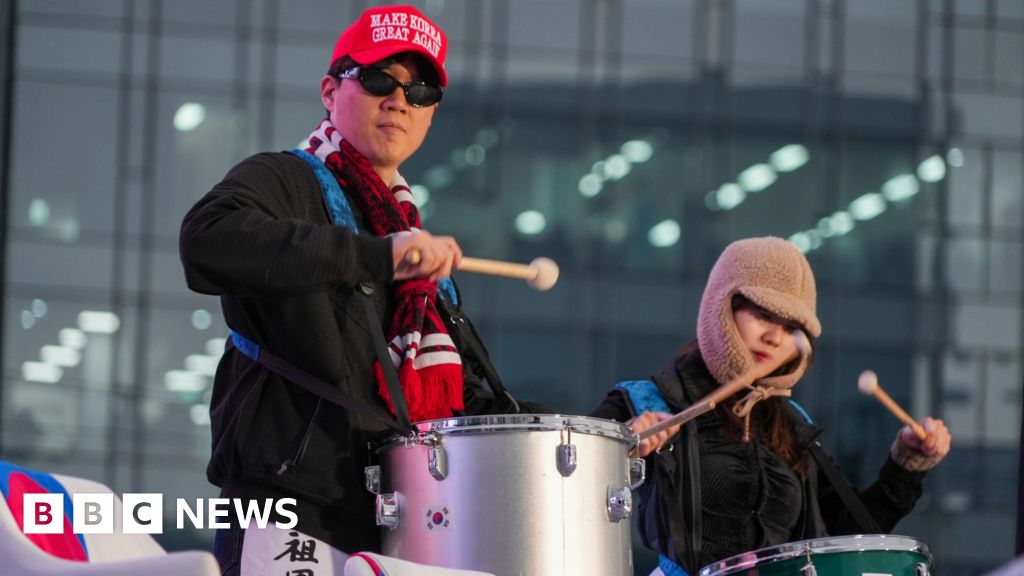
A rapidly growing right‑wing youth movement called Freedom University is mobilizing thousands in support of imprisoned former President Yoon after his failed December martial‑law bid, tapping into youth economic grievances and anti‑China sentiment. The movement, led by 24‑year‑old Park Joon‑young, leverages social media and viral rallies with nationalist slogans while national polling shows only ~27% of the public agree with its views; macro indicators cited include GDP growth of roughly 1–2% since the pandemic, median monthly income near $1,600, very low home‑ownership among young people, and nearly 75% of youth viewing the economy poorly. Political polarisation and proposed criminalisation of disinformation raise policy and stability risks that could weigh on investor sentiment toward Korea and its China‑linked exposures.
Market structure: The immediate winners are national-security/defense suppliers and exporters less reliant on Chinese tourist demand; losers are duty‑free, hotels, mall operators and any consumer discretionary name with >20% revenue from Chinese tourists (expect localized revenue declines of 10–30% if anti‑China actions persist). Political polarisation raises policymaker risk around housing and labor policy which can compress margins for domestic banks and construction names over 6–24 months. Currency sensitivity: a sustained increase in political risk should push USD/KRW +3–8% and widen Korean sovereign CDS by 20–60bp in stressed scenarios.
Risk assessment: Tail risks include a renewed constitutional crisis or heavy-handed crackdowns that trigger capital flight (low probability <10% in next 12 months but high impact: KRW -8% and KOSPI -12% in weeks). Near term (days–weeks) expect headline-driven volatility; medium term (3–12 months) the key risks are policy shifts on housing/immigration and regulatory action against disinformation platforms. Hidden dependencies include export exposure to China for semiconductors and supply‑chain decoupling — a hawkish government could accelerate selective decoupling benefiting domestic semiconductor capex but hurting China‑facing consumer chains.
Trade implications: Tactical hedges and relative value trades preferred to directional bets on Korea. Implement 60–90 day put protection on EWY sized to 2–3% portfolio risk, underweight Korea consumer/tourism names by 20–30% over 30 days, and selectively long Korean defense contractors and high‑quality exporters on 6–12 month view. Use USD/KRW forwards or 3‑month calls to hedge currency exposure; trim local bank exposure if housing policy rhetoric intensifies.
Contrarian angles: Markets may be overpricing systemic collapse — youth movements are fast to mobilize but historically weak at sustaining national policy control (support ~27%). If KRW weakens >5% or KOSPI corrects >8%, selectively buy blue‑chip exporters (Samsung ADR SSNLF, SK Hynix) as valuation dislocations present 12‑month IRR >15% if geopolitics normalise. Monitor legislation windows (next 3 months) as the primary catalyst that will separate noise from durable policy change.
AI-powered research, real-time alerts, and portfolio analytics for institutional investors.
Request DemoOverall Sentiment
moderately negative
Sentiment Score
-0.40
