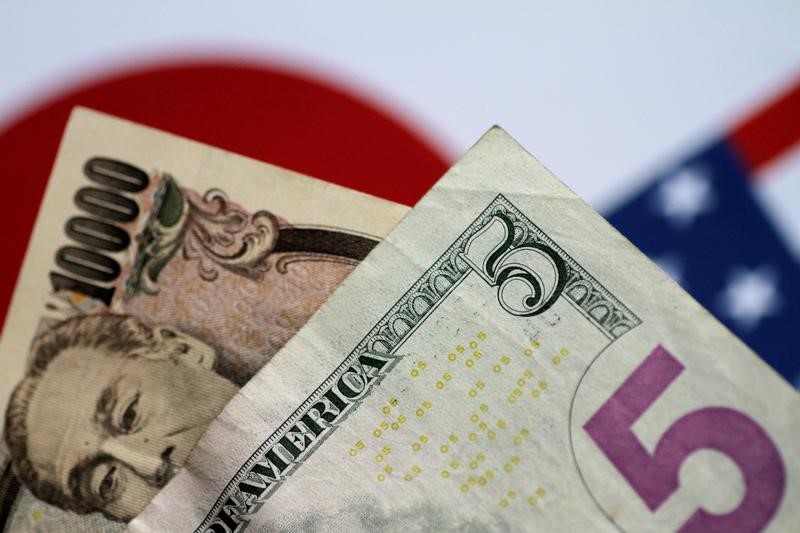
Asian currencies saw marginal gains Friday as risk appetite improved following White House statements indicating a two-week delay in President Trump's decision regarding intervention in the Iran-Israel conflict, causing the dollar to retreat slightly. The Japanese yen strengthened following higher-than-expected CPI data and hawkish signals from the Bank of Japan, while the Chinese yuan remained relatively stable after the PBOC held its loan prime rate steady. Despite Friday's dip, the dollar is still up 0.4% for the week, supported by hawkish signals from the Federal Reserve, which trimmed its outlook for rate cuts in 2026 and warned of potential inflationary pressures from trade tariffs.
Asian currencies broadly firmed on Friday, reflecting a marginal improvement in risk appetite after White House communication indicated President Trump's decision on potential military involvement in the Iran-Israel conflict would be delayed by two weeks. This development led to a retreat in the U.S. dollar, which saw its index and futures fall by 0.2%, though it remained poised for a 0.4% weekly gain due to earlier hawkish signals from the Federal Reserve. The Japanese yen (USDJPY down 0.2%) notably strengthened, supported by hotter-than-expected May national core CPI data reaching a near 2-½ year high and hawkish minutes from the Bank of Japan indicating support for its rate hike path, although the BOJ remains cautious about U.S. trade tariffs. Other Asian currencies also gained against the dollar: the Chinese yuan saw the USDCNY pair fall 0.1% despite the People’s Bank of China leaving its benchmark loan prime rate unchanged; the Australian dollar's AUDUSD pair rose 0.3%; the South Korean won's USDKRW pair slid 0.7%; the Indian rupee's USDINR pair fell 0.3%; and the Singapore dollar's USDSGD pair fell 0.2%. The Federal Reserve, at its latest meeting, maintained current interest rates but projected fewer rate cuts in 2026 than previously anticipated, with Chair Jerome Powell remaining non-committal on near-term cuts and warning that potential trade tariffs could exacerbate inflation, further constraining monetary easing.
AI-powered research, real-time alerts, and portfolio analytics for institutional investors.
Overall Sentiment
mildly positive
Sentiment Score
0.40
Ticker Sentiment
