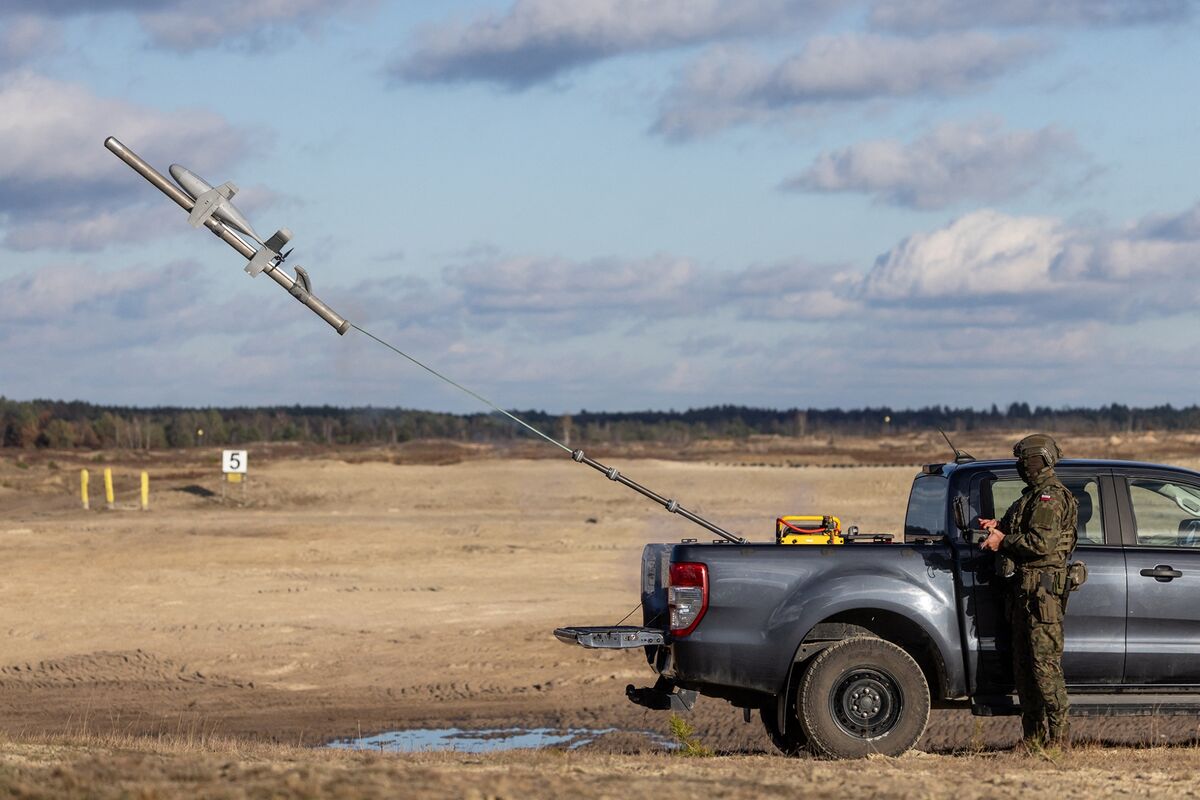
Romania’s defense minister Ionut Mosteanu said the US-supplied Merops anti-drone system is nearly ready for deployment to help deter a rising number of Russian airspace incursions along NATO’s eastern flank. US General Christopher Donahue echoed that the system is close to operational status; the development strengthens Romania’s immediate deterrent posture but carries limited direct market implications aside from potential relevance to regional defense contractors and geopolitical risk assessments.
Market Structure: Short-term market impact is localized—beneficiaries are defense primes and niche EW/ISR suppliers that supply counter-UAV kits, and losers are marginal commercial drone OEMs used in offensive roles or firms exposed to Russian markets. Expect upward pressure on order books for L3Harris (LHX), Northrop (NOC), Lockheed (LMT) and Elbit (ESLT) over 6–24 months as NATO members accelerate procurements; pricing power rises where proprietary sensors/EW software exist, commoditized components see margin pressure.
Risk Assessment: Tail risks include rapid escalation (weeks) causing a commodity shock (oil +20% in 1–3 months) or an arms-contract reversal if budgets stall (months), and supply-chain constraints for rad-hard semiconductors (quarters). Hidden dependencies: procurement is political—contracts often awarded after framework agreements; a deployable system today does not equal sustained revenue until RFPs and follow-ons clear (3–18 months).
Trade Implications: Tactical trades favor aerospace & defense equity exposure and asymmetric hedges: buy selective names/ETFs with 6–12 month horizons, hedge with short-dated oil calls and sovereign-risk protection. Options can be used to express upside with defined risk (call spreads on LHX/LMT) and to buy tail risk protection for commodity spikes; expect volatility to rise only if incidents escalate.
Contrarian Angle: Market likely underprices multi-year modernization demand—one-country deployments tend to seed multi-state framework buys over 12–36 months, so near-term headlines understate durable revenue upside. Conversely, initial hype may be overdone for small-cap drone suppliers; avoid assuming immediate multi-billion-dollar contract flow without RFP milestones or budget line-item confirmation.
AI-powered research, real-time alerts, and portfolio analytics for institutional investors.
Request DemoOverall Sentiment
neutral
Sentiment Score
0.10
