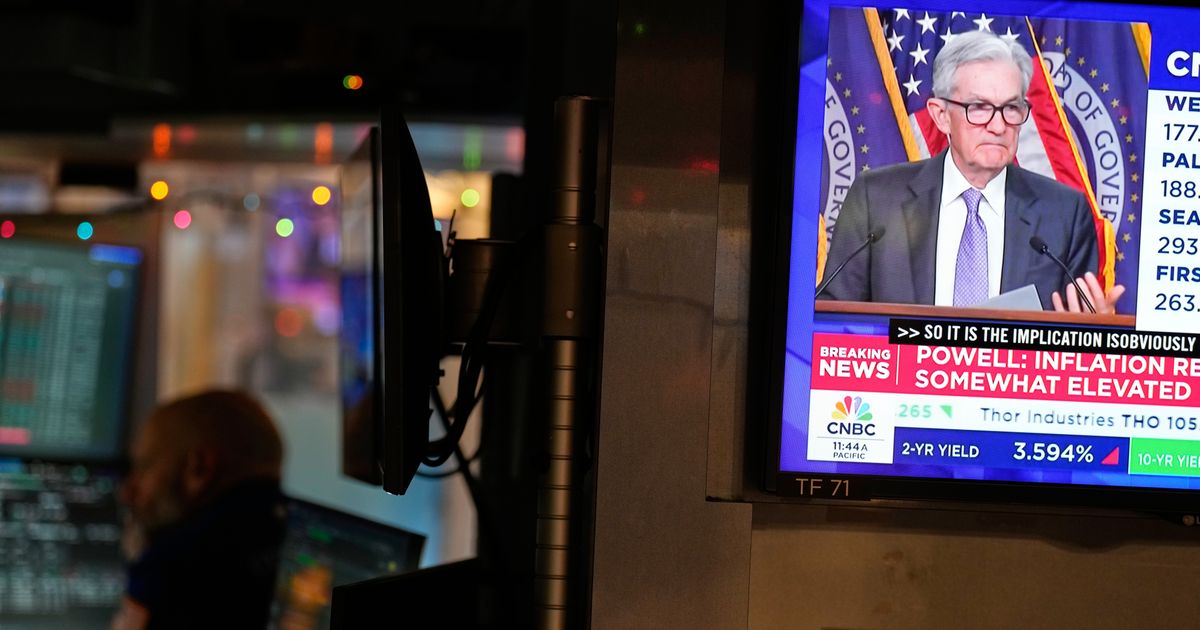
The Federal Reserve’s widely expected rate cut and Fed Chair Jerome Powell’s comments — which left the door open to further easing in 2026 — pushed U.S. benchmarks toward record highs (S&P +0.7%, Dow +1.0%, Nasdaq +0.3%) while producing mixed Asian trade as regional central-bank divergence and company-specific shocks weighed. Asian indices were split: Tokyo’s Nikkei fell 1% (SoftBank -6.8%) on rising odds of a Bank of Japan rate hike, Hong Kong’s Hang Seng ticked up 0.1% after the HKMA trimmed borrowing costs to 4.00%, the Shanghai Composite slid 0.5% amid weak October new-yuan loan data, Taiwan and Korea fell and India was flat; Oracle’s weaker-than-expected results sent its shares down 11.5% after hours and knocked AI-linked names. Commodity and FX moves were muted (WTI ~$58.40, Brent ~$62.14, dollar eased to JPY 155.90) while corporate catalysts included GE Vernova’s 15.6% surge on raised 2028 revenue guidance, an increased dividend and larger buyback — the overall takeaway being a Fed-driven risk-on backdrop tempered by China demand concerns and near-term volatility from AI spending and regional policy divergence.
The Federal Reserve’s widely anticipated cut to its main interest rate and Chair Jerome Powell’s comments that left the door open to further easing in 2026 helped push U.S. benchmarks toward record territory—S&P 500 +0.7% to 6,886.68, Dow +1.0% to 48,057.75 and Nasdaq +0.3% to 23,654.16—even as immediate market reaction was muted. Powell’s characterization that rates are “pushing neither inflation nor the job market” implies the Fed is pausing to reassess incoming labor and inflation data, maintaining optionality for future easing.
Asian markets were mixed on divergent regional policy signals and weak China demand: Tokyo’s Nikkei fell 1.0% to 50,087.11, weighed by SoftBank’s 6.8% decline amid AI-investment concerns and growing odds of a Bank of Japan rate hike next week, while Hong Kong’s Hang Seng edged up 0.1% to 25,564.87 after the HKMA cut borrowing costs to 4.00%. The Shanghai Composite slipped 0.5% to 3,882.72 after October new-yuan loans fell sharply, Taiwan’s Taiex dropped 1.3% and Korea’s Kospi gave up earlier gains to close down 0.3% at 4,121.68.
Company-specific catalysts increased short-term dispersion: Oracle plunged 11.5% in aftermarket trading after missing expectations and raising investor concern about AI-related cash burn, while GE Vernova jumped 15.6% after raising its 2028 revenue forecast, doubling its dividend and enlarging buybacks; Palantir and Cracker Barrel posted modest gains. Oil and FX moved little (WTI $58.40, Brent $62.14, USD/JPY ~155.90), underscoring a risk-on tilt in U.S. equities tempered by regional policy divergence and China demand risk.
Near-term market drivers to watch are the BOJ meeting, China’s upcoming credit prints, Oracle’s follow-up commentary on cash flow and AI spending, and incoming U.S. labor/inflation data that will shape the Fed’s next steps; these factors support continued upside in U.S. risk assets but argue for selective positioning amid heightened cross-market volatility.
AI-powered research, real-time alerts, and portfolio analytics for institutional investors.
Request DemoOverall Sentiment
mixed
Sentiment Score
0.00
Ticker Sentiment
