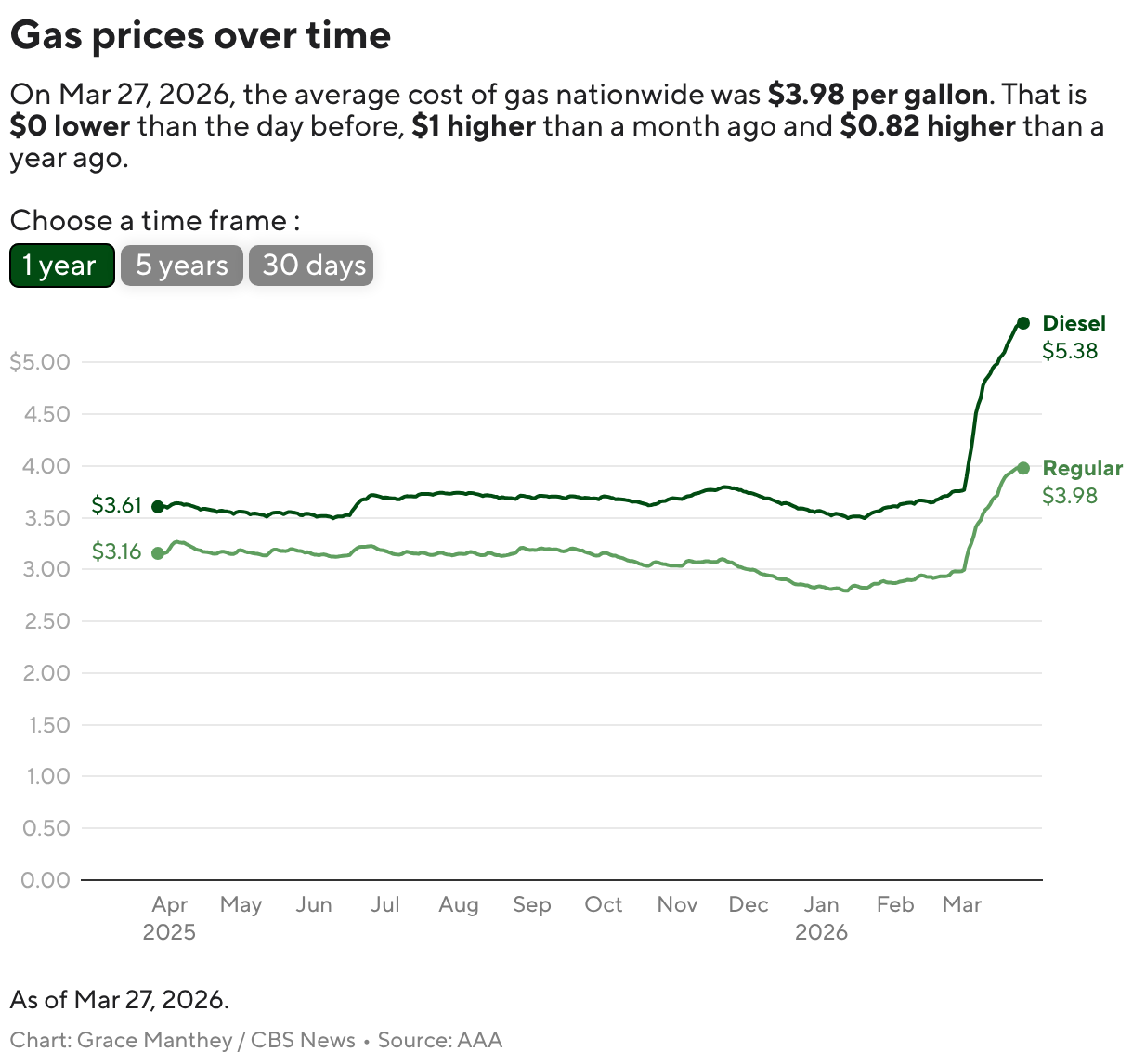
About 20 million barrels/day normally transit the Strait of Hormuz; flows have been reduced by as much as 16 million bpd since the war began. Economists warn Brent could exceed $150/bbl within weeks and potentially reach $150–$200/bbl in extreme scenarios (recent highs around $120/bbl), while U.S. gasoline averaged $4.06/gal and could rise to roughly $4.12–$4.15/gal near term. A prolonged closure would be highly inflationary and market‑wide given limited substitutes and sustained supply constraints even if U.S. operations are wound down.
Price risk is dominated by two amplifiers beyond simple supply loss: logistics friction (insurance, rerouting, tanker availability) and demand elasticity delay. Insurance and freight premia scale non-linearly with duration — a 1-month disruption trades very differently from a 6‑month disruption because storage, charter markets, and refinery scheduling re-optimize on multi-month horizons, creating a feedback loop that can magnify spot moves into the forward curve.
Time horizons matter: days-to-weeks are about volatility and spot squeezes driven by vessels and prompt barrels; months are where upstream production response and strategic inventory releases matter; beyond a year, capex repricing and relocation of refining/trade flows reset equilibrium. This implies different instruments should be used by horizon (options/futures for near-term spikes, equities and shipping for medium-term regime change, select cyclicals and sovereign-credit for long-term inflation/upside risks).
Second-order winners include owners of crude shipping capacity and short-duration US producers with hedged volumes, while losers will be high fuel-intensity service sectors and import-dependent sovereigns that cannot easily pass through higher energy costs. Expect refining cracks to bifurcate regionally (those proximate to alternative supply routes outperform), and for storage economics to flip the futures curve into prolonged contango if physical barrels are displaced from primary routes for multiple months.
AI-powered research, real-time alerts, and portfolio analytics for institutional investors.
Overall Sentiment
strongly negative
Sentiment Score
-0.60
