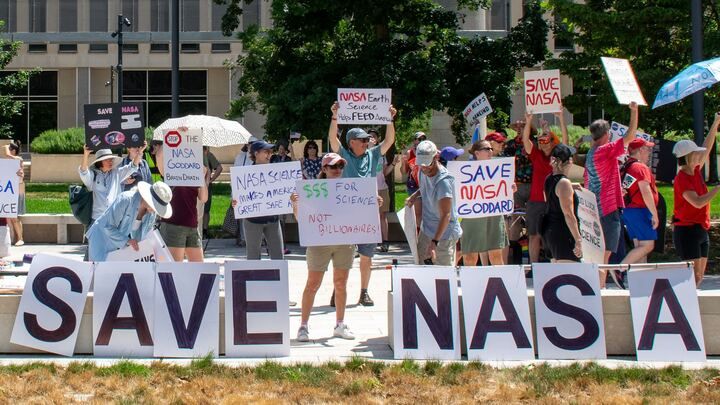
The FY2027 proposal would cut NASA's topline by ~23% to about $18.8B and slash the Science Mission Directorate from $7.25B to $3.9B (a 47% reduction). The cuts risk delaying or cancelling planetary, astrophysics and Earth-observation programs (e.g., Roman Space Telescope, Dragonfly, NEO Surveyor) while preserving human spaceflight priorities like Artemis after the April 1 Artemis 2 launch. Congress previously rejected nearly identical FY2026 cuts—ultimately approving $24.4B and keeping science near $7.25B—and bipartisan pressure (100+ House signatories requesting +$1.75B for science) makes a legislative reversal likely.
The administration's tilt toward crewed exploration concentrates discretionary procurement into a narrower set of programs and primes, effectively shifting mid-single-digit billions of annual awards toward heavy industrial contractors over the next 12–24 months. That reallocation increases revenue visibility and margin leverage for suppliers tightly integrated with Artemis-class hardware, while simultaneously creating a funding vacuum for small instrument builders and science mission integrators that depend on incremental SMD awards.
A durable gap in government-funded Earth- and planetary-science programs creates a commercial demand window that incumbents in satellite imagery and analytics can monetize — expect accelerated commercial buy/supply agreements and B2B contracts to fill mission-class data needs within 12–36 months. Conversely, specialty optics, flight-instrument firms and university-affiliated vendors face revenue compressions, driving near-term negative free-cash-flow and forcing consolidation or project write-downs.
Politically, this is a multi-stage event: immediate headline-driven price moves will occur on release, but the true directional catalyst is the appropriations calendar and floor votes over the coming 3–9 months. The highest-probability reverser is congressional appropriation pressure; historically bipartisan defense of science suggests sizable chance of partial restoration, creating a cliff-risk vs. bounce dynamic for affected equities.
The consensus frames this as a binary NASA story; the overlooked reality is a cross-sector rotation and arbitrage: long large, integrated primes whose cash flows become stickier, and short niche science suppliers whose project pipelines are most exposed. That creates clear pair and options opportunities that pay off whether Congress restores funding (valuation rebound) or cuts persist (earnings dispersion expands).
AI-powered research, real-time alerts, and portfolio analytics for institutional investors.
Request DemoOverall Sentiment
mildly negative
Sentiment Score
-0.35
