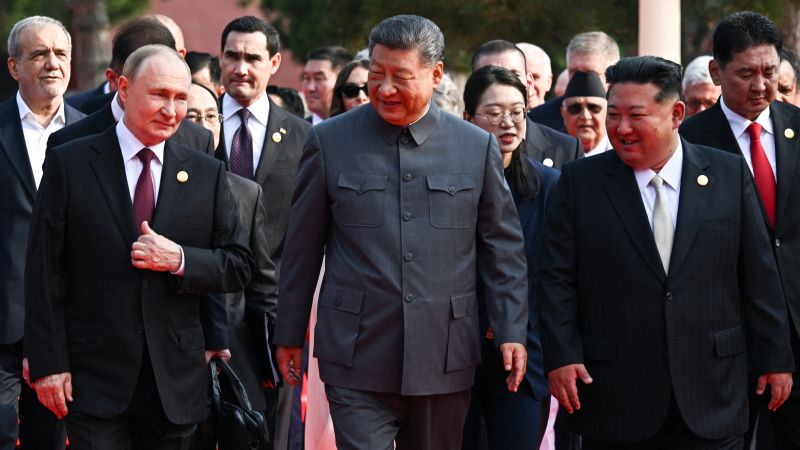
China's recent military parade, prominently featuring Xi Jinping alongside Russian President Putin and North Korean leader Kim Jong Un, served as a forceful demonstration of Beijing's growing military capabilities and its ambition to establish itself as an alternative global leader. This display of advanced weaponry, including hypersonic missiles, underscored China's intent to challenge the US-led international order and reshape global governance through initiatives aimed at diluting Western influence across finance, trade, and security. The event reinforces the emerging geopolitical bifurcation into two distinct camps, signaling potential long-term rivalry with significant implications for international relations, global economic frameworks, and regional stability, particularly concerning Taiwan.
China's recent military parade, featuring President Xi alongside leaders from Russia and North Korea, represents a significant and deliberate escalation in geopolitical posturing. This event was not merely ceremonial; it served as a forceful demonstration of China's advanced military capabilities, including hypersonic missiles and combat drones, signaling a direct challenge to the US-led global order. The display of 'hard power' was strategically coupled with 'soft power' initiatives, such as the 'global governance initiative,' which aims to reshape international systems in finance (e.g., SWIFT), trade, and technology governance to favor China and its allies in the 'Global South.' This dual approach underscores Beijing's ambition to create an alternative world order where its national development and geopolitical goals, such as its claims over Taiwan, are not constrained by Western-led alliances or norms. The event solidifies the perception of an emerging bipolar world, with one camp coalescing around China's 'common opposition to the US.' Furthermore, the article suggests these external actions are partly driven by domestic pressures, as the Chinese Communist Party grapples with a slowing economy and uses nationalism to shore up internal stability for a 'long-term rivalry with Washington,' heightening the risk of a more aggressive foreign policy.
AI-powered research, real-time alerts, and portfolio analytics for institutional investors.
Overall Sentiment
strongly negative
Sentiment Score
-0.65
Ticker Sentiment
