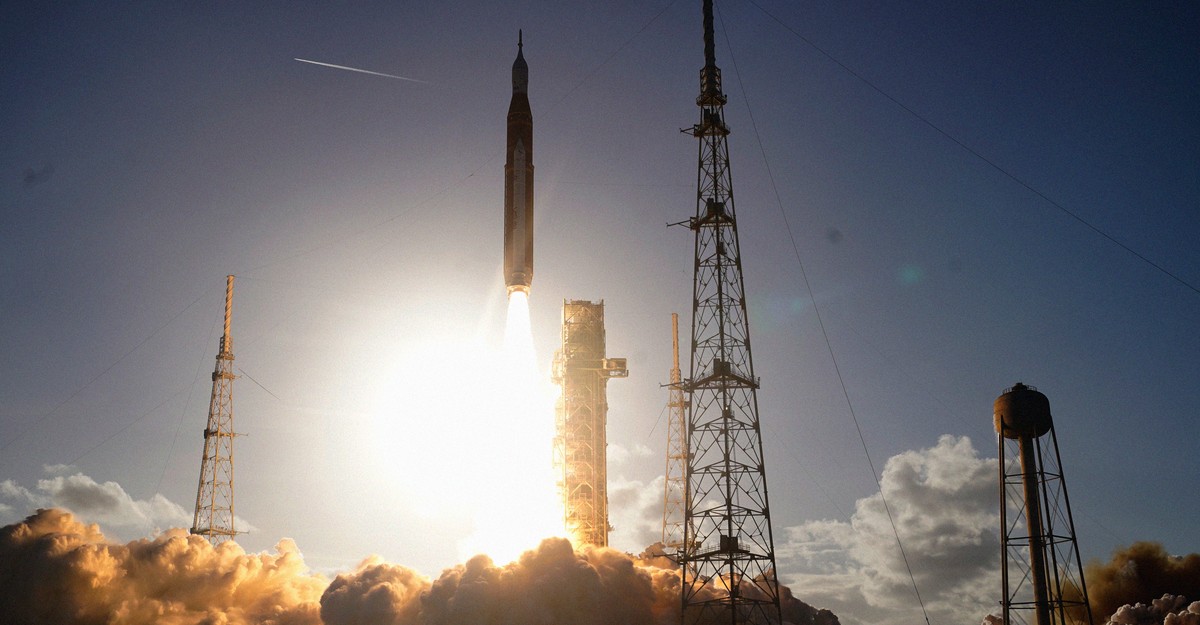
Artemis II launched as the first crewed mission to reach lunar orbit in more than 50 years, but the crew will not land and will swing around the moon’s far side before returning. The Space Launch System (SLS) is described as likely the most expensive rocket per launch, taking 11 years to develop versus Saturn V’s 6 years and being single-use/technologically obsolete, creating fiscal risk as future lunar landings depend on Congress and future administrations. The event is highly symbolic and inspiring, but program sustainment and costs, plus geopolitical competition with China, are the primary risks for investors and policymakers.
This launch is a political and industrial fulcrum more than a pure technology story: SLS/Orion is a single-use, politically-backed cash pump that props up specific prime contractors for years even while reusable rivals (Starship/Falcon) cannibalize the commercial launch market. Expect multi-year, lumpy revenue streams into Boeing/Lockheed/Northrop through contracted milestones and sustainment work — revenues that are highly correlated with appropriations cycles, not commercial demand curves.
Second-order winners are firms that supply heavy structures, avionics and cryogenic systems (large composite shops, avionics integrators, ground-segment telemetry) where lead times exceed 12–24 months; small regional suppliers and ports on Florida’s Space Coast will see outsized economic multipliers. Conversely, small public pure-play launchers and suppliers that bet on high cadence commercial manifest growth will face margin compression as national prestige programs divert skilled labor and factory slots for guaranteed government work.
Key tail-risks center on political change and mission outcome: a high-profile failure this flight or a White House/Congressional reprioritization within 6–18 months materially increases cancellation risk for follow-on SLS buys and forces primes to transition work to commercial partners. A successful, clean mission however creates immediate political momentum and improves the probability of 12–36 month incremental appropriations, effectively derisking fixed-price contract milestones and option exercises for primes.
The market consensus underprices the durability of pork-barrel aerospace spending: even if SLS is technologically obsolete, sunk-cost dynamics plus local jobs and congressional sponsorship make full program wind-down politically costly. That structural stickiness argues for asymmetric exposure to large defense/aerospace primes rather than to volatile small-cap launchers that will feel the squeeze first.
AI-powered research, real-time alerts, and portfolio analytics for institutional investors.
Request DemoOverall Sentiment
mixed
Sentiment Score
0.05
