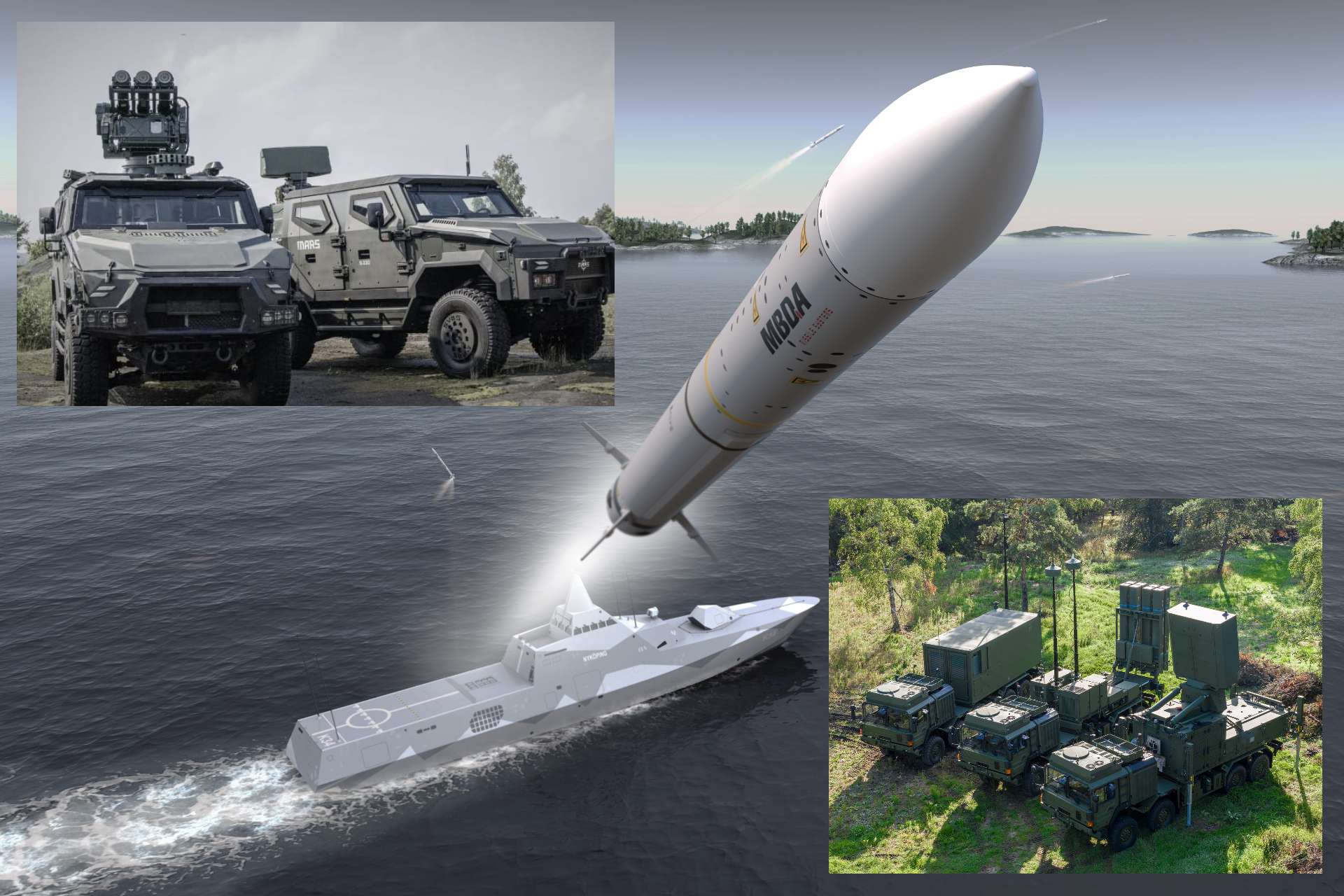
Sweden has directed the Armed Forces to rapidly stand up a territorial short-range air defense capability valued at about SEK 15 billion (~$1.6 billion), with an initial consolidated industry order planned for Q1 2026 and follow-on phases thereafter. The program emphasizes fast procurement of modular, company-sized units combining sensors, C2 and short-range shooters to protect cities, bridges, power plants and mobilization nodes, complementing recent contracts such as Saab’s SEK 2.1 billion sensors/C2 order and prior purchases of IRIS‑T SLM and Sea Ceptor systems. The decision accelerates budgeted defense spending and should benefit Swedish and European defense primes, while signaling a broader, civilian-protection focus driven by lessons from the war in Ukraine.
Market structure: The SEK 15bn (≈$1.6bn) rapid-program is a clear near-term demand shock for short-range radars, IR/EO trackers, C-RAM guns, loitering/drone countermeasures and integration services. Primary winners are Saab (SAAB-B.ST) for sensors/C2, European missile/radar builders (Leonardo LDO.MI, BAE.L/AIR.PA via MBDA links) and Kongsberg (KOG.OL) for mobility/launch platforms; large systems integrators face margin pressure because modular, company-sized units favor plug-and-play suppliers. Expect multi-year procurement tail into 2027–28 supporting order books but competitive pricing on commodity subsystems.
Risk assessment: Tail risks include procurement reversals, export-control frictions, supply-chain bottlenecks (semiconductors, GaN radar components) and cost overruns—each could erase 20–50% of near-term supplier upside. Immediate (days–weeks): price moves on Q1 consolidated-order RFPs; short-term (1–6 months): contract awards and FX reaction; long-term (2027–28): revenue recognition with integration/maintenance margin capture. Hidden dependency: effectiveness hinges on Sweden’s C2/radar backbone (Saab FMV deals); failure there reduces lifetime sustainment revenue materially.
Trade implications: Direct plays: overweight SAAB-B.ST (2–3% NAV) into Q1 bids and LDO.MI (1–2%) for missile/radar exposure; buy ITA (2%) to tilt US A&D exposure. Options: purchase 9–12 month call spreads on SAAB-B.ST (~10–20% OTM) sized to limit downside; consider pair trade long SAAB-B.ST vs short a European heavy-cap industrial ETF to isolate defense-specific alpha. Time exits: trim 50% on +25–30% move or after public contract award; hold remaining into 2027 delivery milestones.
Contrarian angles: Consensus may overstate absolute size—SEK15bn is tactical, not transformational; market could overpay for speculative domestic winners. Conversely, modularization can commoditize hardware and shift profits to software/C2—favor companies with recurring software/maintenance revenue. Historical parallel: post‑2014 Ukraine buy cycles produced 20–60% rallies then mean-reverted; monitor Feb 16 report and Q1 procurement list as pivot points.
AI-powered research, real-time alerts, and portfolio analytics for institutional investors.
Request DemoOverall Sentiment
mildly positive
Sentiment Score
0.30
