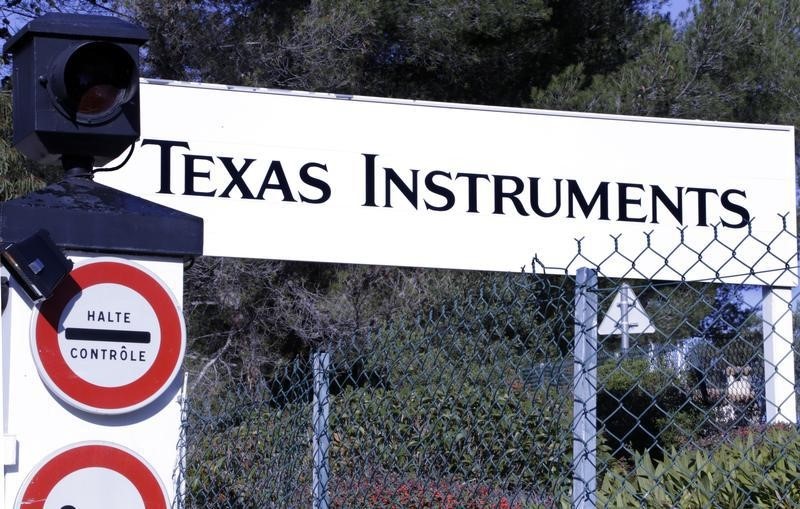
Mizuho raised its price target on Texas Instruments to $300 from $255 while keeping a Neutral rating, citing a $563 million quarterly AI data center run rate and improving industrial demand. The firm sees upside from the SLAB acquisition and higher lead times, though the stock already trades at $300.60, near its 52-week high of $310.29 and at 50.83x earnings. Overall analyst sentiment remains constructive, with multiple recent target increases from Stifel, BofA, UBS, Cantor Fitzgerald, and Truist.
TXN is becoming less of a cyclical analog recovery story and more of a capital-allocation and scarcity-premium trade: management’s internal manufacturing footprint gives it leverage if industrial demand keeps healing, but that same control also makes the equity increasingly sensitive to any disappointment in utilization. The market is already paying up for the notion that AI data center demand can offset slower auto and industrial end markets, so the near-term upside is mostly multiple expansion from continued execution rather than a dramatic earnings inflection.
The second-order effect is on the rest of analog: if TXN’s long-cycle capacity build and specialty demand prove durable, it supports a more constructive read-through on peers with similar factory strategies, but it also raises the bar for valuations across the group. Conversely, if the AI data center contribution plateaus before the broader industrial recovery fully arrives, the market could quickly re-rate TXN from “quality compounder” back to “expensive cyclical,” which is a meaningful risk at these levels.
Contrarian take: the consensus is likely overestimating how cleanly AI capex translates into a sustained analog revenue runway. A few quarters of strong design-in wins can look like a secular step-function, but the actual test is whether that demand survives after initial platform build-outs normalize; that window is months, not years. The stock’s valuation already embeds a very high degree of confidence, so any guidance that implies slower 2026–2027 conversion, weaker pricing, or slower fab absorption would matter more than another modest beat.
For trading, the setup favors patience over chase: the risk/reward is better on pullbacks or via structures that monetize elevated implied volatility than on outright chasing strength. The cleanest expression is to own TXN versus lower-quality analog peers if you want to express a relative-value view on internal manufacturing durability, but hedge with the expectation that premium multiples compress if macro reaccelerates unevenly. Near term, the tape likely trades as a sentiment proxy for semis and industrials rather than on fundamental revision alone.
AI-powered research, real-time alerts, and portfolio analytics for institutional investors.
Request DemoOverall Sentiment
mildly positive
Sentiment Score
0.35
Ticker Sentiment
