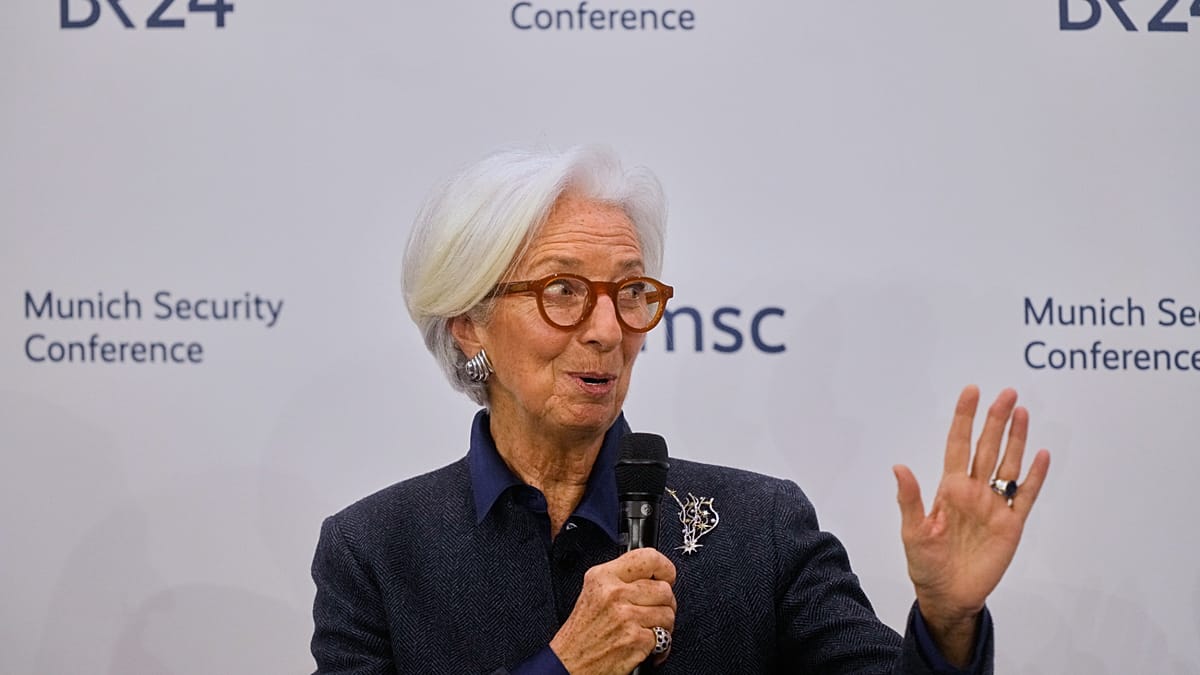
Speculation that ECB President Christine Lagarde might step down before her mandate ends — reportedly to allow French authorities to influence the succession ahead of the 2027 presidential race — has prompted concerns about political engineering of EU central bank appointments. Economists say the European Council appointment process makes it highly unlikely a future far‑right French government could force through a maverick ECB chief, but warn the manoeuvring risks reputational damage to the ECB and increased political uncertainty for euro‑area governance.
Market structure: Political manoeuvring around the ECB presidency raises reputation risk rather than an immediate shift in monetary policy; voting rules (Qualified Majority in the European Council) make a maverick appointment low-probability. Short-term winners are safe-haven assets (German bunds, CHF, gold), losers are politically-sensitive French assets (OATs, French banks, EWQ) if polls or succession chatter persist; expect market-implied French risk premia to widen by 10–30bp in stress episodes.
Risk assessment: Tail risk is a populist shock where perceived ECB independence falls materially — a low-probability/high-impact event that could widen peripheral spreads by 50–150bp and depress EUR by 3–7% in 3–12 months. Immediate (days) volatility is reputational; short-term (weeks–months) sees repricing in F/O markets and CDS; long-term (quarters) could change fiscal trajectories if RN gains power in 2027 and pushes fiscal looseness.
Trade implications: Implement hedges that pay if French risk re-prices: protection via France 5y CDS or iTraxx Main widening, long German bund futures as portfolio tail-hedge, and EURUSD downside optionality sized to 0.5–1% NAV for 3–6 months. Trim directional exposures to French banks by 2–5% and prefer Euro-area banks with limited French sovereign linkage.
Contrarian: Consensus underestimates second-order FX and funding effects — even without policy capture, reputational hits can tighten bank funding and elevate wholesale haircuts, pressuring credit spreads. If markets over-react, buying beaten-up high-quality French corporate credit (investment-grade) on spreads +30–50bp vs Germany for 6–12 months can offer asymmetric returns when repricing normalizes.
AI-powered research, real-time alerts, and portfolio analytics for institutional investors.
Request DemoOverall Sentiment
mildly negative
Sentiment Score
-0.25
