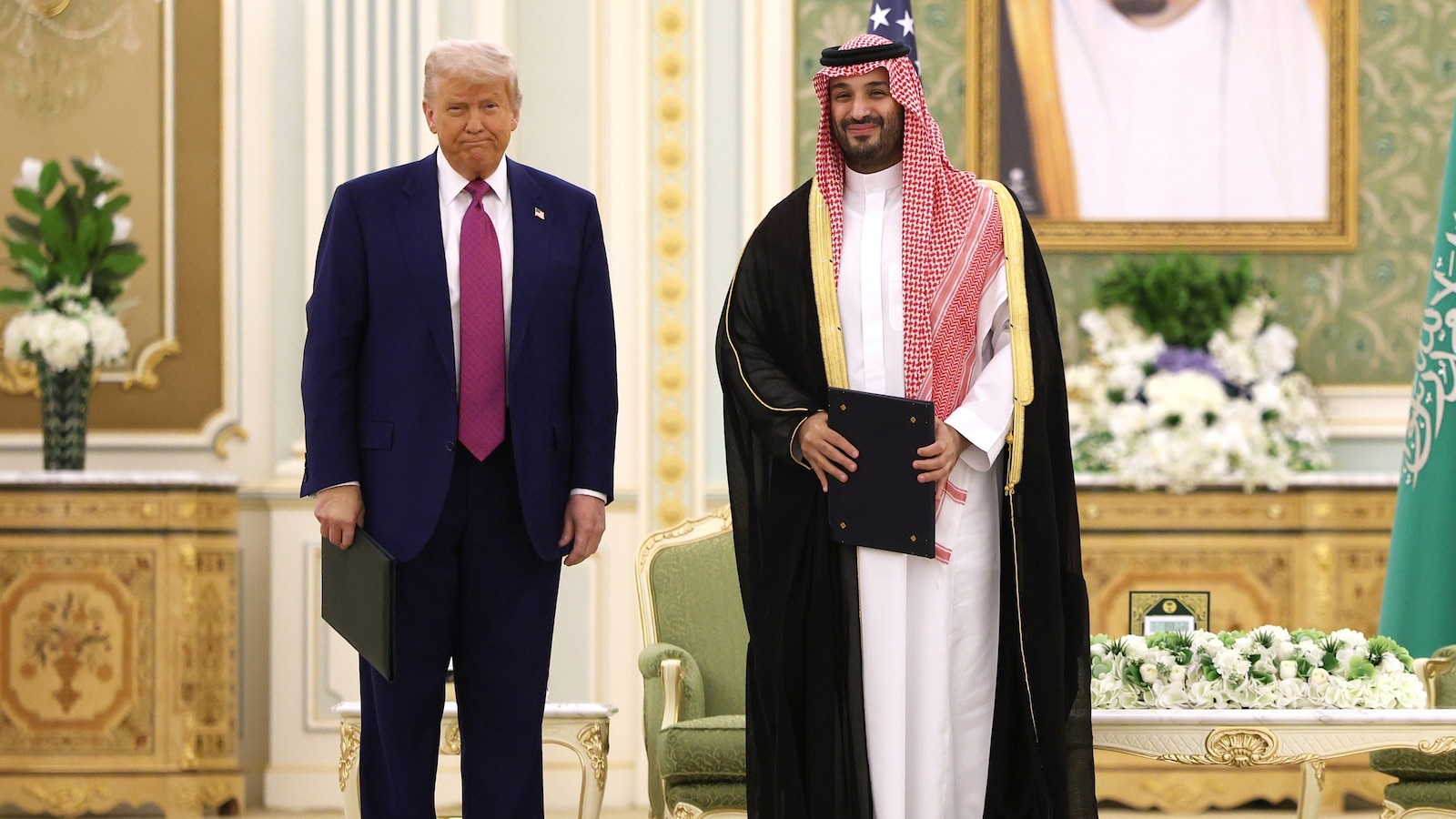
Saudi Crown Prince Mohammed bin Salman makes his first U.S. visit since 2018 to reset bilateral ties with an emphasis on oil, security, and expanded investment in finance, AI and technology, meeting President Trump as Washington pushes follow-up to Trump's May visit. The trip builds on a previously announced $142 billion U.S. arms package and a Saudi pledge of up to $600 billion in cross-border investment, and Trump has signaled plans to sell F‑35s to Riyadh—a move that would be unprecedented for an Arab state and could provoke Israeli and congressional scrutiny over Israel’s qualitative military edge. Riyadh is also seeking formal U.S. security guarantees similar to those extended to Qatar while insisting on a credible pathway to Palestinian statehood as a precondition for supporting Gaza’s demilitarization and reconstruction, leaving normalization with Israel and the timing of major defense and infrastructure deals uncertain and a key geopolitical risk for markets and defense, energy and tech investors.
Mohammed bin Salman returns to the U.S. for his first visit since 2018 following the Jamal Khashoggi crisis, undertaking an "official working visit" with President Trump that emphasizes cooperation on oil, security, finance, artificial intelligence and technology; public pomp at the White House and a state dinner underline the political significance. The trip follows Trump's May visit announcements, notably a $142 billion U.S. arms package and a Saudi pledge of up to $600 billion in cross-border investment covering AI data centers, energy infrastructure, defense, commercial aircraft, health supply chains and sports projects. The administration has signaled intent to sell F-35s to Saudi Arabia — a first for an Arab state — which would likely prompt Israeli and congressional scrutiny because of Israel's congressionally-mandated qualitative military edge. Riyadh is also seeking a formal U.S. security guarantee similar to Qatar's while conditioning Gaza reconstruction on a credible pathway to Palestinian statehood, creating political friction that leaves normalization and deal execution timing uncertain. Market signals are mixed and cautious (sentiment_score 0.05, market_impact_score 0.45), implying headline-driven volatility for defense contractors, Saudi-related financial flows, energy markets and technology vendors; experts in the article note ambiguity around how much "teeth" initial announcements will have, making formal contract disclosures and legislative approvals key execution risks.
AI-powered research, real-time alerts, and portfolio analytics for institutional investors.
Request DemoOverall Sentiment
mixed
Sentiment Score
0.05
Ticker Sentiment
