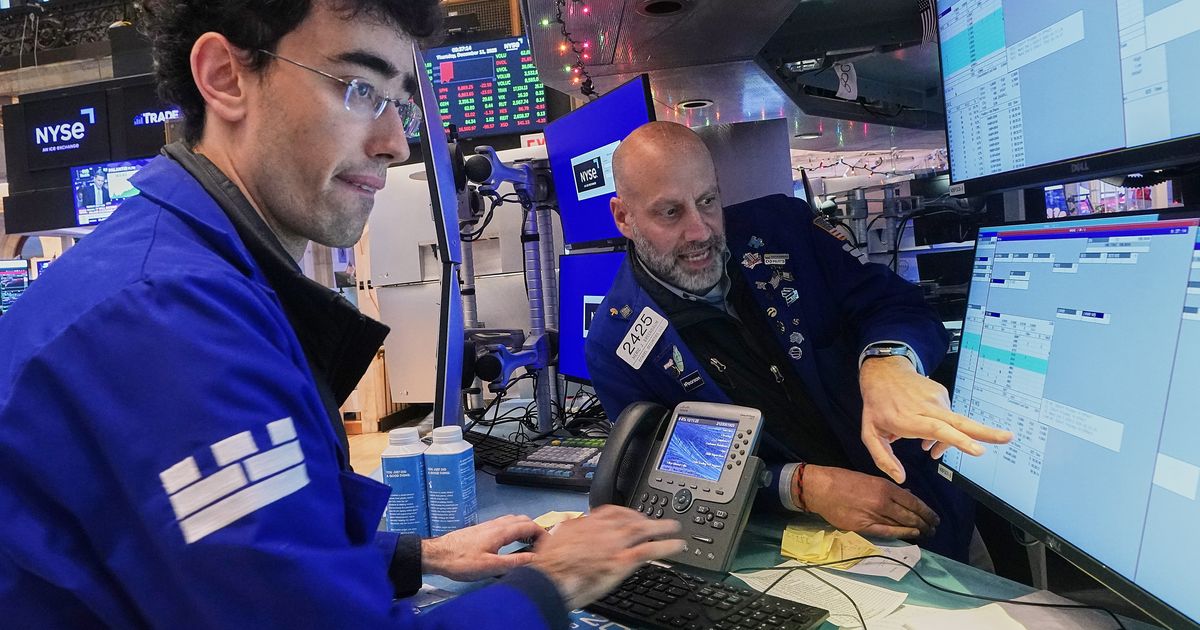
The Bank of Japan raised its policy rate by 25 bps to 0.75% — the highest since 1995 — sending Japan’s 10-year government bond yield above 2% for the first time since May 2006 and pushing USD/JPY to 157.08 from 155.53; the Nikkei rose 1% to 49,507.21. U.S. futures were mixed (S&P +0.1%, Nasdaq +0.2%) as markets parsed the BOJ move alongside a softer-than-expected U.S. November CPI print of 2.7% that bolstered hopes for future Fed cuts; oil edged higher (WTI $56.31, Brent $60.12) and bitcoin gained about 3.9% to just under $88,000. Corporate noise included Nike tumbling over 10% on tariff concerns, Deckers slipping ~3%, and Oracle jumping 4% after signing a deal in a proposed TikTok U.S. joint venture with Silver Lake and MGX.
Market structure: The BOJ 25bp hike (policy rate 0.75%) and 10y JGB >2% reprice Japanese duration and hands a clear near-term win to banks, insurance and FX carry (USD/JPY bias). Exporters face mixed forces — a weaker yen earlier helped earnings but a rising yield/yen raises funding costs; global retailers with China/U.S. tariff exposure (NKE) are immediate losers as margin risk now trumps a solid quarter. The Oracle/TikTok JV re-rates ORCL on potential recurring revenue and strategic IP access, while MGX is a smaller, higher-beta beneficiary.
Risk assessment: Tail risks include an accelerated BOJ tightening cycle that forces a sharp JPY rally (USD/JPY <150) and forces Japanese pension selling into equities, or a US regulatory denial of the TikTok JV that would vaporize ORCL upside — both low-prob/high-impact over 30–90 days. Near-term (days-weeks) volatility will be driven by US CPI prints, BOJ forward guidance and any new US tariff moves; medium-term (3–12 months) the risk is a persistent global policy divergence that steepens cross-country curves and stresses USD funding.
Trade implications: Tactical short on NKE via limited-risk put spreads for 30–60 days to capture tariff-driven repricing; tactical long in ORCL with 6–12 month call spreads to play JV upside while capping premium. Rotate away from long-duration JGB exposure (reduce benchmark weight by ~50% within two weeks) and redeploy into Japanese bank/financial equities (target +1–2% portfolio overweight) and a USD/JPY directional FX trade (target 162 in 1–3 months).
Contrarian angles: Consensus treats BOJ move as fully priced; markets may underprice persistent JGB sell pressure and resulting equity outflows — creating a 3–6 month dislocation risk and a buying window in Japanese cyclicals after an initial repricing. Nike’s >10% drop may be overdone if tariffs are negotiated or delayed — consider structured buybacks rather than unilateral shorts. Conversely, ORCL’s pop may be premature: regulatory/earnings delivery risk argues for staged scaling with profit-taking at +15–20%.
AI-powered research, real-time alerts, and portfolio analytics for institutional investors.
Request DemoOverall Sentiment
mildly positive
Sentiment Score
0.22
Ticker Sentiment
