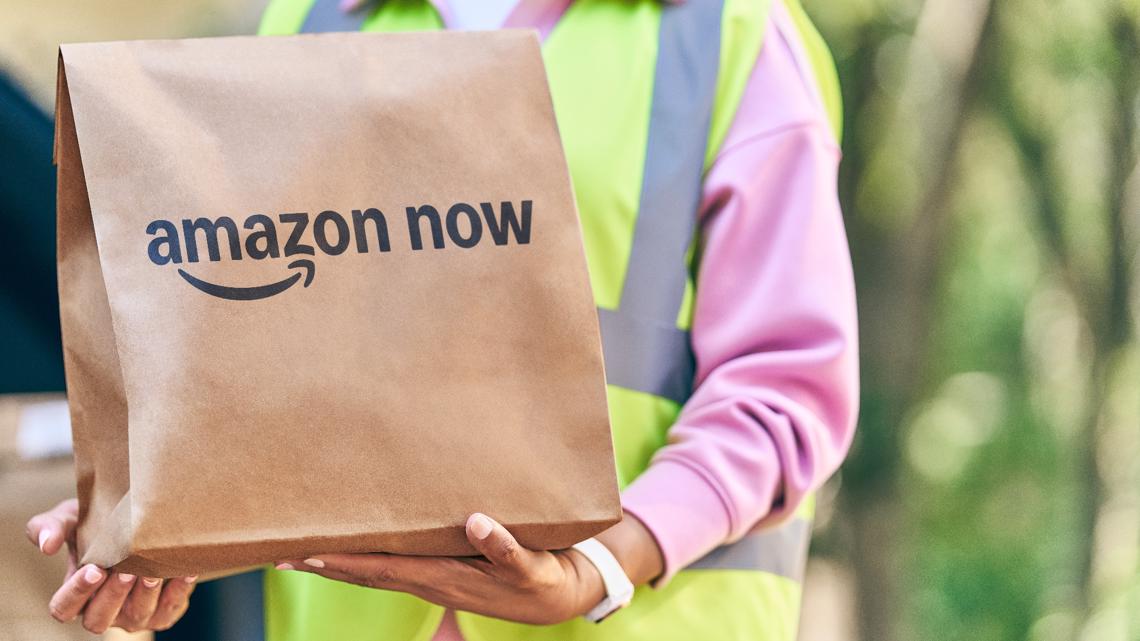
Amazon launched Amazon Now in Houston, offering grocery and essentials delivery in around 30 minutes or less, with Prime members paying $3.99 per order and non-Prime customers $13.99. The service is expanding to dozens of U.S. cities, including Austin, Dallas-Fort Worth, Orlando, Phoenix and Denver, and Amazon plans to reach tens of millions more customers by year-end. The rollout reinforces Amazon’s push deeper into rapid commerce and last-mile logistics, but the article is mainly a product/service update rather than a material financial event.
This is less about a single delivery product and more about Amazon monetizing density: once a local fulfillment node is utilized across groceries, essentials, and impulse electronics, fixed-cost leverage improves quickly if order frequency stays high. The strategic edge is not speed alone but habit formation—if consumers shift even a modest share of emergency and replenishment baskets into Amazon, the company raises switching costs and weakens the pricing power of regional grocers, dollar stores, and same-day specialists.
The second-order effect is on logistics economics. Shorter delivery windows force higher network capex, more labor intensity, and tighter inventory positioning, which can compress margins near term unless basket sizes and attachment rates rise. That creates a bifurcation: Amazon can absorb the rollout cost because it monetizes membership, ads, and broader retail share, while smaller competitors face a bad choice between matching speed and protecting margin.
The key risk is execution at scale over the next 3-12 months: labor availability, shrink, and out-of-stock rates will determine whether this becomes a profit driver or a service subsidy. If repeat usage is low, the economics deteriorate fast because rapid-delivery networks are unforgiving—high fixed costs and perishable inventory mismatch can destroy return on capital. The market may be underestimating how much this feature strengthens Prime retention and incremental spend more than it directly boosts headline retail growth.
The contrarian view is that the launch is not immediately bullish for near-term earnings, but it is strategically bullish for multiple expansion if investors believe Amazon is widening its moat in local commerce. The real tell will be order mix: if essentials dominate, this is a defensible replenishment channel; if electronics/impulse items dominate, it becomes a lower-frequency convenience service with weaker economics. In that case, the rollout would still matter competitively, but less as an incremental profit engine than as a customer-acquisition and retention tool.
AI-powered research, real-time alerts, and portfolio analytics for institutional investors.
Request DemoOverall Sentiment
mildly positive
Sentiment Score
0.25
Ticker Sentiment
