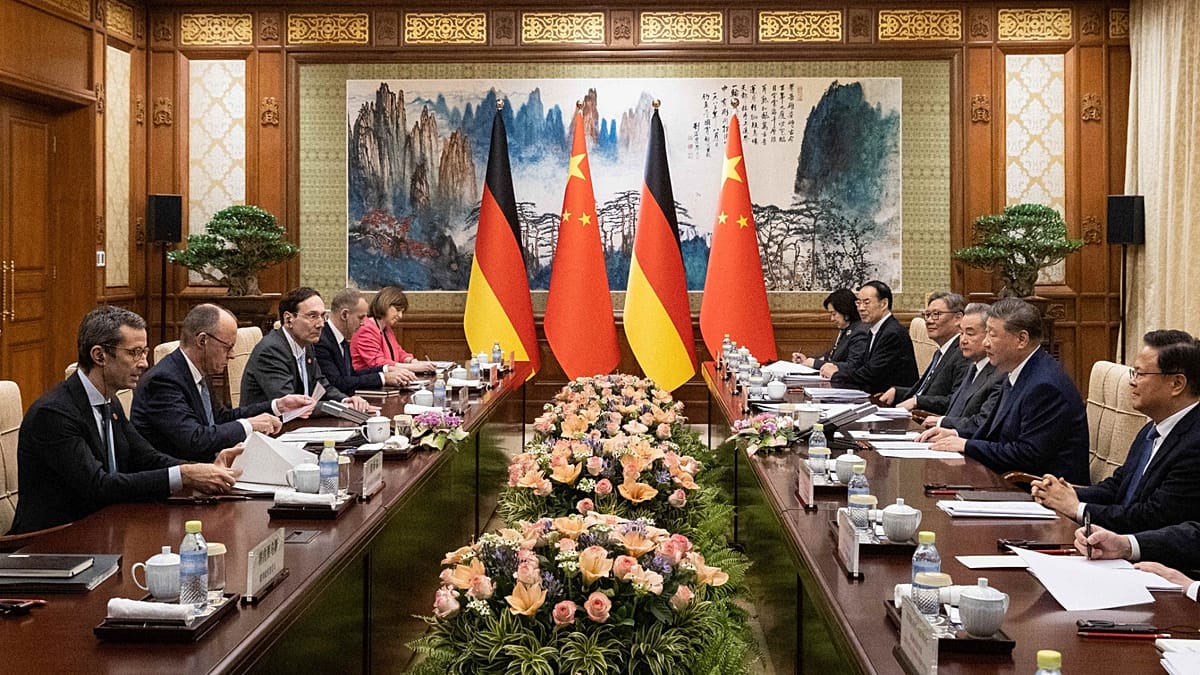
German Chancellor Friedrich Merz met with Chinese President Xi Jinping and Premier Li Qiang in Beijing, where he said China will order up to 120 additional aircraft from Airbus, signaling a material boost to European aerospace demand and supply chains. Merz stressed expectations for a balanced, regulated and fair partnership for German companies while seeking Beijing's role in resolving the Ukraine conflict; he will also visit tech hub Hangzhou and Unitree Robotics. The visit deepens commercial ties but underscores ongoing concerns about market access and strategic trust, relevant for investors in aerospace, industrial suppliers and EU-China trade exposures.
Market structure: The announced potential order of up to 120 Airbus jets is an explicit win for Airbus (AIR/EADSY) and its European engine and avionics suppliers (Safran SAF.PA/SAFRY, MTU.DE). Expect modest near-term pricing power for airframe suppliers as Chinese demand reduces OEM idle capacity; Boeing (BA) faces incremental share pressure in narrow- and mid-body segments over 12–36 months. Commodities (aluminum, titanium) and jet-fuel demand implications are incremental — price impact likely visible in raw-material procurement cycles over 6–18 months, with EUR marginally supported vs. USD on improved Eurozone export outlook.
Risk assessment: Tail risks include export-control escalation, financing/FX constraints in China, and production bottlenecks that could push delivery schedules 12–36 months and materially compress OEM margins. Immediate (days) market moves will be muted; short-term (weeks–months) focus on formal contract announcement and financing terms; long-term (years) hinges on delivery flows and certification supply-chain performance. Hidden dependency: Chinese purchases may be conditional or staged and could be used as geopolitical leverage — monitor official ordering confirmations and deposit schedules within 30–90 days.
Trade implications: Tactical longs: overweight AIR/EADSY and SAF.PA for 12–24 months, with hedge via short BA exposure to capture expected share shift; use call spreads to control capital and theta. Consider short-duration supply-chain volatility trades in aluminum/titanium miners if delivery slippage probabilities rise above 30%. FX: modest EUR long vs USD via 3–6 month forwards if Airbus order is contractually confirmed.
Contrarian: Consensus treats this as a clean win for Airbus, but execution risk and supplier capacity constraints are underpriced — real revenue recognition will lag deliveries by 2–5 years and margins may be squeezed by overtime and subcontracting costs. If Airbus stock rallies >25% without evidence of firm deposits/delivery schedule within 90 days, the rally is likely overdone and ripe for mean-reversion trades. Historical parallel: 2013–2018 narrowbody backlog growth led to margin pressure despite order-book strength.
AI-powered research, real-time alerts, and portfolio analytics for institutional investors.
Request DemoOverall Sentiment
mildly positive
Sentiment Score
0.30
