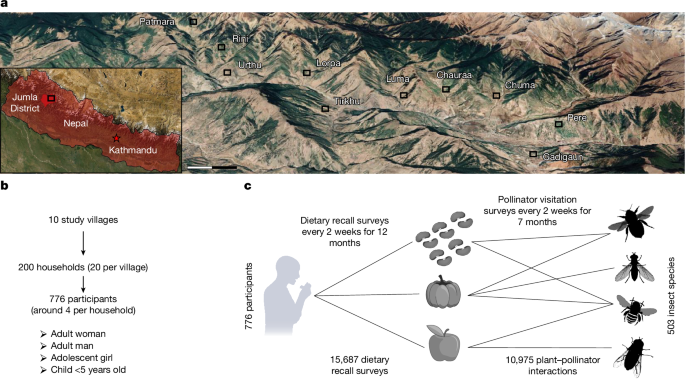
A Nature study in Nepal finds insect pollinators directly support 44% of farming income and more than 20% of vitamin A, folate and vitamin E intake in 776 smallholder households across 10 villages. Simulations show a complete pollinator loss could cut vitamin A intake by 21%, folate by 19% and household farming income by 44%, while improved pollination management could raise income by 15% and boost folate intake by 9%. The work is scientifically important for biodiversity, nutrition and rural livelihoods, but near-term market impact is limited.
This is not an investable “farm story” so much as a pricing signal for two underappreciated policy vectors: climate adaptation in frontier agribusiness and the monetization of ecosystem resilience. The key second-order effect is that pollinator loss is effectively an input-cost shock for cash crops with high micronutrient density and high household income dependence; that should bias capital toward firms and assets that reduce biological fragility rather than simply increase synthetic inputs. In public markets, that favors diversified agricultural-input and protected-agriculture exposures over pure commodity-beta, because the former can sell resilience, monitoring, and yield stabilization even when end-demand is stagnant. The most interesting contrarian angle is that the paper makes “biodiversity” quantifiable in cash-flow terms, which should accelerate grant, NGO, and development-bank funding into pollinator management, native beekeeping, habitat strips, and low-cost agronomy extension. That creates a relatively low-capex, high-ROI adoption curve in EM smallholder regions over 12-36 months, especially where export crops and local nutrition overlap. The win is not just higher yields; it is reduced volatility in household income, which lowers default risk and should improve microfinance and rural-credit underwriting in the same geographies. For AAPL specifically, the direct fundamental link is zero, but there is a subtle ESG/data angle: climate-resilience and supply-chain traceability vendors are likely to see budget reallocation as food-system stakeholders seek measurable biodiversity metrics. The consensus mistake would be to treat pollination as a niche conservation issue; the more relevant frame is operational resilience for agriculture, food security, and development finance. The risk to the thesis is slow monetization—this is a multi-year adoption curve—and weather/climate noise could obscure the signal quarter to quarter, making it more suitable for thematic baskets than single-name urgency.
AI-powered research, real-time alerts, and portfolio analytics for institutional investors.
Request DemoOverall Sentiment
mildly positive
Sentiment Score
0.15
Ticker Sentiment
