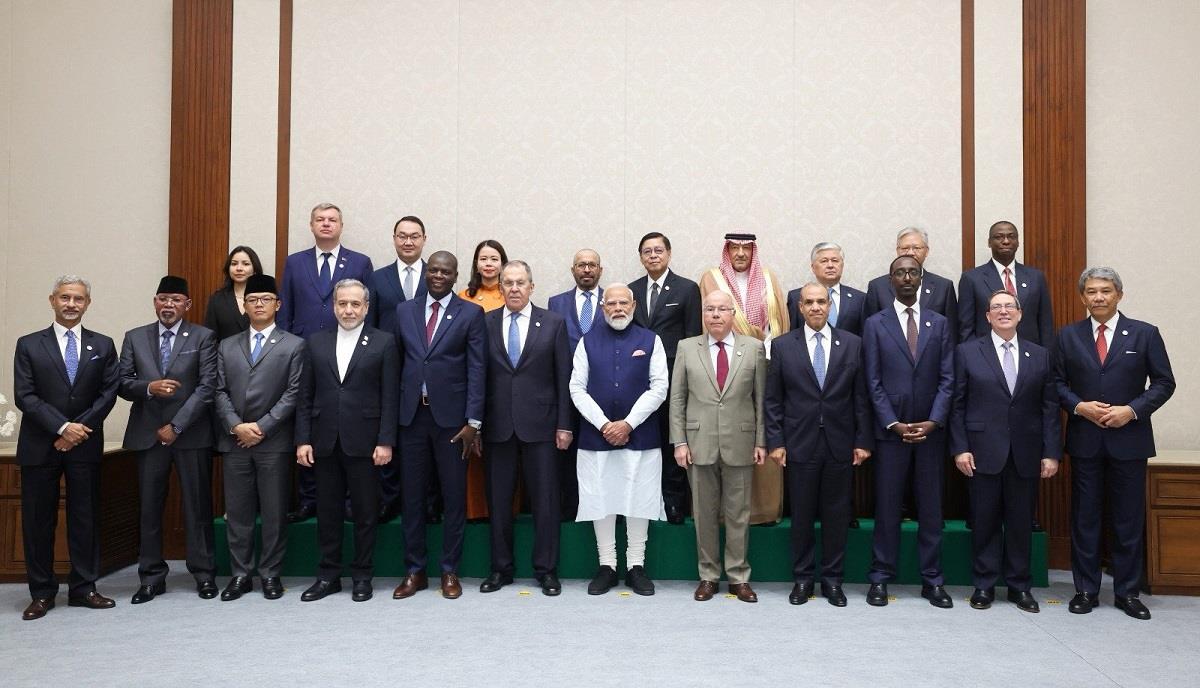
India hosted BRICS foreign ministers in a two-day meeting ahead of the September summit, with discussions centered on the West Asia crisis, energy supply disruptions, and Washington’s trade and tariff policy. The bloc now spans 11 major emerging economies, representing about 49.5% of the global population, 40% of GDP, and 26% of global trade. The article is largely geopolitical and informational, with limited direct market-moving detail.
This is less a market event than a coordination signal: BRICS is increasingly functioning as a forum for non-U.S. trade plumbing, sanctions circumvention, and energy security alignment. The immediate second-order effect is not a direct macro shock, but a higher probability of incremental bilateral settlements, shipping reroutes, and insurance/friction adjustments that slowly reduce the dollar’s transactional share in affected trade corridors. That tends to matter first in EM FX volatility, commodity basis differentials, and shadow-finance beneficiaries rather than in headline commodity prices. The most investable read-through is for energy logistics and refining complexity. When sanctioned or politically stressed producers get more diplomatic cover inside a large bloc, the market usually sees wider spreads between benchmark crude and delivered barrels, plus higher value for non-sanctioned intermediaries, storage, tanker utilization, and non-Western payment rails. The losers are companies with concentrated exposure to Western compliance regimes and logistics networks that cannot easily adapt; the winners are firms that can route, blend, finance, and insure barrels across jurisdictions. For risk timing, the catalyst is months, not days: any meaningful shift in settlement mechanisms, tariff coordination, or sanctions compliance will take time to implement, but the market can start discounting it once communiques hint at institutional follow-through. The downside tail is a sharper U.S./EU response that hardens enforcement, which would hit sanctioned-flow facilitation assets and widen EM risk premia. The upside tail is modest but real: even small gains in local-currency settlement can compound into lower funding costs and improved trade elasticity for BRICS-linked importers over 6–12 months. Consensus is probably overstating the geopolitics and underestimating the microstructure. The headline risk is loud, but the tradable edge is in second-order beneficiaries of fragmentation: shipping, commodity trading, selective EM banks, and Gulf/Asian intermediaries with cross-border execution capability. This is a regime where the market often prices the narrative before the plumbing changes, so the better trade is to own optionality on fragmentation rather than chase a broad EM beta rally.
AI-powered research, real-time alerts, and portfolio analytics for institutional investors.
Request DemoOverall Sentiment
neutral
Sentiment Score
-0.05
