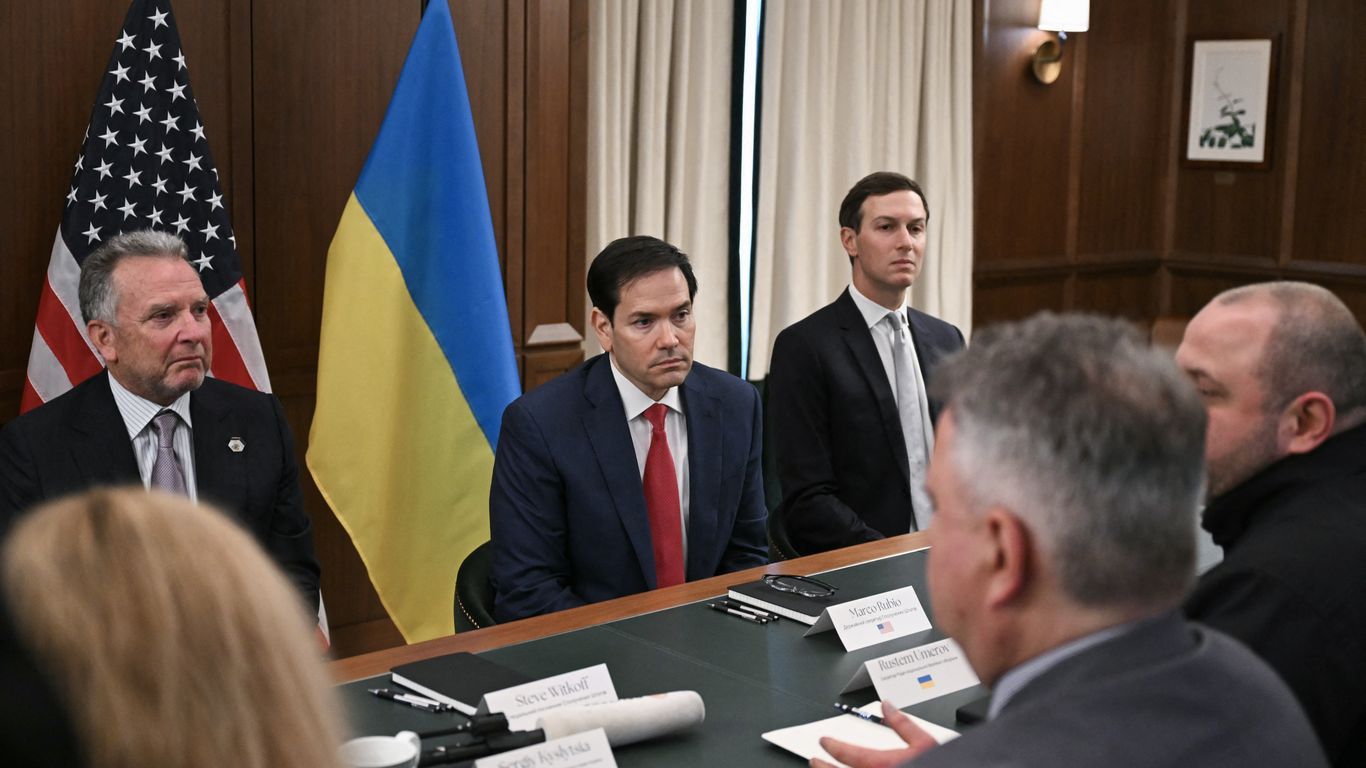
U.S. and Ukrainian delegations held a five-hour, "intense" meeting at U.S. envoy Steve Witkoff’s Shell Bay club focused almost exclusively on where the de facto border with Russia would be drawn under any peace deal, particularly control of the Donbas. Witkoff plans to take the U.S. position to Moscow for a Tuesday meeting with Putin after Ukrainian officials reported progress but emphasized sovereignty and security concerns; a credible move toward compromise would reduce regional risk premia, while failure would sustain elevated geopolitical uncertainty.
Market structure: A credible move toward a negotiated border line compresses the geopolitical risk premium — immediate winners would be European equities (cyclicals, travel) and import-sensitive EMs while losers include spot-sensitive commodity exporters and short-volatility plays in defense. Expect a 5–15% re-rating risk for pure-play defense contractors (RTX, LMT, GD) if US/European emergency funding debates cool; oil risk-premium could compress $5–10/bbl within 1–3 months if Russian exports normalize materially.
Risk assessment: Tail scenarios are binary and high-consequence — a failed deal or Russian escalation could spike Brent +$10–20 and push gold +5–10% within days; an enacted compromise could knock 10y UST yields +10–25bp as risk premia fall and equity flows rotate into Europe. Hidden dependencies include US congressional funding votes, EU sanctions enforcement, and OPEC+ supply policy; any one can reverse the market’s direction within 1–8 weeks. Key catalysts: Witkoff–Putin statement (within days), Zelensky–Umerov briefing in Paris (24–48h), US Congress votes (30–60d).
Trade implications: Implement nimble, small-sized tactical trades: favor long European equity exposure and travel/airlines on a 1–3 month horizon, hedge via short energy exposure and put protection on defense names. Use options to control tail risk: buy 3-month Brent put spreads and 3-month puts on RTX/LMT; size initial positions 0.5–2% NAV with clear stop-losses. Rotate into rebuilding-linked industrials and European banks only after sanctions clarity (60–120d).
Contrarian angles: Consensus fear = defense bulls unwind; that may be overstated because multi-year contract backlogs and bipartisan spend inertia can keep revenues elevated — shorting defense too aggressively is crowded and catalyst-sensitive. Conversely, markets underprice rapid resumption of Russian commodity exports: a 10%+ drop in wheat/oil within 60 days would strain US grain exporters (ADM, BG) and energy producers (XOM) more than general markets expect, creating asymmetric opportunities.
AI-powered research, real-time alerts, and portfolio analytics for institutional investors.
Request DemoOverall Sentiment
neutral
Sentiment Score
0.05
