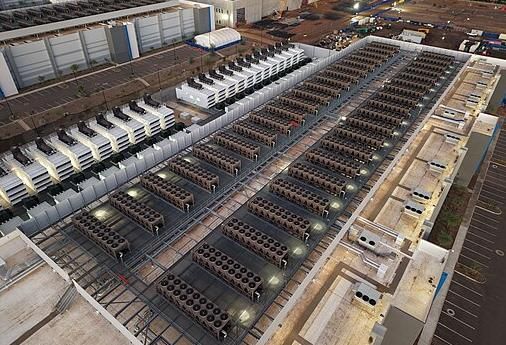
JLL’s report projects Texas could overtake Virginia as the largest U.S. data-center market by 2030, citing roughly 4 GW of existing capacity and 6.5 GW under construction versus Virginia’s 8 GW existing and 4 GW under construction. Key Texas hubs include Dallas–Fort Worth (≈2.4 GW) and Austin (≈1.7 GW, expected to double), with major planned projects such as the GW Ranch campus, the OpenAI/Oracle/SoftBank Stargate project, Comanche Circle and VivaVerse’s 774k SF buildout; Microsoft also filed plans for ~200k SF in Castroville. The shift is driven by abundant energy, land and business-friendly policy, but investors should monitor rising local regulatory and resource risks—water reporting requests by the Texas PUC, county moratorium bids and political pushback in Virginia—that could constrain development or increase costs.
Market structure: Texas rising from ~4 GW to >10 GW implied by current builds (4 GW live + 6.5 GW under construction) shifts incremental capacity and land-based pricing power to Texas landowners, wholesale developers and power providers. Winners: data‑center land owners, wholesale campus operators and ERCOT power generators; losers: Northern Virginia‑centric service providers facing local permitting risk and potential demand re‑allocation. Expect downward pressure on lease spreads in Ashburn if hyperscalers re‑home capacity to lower‑cost Texas by 2028–2030.
Risk assessment: Key tail risks include county/state moratoria on water use (30–180 day political windows) and ERCOT congestion/price spikes causing higher opex or curbed builds. Short term (weeks/months) regulatory headlines can halt projects; long term (years) oversupply could compress rents 10–30% in hotspots. Hidden dependency: water + transmission capacity are binding constraints — projects that lack long‑term water rights or transmission interconnects carry binary execution risk.
Trade implications: Prefer selective long exposure to companies with Texas land/utility ties and corporate customers (ORCL, MSFT) via small tactical positions (1–3%), and long developers/REITs that own Texas campuses while hedging Virginia concentration. Use 9–18 month option structures (call spreads/LEAPS) to capture asymmetric upside while limiting capital into potentially volatile build cycle. Monitor bond issuance from large developers — spreads widen as supply becomes visible.
Contrarian angles: Consensus assumes endless hyperscaler demand; missing is that hyperscalers increasingly self‑build (reduces wholesale demand) and water constraints could cap usable capacity below current builds. Reaction is likely underdone in credit: high‑yield paper of smaller developers may reprice 200–500bps if moratoria spread. Historic parallel: 2016 hyperscale build wave led to mid‑cycle vacancy spikes before re‑rating — expect similar 12–36 month dispersion.
AI-powered research, real-time alerts, and portfolio analytics for institutional investors.
Request DemoOverall Sentiment
mildly positive
Sentiment Score
0.25
Ticker Sentiment
