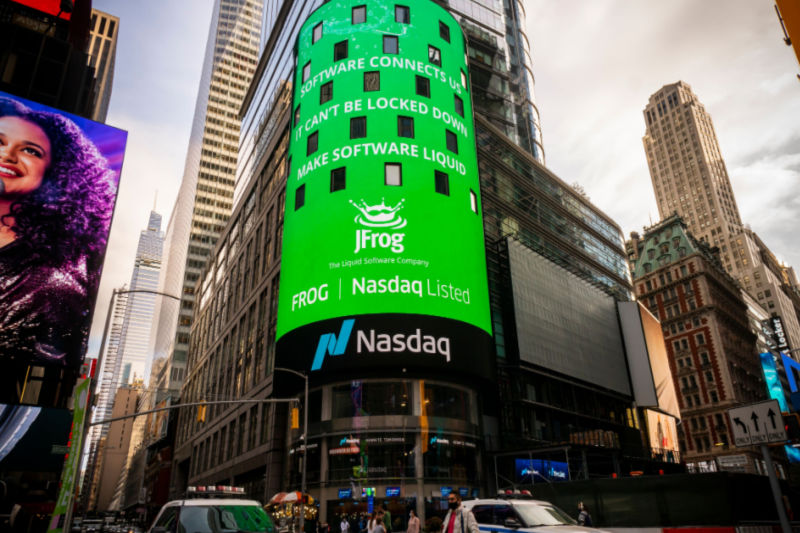
UBS upgraded JFrog to Buy from Neutral with a $60 price target, citing improved risk-reward after about a 30% decline and the stock trading down 32% YTD at $42.64. UBS expects revenue growth of 24%/21%/19% for fiscal 2026–2028 versus consensus 18%/17%/17%, values the stock at 23x calendar‑2027 FCF, and flags Q1 2026 earnings (May 7, 2026) as the next catalyst. JFrog announced a $300M buyback (~6% of market cap), holds ~$700M cash with no debt, and launched an NVIDIA-integrated Agent Skills Registry, while TD Cowen, Raymond James and Guggenheim issued supportive ratings/targets ($80/$70/$60).
JFrog’s push into AI agent governance is less a product win and more a change in the structural economics of developer tool adoption: agents generate persistent telemetry and dependency flows that raise switching costs once integrated into CI/CD and security pipelines. That creates a recurring-revenue multiplier beyond headline ARR growth because customers pay not just for feature access but for continuous agent governance, observability, and risk controls — a 12–24 month lever that can materially lift net dollar retention if conversion from pilots to production accelerates.
The primary near-term risks are executional and compositional: missed conversion metrics (pilots → paid agents), a slowdown in enterprise security spend, or aggressive bundling by hyperscalers could force a multiple re-rating within a single quarter. Over a 6–18 month horizon, regulatory scrutiny of autonomous agent behaviors and enterprise procurement delays represent non-linear downside events that can reverse sentiment quickly, while buyback-driven float reduction can exacerbate volatility on both moves.
If adoption follows the stronger curve, the second-order beneficiaries are SI partners, observability vendors, and GPU ecosystem players who monetize the increased inference and orchestration load; the competitive losers are smaller point tools without governance primitives, and incumbent cloud offerings that lack deep CI/CD integrations. Key signals to watch are agent MAUs, pilot-to-paid conversion rates, net retention trends, and incremental contribution margin from AI-related services — those will determine whether this becomes structural or stays a near-term trade narrative.
AI-powered research, real-time alerts, and portfolio analytics for institutional investors.
Request DemoOverall Sentiment
strongly positive
Sentiment Score
0.60
Ticker Sentiment
