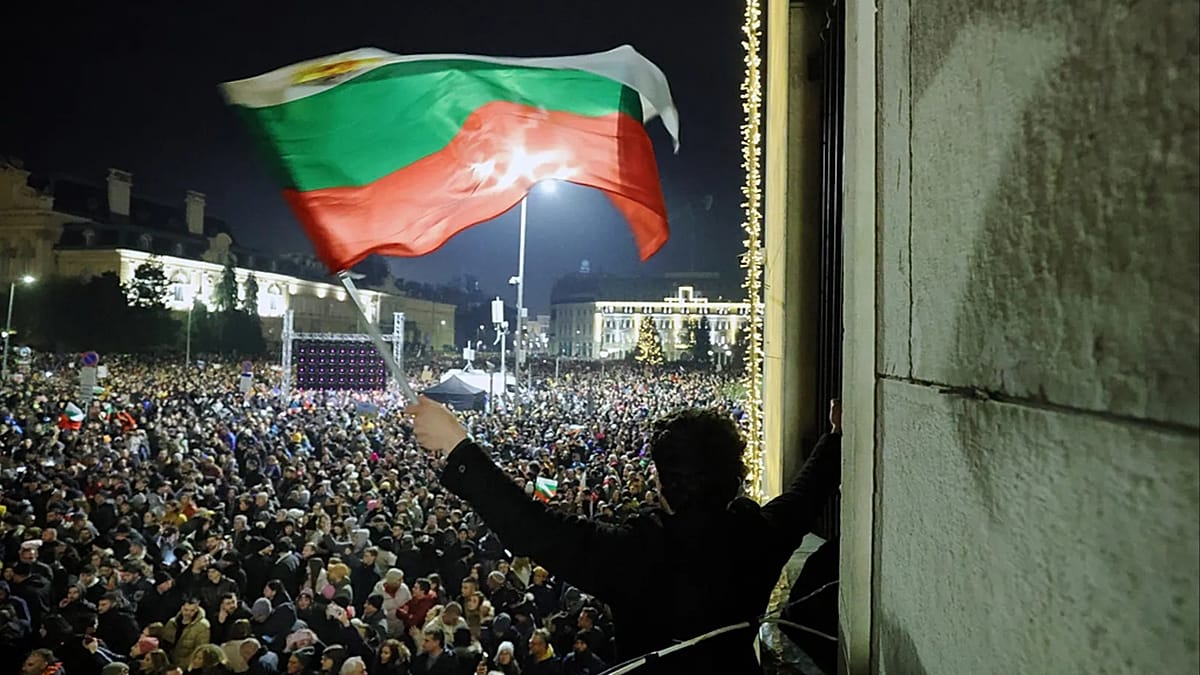
Tens of thousands of Bulgarians rallied across more than 25 cities — with estimates of 100,000–150,000 in Sofia alone — to demand Prime Minister Rosen Zhelyazkov’s resignation over alleged widespread corruption; Zhelyazkov announced his cabinet’s resignation on Thursday after the protests, which followed backlash to a withdrawn 2026 budget proposing higher taxes and social-security contributions. Protesters have focused on oligarch-politician Delyan Peevski, who has been sanctioned by the US (2021) and UK (2023) and whose allied Movement for Rights and Freedoms provides crucial parliamentary votes to the minority coalition, prompting an opposition no-confidence motion that became moot with the resignation. The upheaval, including diaspora demonstrations and student participation, injects political uncertainty days before Bulgaria’s planned entry into the eurozone on Jan. 1, raising near-term risks to policy continuity, fiscal plans and investor sentiment.
Tens of thousands of Bulgarians rallied in more than 25 cities this week with media estimates of 100,000–150,000 in Sofia, forcing Prime Minister Rosen Zhelyazkov to announce his cabinet's resignation ahead of a scheduled no-confidence vote. The demonstrations were triggered by a withdrawn 2026 budget that proposed higher taxes and social-security contributions and were amplified by student and diaspora participation, signaling broad-based domestic discontent.
Protesters concentrated anger on oligarch-politician Delyan Peevski, who was sanctioned by the US in June 2021 and by the UK in February 2023, with accusations that his affiliated Movement for Rights and Freedoms exerts decisive parliamentary leverage over the minority coalition. Law enforcement detained 57 people in Sofia amid scuffles and found cash on some detainees, underscoring risks of episodic disorder even in largely peaceful protests.
Political turnover occurs days before Bulgaria's planned eurozone entry on 1 January and follows a June Ministry of Finance survey showing 46.8% of citizens opposed the euro versus 46.5% in favour, creating a sensitive policy window. The combination of cabinet resignation, suspended fiscal reform and oligarch-related governance concerns elevates near-term political and policy uncertainty that could weigh on investor sentiment, fiscal continuity and the mechanics of the currency transition.
AI-powered research, real-time alerts, and portfolio analytics for institutional investors.
Request DemoOverall Sentiment
moderately negative
Sentiment Score
-0.50
