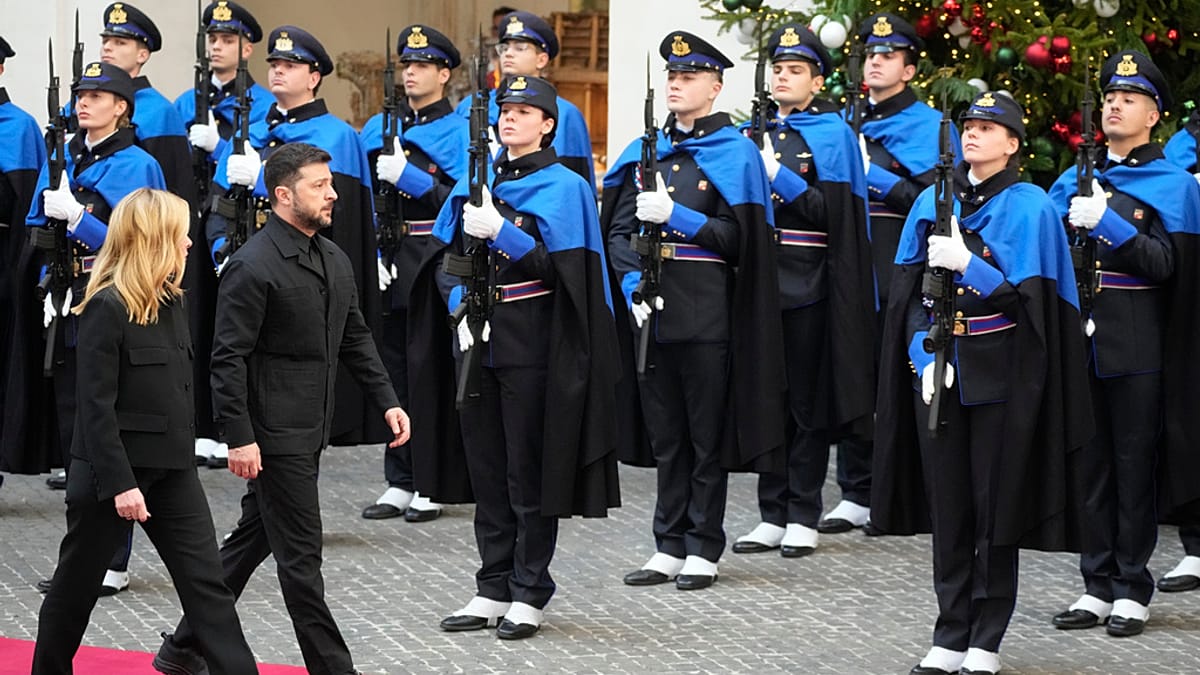
Ukrainian President Volodymyr Zelenskyy met Pope Leo XIV and Italian Prime Minister Giorgia Meloni in Rome as he pressed European leaders for continued support and rejected US pressure to make territorial concessions after US negotiators pared a proposed 28-point peace plan down to 20 points; he reiterated that Ukraine will not cede Donbas or hold presidential elections under martial law. The meetings followed talks in London and Brussels with senior UK, French, German and EU officials and highlighted unresolved disputes over territorial control and security guarantees with Moscow—Kremlin demands go further than the US proposal—while the Vatican urged dialogue and the return of POWs and abducted children. Italy has postponed a decision on renewing military aid due to expire Dec. 31, with coalition partners more skeptical and Rome limiting weapons for use only inside Ukraine and ruling out deployment to a proposed monitoring force, signaling potential strains in European support that could complicate the conflict's trajectory and related market and geopolitical risk dynamics.
Ukrainian President Volodymyr Zelenskyy conducted a concentrated diplomatic push in Europe, meeting Pope Leo XIV and Italian Prime Minister Giorgia Meloni in Rome after talks in London and Brussels; he said US negotiators have revised an initial 28-point peace plan down to 20 points following recent rounds of talks. Zelenskyy stated the 20-point plan still leaves unresolved issues around territorial control and security guarantees, signaling remaining negotiation friction that could prolong uncertainty.
Zelenskyy publicly and unequivocally rejected ceding territory, citing Ukrainian law and moral grounds, directly contradicting parts of the Trump administration proposal that include surrendering the Donbas and calls for presidential elections despite martial law. The Kremlin’s insistence on full Donbas control, coupled with US and Ukrainian differences, creates a substantive gap that makes a near-term political settlement unlikely based on the article’s account.
European support shows signs of strain: Italy has postponed a decision to renew military aid due to expire on December 31, Meloni has limited weapons use to inside Ukraine and ruled out troop deployment to a proposed monitoring force, and the Vatican urged dialogue and humanitarian priorities. These developments increase the probability of a protracted conflict scenario with attendant implications for defense demand, European political risk, and event-driven market volatility in the near term.
AI-powered research, real-time alerts, and portfolio analytics for institutional investors.
Request DemoOverall Sentiment
mildly negative
Sentiment Score
-0.25
Ticker Sentiment
